Debate over the Blue Square Super Bowl ad is fading. The racist responses from my fellow Jews will be felt longer.
We will not succeed in combating antisemitism if we allow anti-blackness to live within our movements, writes an advocate and mother of Black Jewish children
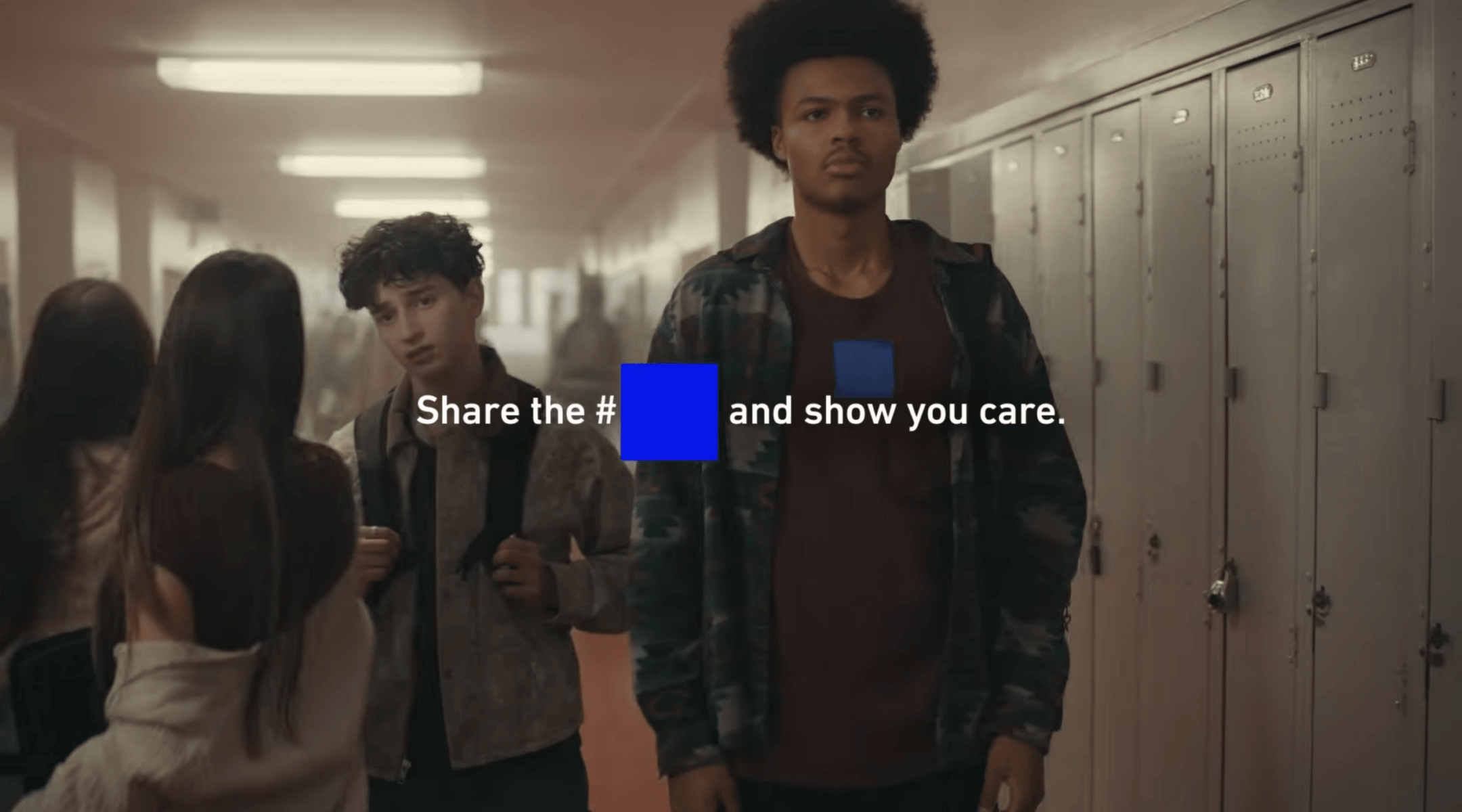
The 2026 Super Bowl ad from Robert Kraft’s Blue Square Alliance showed a Black child supporting a Jewish child who faced antisemitic bullying. Screenshot of Super Bowl ad

Carly Pildis February 13, 2026
(JTA) — Days after the Super Bowl, I am still reeling from how a moment designed to confront antisemitism — a 30-second ad from Robert Kraft’s Blue Square Alliance — shined a light on the hate within some corners of our own community.
The ad spurred debate over its effectiveness — a worthy conversation. But what immediately struck me was how quickly and prominently anti-Black responses played a role. I realized once again that American Jews are not only experiencing hate but must confront it within our own ranks as well. As a community, we will not succeed in combating antisemitism if we allow anti-blackness to live within our movements.
The ad, called “Sticky Note,” featured a non-Jewish Black child showing kindness to a Jewish child who was the victim of antisemitic bullying.
It spurred legitimate criticism about how to best fight antisemitism. But layered throughout was casual racism cloaked in the language of Jewish advocacy — even glee in an opportunity to engage in anti-Blackness under the guise of combating antisemitism.
Online, one person dedicated time to remaking the ad with AI so the bullies were darker-skinned and then had the Jewish child attack them.
Another person wrote that the bullies in the ad needed to be recast, because “most of our enemies aren’t white.”
Some exotified the Black child and leered at his natural hair, his height, his walk and his apparent “coolness.” People wrongfully claimed that the scenario was entirely unrealistic because Black people — at the individual or the organizational level — never stand against antisemitism.
Even more bizarrely, others claimed that the ad was somehow a tacit endorsement of the Black Lives Matter movement.
“There is a very casual and thoughtless ‘why the hell was a Black person shown being nice to a Jew, how dare they’ view being expressed here, and it’s not right,” tweeted Ben Badejo, who is both Black and Jewish.
“I am not asking Jews on X to like Kraft’s ad,” he added. “But I am definitely asking Jews on X to stop saying that a black person would never befriend a Jew and that it was wrong for the ad to depict this.”
Indeed, the downright racist responses from some parts of our community hurt Jews, our allies in Black communities, and the fight against antisemitism at a moment when the stakes couldn’t be higher. They highlight just how much work remains in fighting our own anti-Black racism.
None of the critics who were so furious about the inclusion of a Black child acknowledged a basic fact: There are hundreds of thousands of Jews of Color in the United States. The child in the ad — who approaches the Jewish protagonist and says he has experienced hatred too — could easily be Jewish himself, or have Jewish family members. Yes, his name is later revealed to be Bilal, but names do not always reliably map onto religious, racial or ethnic identity.
And that matters.
I know because I feel it personally. I am married to a Jew of Color, and we have two Black Jewish kids.
The claim that it is impossible, outrageous or ideologically suspect to depict Black people as allies in the fight against antisemitism does something deeply harmful: It erases the existence of Black Jews. That erasure is itself both antisemitic and racist. You cannot claim to defend the Jewish community while denying the reality of over 200,000 Black Jews in America. That number will only grow. Those numbers come from a 2020 Pew survey — my youngest wasn’t born yet.
You cannot fight antisemitism while actively and purposefully hurting Jewish kids — including my kids.
The claim also erases important alliances with members of the non-Jewish Black community.
In both my professional and personal life, I have experienced profound moments of solidarity and kindness in the fight against antisemitism from non-Jewish Black Americans. As director of Advocacy for One Mitzvah A Day, a project of Jewish Federations of North America that mobilizes communal gratitude to those who support us, I witness daily acts of courage and moral clarity from people of all backgrounds who choose to stand against antisemitism. Through our daily texts highlighting these moments of solidarity, our subscribers have sent more than 1.5 million messages of gratitude. We have thanked artists, elected officials, government leaders, and civil rights activists — many of them Black — who have spoken out loudly against antisemitism and stood with the Jewish community. To remain silent in the face of racism would be a betrayal of the kindness, solidarity, and moral leadership they have shown.
I felt compelled to post something on X on Sunday to push back against the racism I was seeing online: “You’re not making Jews safer. You’re hurting Jews. You’re not fighting antisemitism — you are hurting your community.” The backlash was swift and predictable. The rage didn’t stop at disagreement — it turned personal, aimed at me and at anyone who pointed out that being racist does nothing to combat antisemitism in American society. Within hours, I was branded an enemy of Israel, a self-hater, an apologist, and accused of being paid to tweet.
It’s important to emphasize: Debate is core to Jewish culture – it has kept us a strong, vibrant community for over 3,000 years. Debates about this 30-second spot are happening around Shabbat dinners, shul lunches and friendly coffees. All of this is fair game, healthy even. Criticize the ad. Debate Jewish professionals and how we are fighting antisemitism. It’s our job to serve the community. But hatred is not a productive form of debate. I know these spaces intimately. I’ve been a full-time Jewish professional since 2019 and have been active in Jewish advocacy long before that. As the mother of Black children and wife to a Black Jew, my commitment to normalizing Jewish life as multiracial is non-negotiable.
Still, I mostly responded with humor. When you’ve walked these lines long enough, none of it is surprising.
That, perhaps, is the saddest part of all.
How completely predictable it was.
The Super Bowl is over, and the controversy around the ad will soon fade, replaced by the next hot topic. But the effects of the racist posts are forever and leave an ugly, enduring stain that harms us all.
The views and opinions expressed in this article are those of the author and do not necessarily reflect the views of JTA or its parent company, 70 Faces Media.