We are talking past one another on Zionism
Does the term refer to an ideology in theory, or a historical reality?
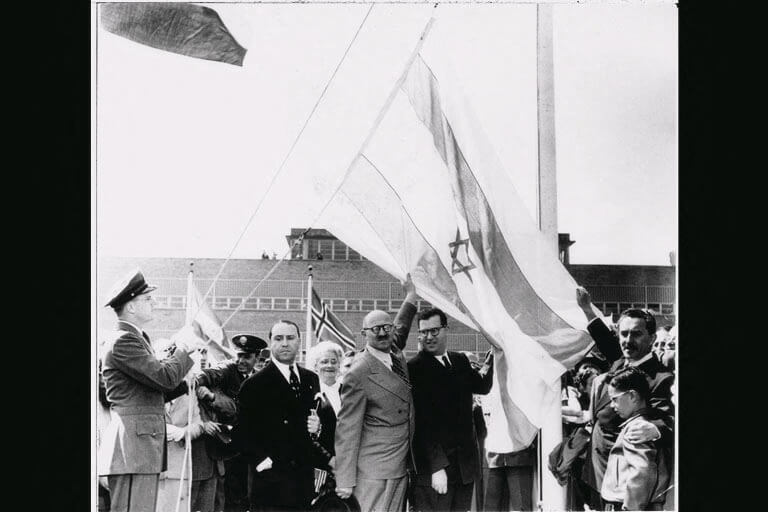
Israeli Foreign minister Moshe Shertok (right), Abba Eban (center), the first Israeli ambassador to UN and David Hachohen raise the Israeli flag for the first time at the United Nations. Photo by FILES-GPO/AFP via Getty Images

Contributing Columnist Jay Michaelson February 24, 2026
A recent study of American Jews’ attitudes toward Israel has provoked much confusion in the Jewish establishment: Only 37% of Jews said they identified as Zionists, according to the data, but 88% said that “Israel has the right to exist as a Jewish, democratic state.”
Which, of course, is the standard definition of Zionism.
What’s going on? Responding to the study, Mimi Kravetz of the Jewish Federations of North America, which commissioned it, noted that large numbers of respondents conflated Zionism with “supporting the policies, decisions, and actions of the Israeli government.” Thus, Kravetz wrote, the 51% of Jews who do not identify as Zionists but support Israel’s right to exist:
are not rejecting Israel’s existence or the idea of a Jewish state. They are reacting to an understanding of Zionism that includes policies, ideologies, and actions that they oppose, and do not want to be associated with.
I agree with Kravetz’s analysis, but propose that we should take it a step further. Because the issue isn’t one survey. Americans, Jewish and otherwise, have been talking past one another about Zionism for years, and the ‘standard definition of Zionism’ hasn’t reflected reality for decades. And maybe those 51% of Jews are right.
Instead of Kravetz’s framing of “correct vs. incorrect understanding of Zionism,” it might be fruitful to see this as the difference between Zionism in principle and Zionism in practice.
Zionism in principle is what Nathan Birnbaum meant when he coined the term in 1890: the movement to establish a Jewish state (details TBD) in the historic land of Israel. That sounds fairly unobjectionable. There are states for French people, Ugandan people, Vietnamese people — so why not a state for Jewish people?
But Zionism in practice has turned out to be something altogether different. For at least 80 years, it has involved the dispossession of another population that calls the territory home, the second-class citizenship held by non-Jews in the Jewish state (which shows up in countless specific legal contexts), and, ultimately, various forms of discrimination, dehumanization and violence. Contrary to the way some on the Left use the word, Zionism is not only these things, but it has, historically, involved all of them.
I was raised to believe that all this was not intrinsic to Zionism, but was the unfortunate result of Arab rejectionism and terrorism, plus a few bad right-wing-nationalist apples in the Israeli population. I was educated in a pre-internet world by Jewish educators who presented a very partial view of Israeli/Palestinian history. I never learned this history from a Palestinian point of view. I never learned about the Nakba. I believed that terrorists hijacked airplanes because they hated Jews.
This understanding was always woefully incomplete and incorrect, but even as a young adult, it still made some sense to me. I was living in Israel when Rabin and Arafat shook hands on the White House lawn. I saw Rabin himself speak many times. I met with Israeli and Palestinian peace workers who believed, sincerely, that coexistence was finally at hand. Finally, the real Zionist dream would be realized.
Then Rabin was assassinated. And for most of the subsequent 30 years, Israelis elected right-wing and far-right governments. Settlements have swallowed large swaths of the West Bank. And for anyone under 30, this period of Israeli history is all they have ever known.
What is “Zionism” supposed to mean to that person? The dream of Herzl or the reality of Sharon, Netanyahu and Ben Gvir?
I’m not saying that this is a full depiction of recent history. It wasn’t only Bibi expanding settlements; it was Hamas blowing up buses and Yasser Arafat letting peace slip through his fingers at Camp David. I’m only saying that the “Zionism” that a Gen Z or young Millennial American has known for their entire life is totally different from the Zionism that I learned about in Jewish day school or saw in my own younger years.
So who is right about what Zionism really means? Those of us who cling to the classical definition in spite of its remoteness from reality, or those who define Zionism as it has actually been put into practice in the decades of Netanyahu’s rule?
Personally, I still cling to that dream, even if it is a delusion. And obviously, I am not alone. Organizations like J Street, the New Israel Fund, Truah, and many others still believe that Zionism can mean, or should mean, a Jewish and actually-democratic state alongside a Palestinian one. What’s left of the Israeli Left does too. Even Bono managed to issue a nuanced statement on Israel/Palestine accompanying U2’s surprise new release, which includes both a Yehuda Amichai poem and a song dedicated to peace activist Awdah Hathaleen.
But many of my close friends do not. And many intellectuals including Avraham Burg, Peter Beinart, and Shaul Magid have demonstrated that the dream was never reality; that it could not ever have been reality; that Zionism was ethno-nationalism from the beginning and thus inevitably leads to a politics of domination. In this view, the war crimes in Gaza aren’t an aberration from Zionism, but its inevitable expression.
I admit, I find it increasingly hard to disagree with this dim view of Jewish nationalism, especially as Israeli Jews keep voting for the Right.
Of course, I understand that many are not selecting an ideology so much as trying to keep their families safe from unrelenting violence. One can hardly blame a population for voting for security rather than peace when they are subjected to constant rocket fire from Gaza, Lebanon, Iran and Yemen. Nor do I embrace the hyperbolic exaggerations of some on the hard left, which often slide into antisemitism.
But sometimes I wonder if I’m just clinging to a nostalgic, diaspora-tinted image of what a Jewish state could be. Where I could go to the symphony at the Jerusalem Theater and eat gourmet kosher food in the German Colony. Where I could sit in my favorite field and imagine ancient pasts. Where the patterns of my religious and cultural life were embedded in the society itself.
Maybe, like the nationalists further to my right, I am so besotted by these emotions that I am unable to see the reality of what Zionism really entails, particularly for those on the wrong end of its hierarchies. I would submit that many of us who maintain the classical definition of Zionism in principle, rather than adopt the historical one of Zionism in practice, may be similarly swayed by emotion.
At the end of the day, I despise right-wing ethno-nationalism (in the United States as well as in Israel) and its consequences, most recently the ethnic cleansing proposed for Gaza and the state-sanctioned pogroms underway in the West Bank. I feel ambivalent when I hear the Hatikva. But ultimately, there are 7.5 million Jewish people living between the river and the sea, and the large majority of them will not surrender their sovereignty. Neither will the 9.5 million Palestinians living in the same territory. Ultimately, there will still, one day, have to be some division of the land — if not this decade, then in the next one.
If this is Zionism, it is a Pragmatic Zionism, born of exhaustion. I have no utopian visions to offer, no dreams. What I yearn for is what Yehuda Amichai describes in Wildpeace, the poem that U2 just set to music:
Not the peace of a cease-fire
not even the vision of the wolf and the lamb, but rather
as in the heart when the excitement is over
and you can talk only about a great weariness.
This is a moment of great uncertainty. Here’s what you can do about it.
We hope you appreciated this article. Before you go, we’d like to ask you to please support the Forward’s independent Jewish news this Passover. All donations are being matched by the Forward Board - up to $100,000.
This is a moment of great uncertainty for the news media, for the Jewish people, and for our sacred democracy. It is a time of confusion and declining trust in public institutions. An era in which we need humans to report facts, conduct investigations that hold power to account, tell stories that matter and share honest discourse on all that divides us.
With no paywall or subscriptions, the Forward is entirely supported by readers like you. Every dollar you give this Passover is invested in the future of the Forward — and telling the American Jewish story fully and fairly.
The Forward doesn’t rely on funding from institutions like governments or your local Jewish federation. There are thousands of readers like you who give us $18 or $36 or $100 each month or year.
Support our mission to tell the Jewish story fully and fairly.