It’s time to talk about Purim’s unsettling message about conversion
Questions about how power changes the face of Judaism often go unacknowledged amid festivities

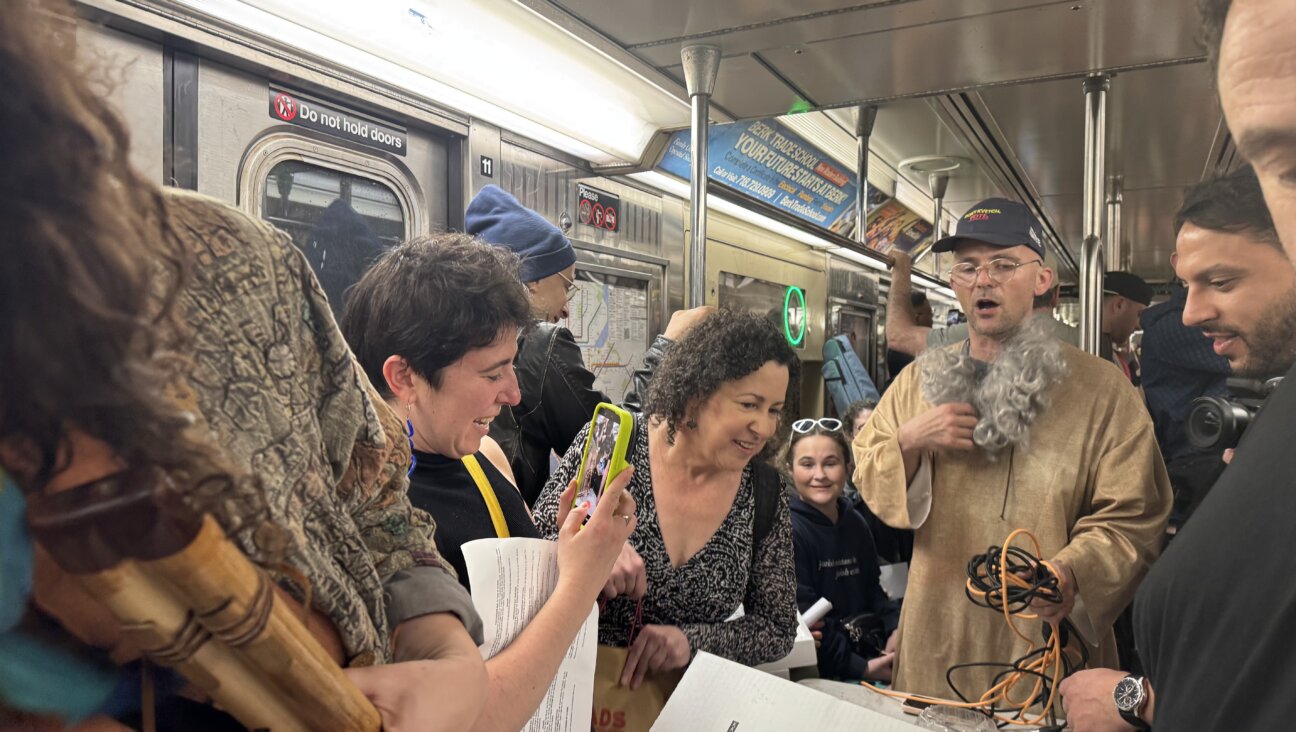
Purim is a joyous holiday — but raises troubling moral questions, including about coerced conversion. Photo by iStock by Getty Images/tovfla
Austin Albanese February 26, 2026
Purim is meant to be loud: a holiday for drinking, dressing up, yelling and retelling a story of miraculous survival.
Which means it’s easy to miss a brief but significant verse near the end of the Book of Esther — one that deserves to be lingered over:
“And many of the people of the land professed to be Jews, for the fear of the Jews had fallen upon them.”
That line doesn’t lend itself to celebration. It does not describe people drawn to Judaism by teaching or conviction. Instead, it chronicles a far more troubling choice: people becoming Jews because they are afraid of Jews.
Whether the Book of Esther records events that literally occurred is beside the point. What matters is that Jews read this line aloud every year, carrying its language forward across generations. For a tradition that often insists Judaism does not seek converts and rejects religious coercion, this verse preserves an unsettling possibility: that joining the Jewish people can be driven by fear as much as conviction.
By the end of the narrative, Jews wield power, and the dread that once haunted them shifts outward.
Yes, some read the verse as referring to political alignment rather than religious change. Others treat Esther as satire, its excesses not meant for emulation. Still others point to the absence of God in the book, and dismiss the line as non-theological.
Even with those readings, the line still does something difficult. It places an unresolved moral question inside a festival we otherwise frame as joyful: How does holding power change the face of Judaism?
When conversion was possible — or required
The common claim that Judaism has always discouraged conversion is historically inaccurate. Jewish attitudes toward converts have shifted with political conditions, not because theology changed, but because power dynamics did.
The truth is that for much of Jewish history, conversion was dangerous. After the destruction of the Temple in 70 C.E. and the failure of later revolts against Rome, much of Jewish life developed under sustained imperial pressure. Welcoming people raised outside the community became, practically, risky.
This is why the familiar line “Judaism doesn’t seek converts” is more of a survival posture than an eternal principle. After all, the Hebrew Bible repeatedly reminds readers that Israel’s calling was never meant to be entirely inward. A “mixed multitude” leaves Egypt. Gerim, resident outsiders, are repeatedly considered in biblical law. Isaiah imagines God’s house as a house of prayer for all peoples.
In the late Hellenistic and early Roman periods, Jewish communities were widely visible across the diaspora. An inscription from Aphrodisias in Asia Minor in modern-day Turkey lists not only Jews but also “proselytes” and “God-fearers” among synagogue donors, suggesting gentiles were sometimes attached to synagogue life. Similar “God-fearer” inscriptions survive from other cities in Roman Asia Minor, where gentiles were known to attend synagogues, admire Jewish ethics, and sometimes decide to join the Jewish people.
Even polemical texts preserve traces of this world. Matthew 23:15 mocks those who “travel across sea and land” to make a proselyte — meaning to convert to Judaism. Whatever one makes of the polemic, the line treats the basic fact as unremarkable: that conversion to Judaism was a regular part of the religious landscape in the first-century Mediterranean.
Other ancient sources, including the first-century historian Josephus, describe moments when Jewish rulers used conversion as a tool of rule. One of the starkest examples comes from the Hasmoneans, the priestly family behind the Maccabean revolt who ruled Judea from roughly 140 to 37 B.C.E. Under John Hyrcanus, who reigned from 134 to 104 B.C.E., the kingdom of Judea expanded through conquest. Hyrcanus governed as many ancient rulers did, through coercion.
Among the territories absorbed was Idumea, homeland of the Edomites. According to Josephus, Hyrcanus offered the Idumeans a choice: adopt Jewish law or leave the land. They chose conversion.
This is not an obscure episode. It sits in the shadow of Hanukkah, one of Judaism’s most widely celebrated holidays.
Centuries later, Jewish sovereignty appeared again in the Himyarite kingdom of southern Arabia, where a ruling elite adopted Judaism in the fourth century CE. Eventually, persecution of non-Jews followed. The kingdom’s final ruler, Dhu Nuwas, who reigned from 522 to 530 C.E., oppressed local Christian populations, provoking retaliation from the neighboring Kingdom of Aksum. After more than a century, the Jewish kingdom fell.
Not a powerless minority faith
The reigns of Hyrcanus and Nuwas complicate the familiar story of Judaism as only a powerless minority faith, always deterring conversion. They suggest that Jewish sovereignty could carry the same temptations that haunt sovereignty everywhere, including the temptation to force compliance on those of different beliefs.
The Book of Esther verse about conversion offers a warning about that dynamic, and an imperative to learn from it. The lesson is not to condemn Judaism. It is to refuse a simplified story in which Judaism’s posture toward conversion has been static and untouched by the realities of power.
Across many faiths, when political power disappears, priorities often shift. Teachings turn inward. When power reappears, however briefly, older questions have a habit of returning. Who belongs? Who chooses? And under what conditions are those choices made?
Purim does not allow us to keep those questions at a safe distance. We are meant to hear this troubling verse amid the laughter and noise of our celebrations, not as an endorsement of coercion, but as a warning.
Esther’s story insists that two things can be true: Jews can be vulnerable, and Jews can hold power. And if we can be afraid, it warns, we can also inspire fear, with consequences not only for the societies in which we live, but also for the kind of Jewish life we make possible.
This is a moment of great uncertainty. Here’s what you can do about it.
We hope you appreciated this article. Before you go, we’d like to ask you to please support the Forward’s independent Jewish news this Passover. All donations are being matched by the Forward Board - up to $100,000.
This is a moment of great uncertainty for the news media, for the Jewish people, and for our sacred democracy. It is a time of confusion and declining trust in public institutions. An era in which we need humans to report facts, conduct investigations that hold power to account, tell stories that matter and share honest discourse on all that divides us.
With no paywall or subscriptions, the Forward is entirely supported by readers like you. Every dollar you give this Passover is invested in the future of the Forward — and telling the American Jewish story fully and fairly.
The Forward doesn’t rely on funding from institutions like governments or your local Jewish federation. There are thousands of readers like you who give us $18 or $36 or $100 each month or year.
Support our mission to tell the Jewish story fully and fairly.