In a viral social media showdown, a glimpse of the real Israel
There are two visions for what civic life should look like in Israel, and only one leads to a viable future
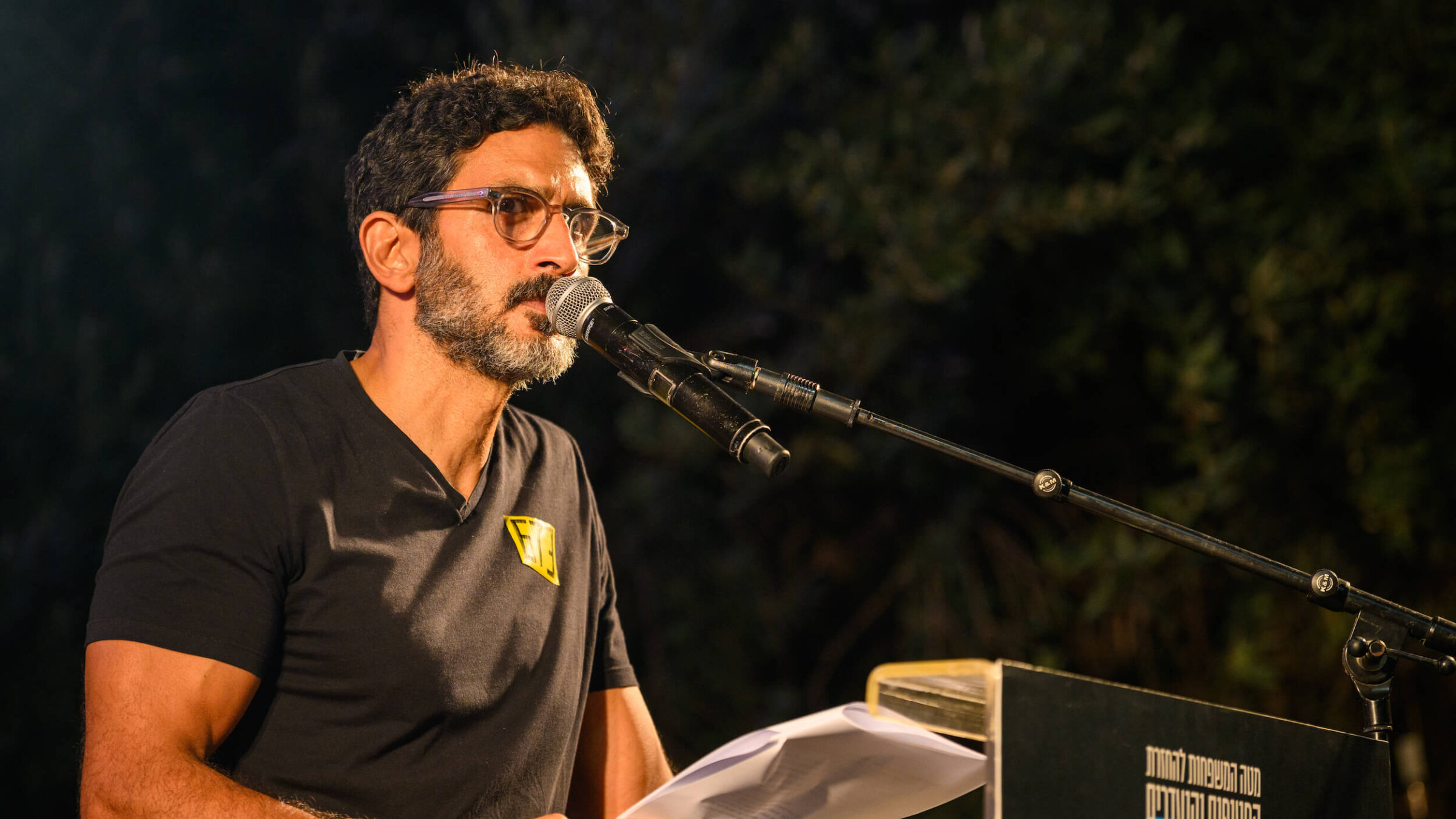
Actor Tsahi Halevi speaks during a “Families of Hostages” rally calling for an end to the war on Aug. 9, 2025 in Tel Aviv, Israel. Photo by Alexi Rosenfeld/Getty Images

Columnist Dan Perry February 27, 2026
In amateur video footage circulated across Israeli social media in recent weeks, a disturbing scene unfolds. A young man in his mid-20s, wearing a military-style jacket, looms over a silver car in the heart of Tel Aviv. Inside the vehicle sits an 89-year-old man, mouth agape, expression frozen.
“Dictator! Khamenei!” the young man shouts, his voice sharp, emotional and aggressive.
The young man was Mordechai David, a provocateur who has been documented in a series of confrontations with public figures, journalists and protesters, adopting a style built on creating moments designed for virality. The elderly passenger was former Supreme Court president Aharon Barak — the man whom Prime Minister Benjamin Netanyahu’s propaganda machine has painted as a demon, blamed for building, during his tenure in the 1990s, an allegedly over-independent judiciary that supposedly obstructs “governance” by a government eager for unrestrained power.
David, raised in Bnei Brak as the son of a convert to religious life, has become something of a celebrity. His past includes multiple criminal highlights. Blocking Barak’s car may have marked his peak. In a subsequent social-media video, David “apologized” for not blocking Barak’s vehicle “more.”
Two different visions of Israel
David’s stunt is one of several intertwined recent stories in Israel that, between them, outline the contours of a deeper struggle over the character of its society. It is a clash between two fundamentally different visions for the country. And Israel’s fate hangs in the balance.
David’s is a political culture where perpetual confrontation and boundary-breaking increasingly define public behavior. On the other side sits Lucy Aharish, a 44-year-old journalist who grew up in Dimona.
Aharish studied political science at the Hebrew University, and over the years has worked at a variety of radio and TV stations in Israel, including I24News in English, a channel on which I also frequently appear. Today, she hosts a current affairs program. The mother of a little boy, she is also a fierce opponent of Netanyahu and his circle.
That has attracted the ire of the Netanyahu machine’s street rabble. This week, Mordechai David arrived at her doorstep with a megaphone. According to reports, David and one of his followers managed to enter her building — and at the entrance, a tense confrontation unfolded.
This requires the introduction of another character: Tsahi Halevi, 50, an artist of unusual charisma. He is a singer and highly accomplished actor who portrayed Naor in the internationally acclaimed series Fauda, a character admired for intelligence, composure and moral clarity.
In a twist that could only occur in Israel, Halevi also partly plays himself. The son of a Mossad officer, he, like Naor, served as an officer in an elite undercover unit. On Oct. 7, 2023, he volunteered for reserve duty and rushed to the scenes of devastation, where he helped save many lives.
Matan Gendelman, a survivor of the Kfar Aza massacre, recently recounted in Israeli media that Halevi helped rescue her trapped family members after being directed to the scene by his wife, who received the family’s location through social media.
His wife is Lucy Aharish. “Pure gold, the salt of the earth,” Gendelman said of the couple.
The likes of David would vehemently disagree.
Why? Because Aharish, in addition to being a Netanyahu critic, is a member of Israel’s Arab minority. And because Aharish and Halevi are a mixed couple, the hostility against them burns even more intensely.
Back at their house, there was a scent of violence in the air as the decorated officer and provocateur traded barbs.
“You come to my home?” Halevi challenged; “I feel like protesting against your wife!” David replied. “How far do you want this to go?” Halevi asked, menacingly, as police separated the two. The police dragged David away, but he ensured himself another viral success; his future may hold a respectable place on the Likud list for the Knesset.
‘The affliction of Israeli society’
Aharish chose to respond on television. “Bullying — this is the affliction of Israeli society,” she said. “It is escalating. We see it in the streets, on the roads, in public discourse — and now it has reached my own doorstep.”
Worse, she added, “The spirit of this government is a bad spirit that encourages bullies. I will not bow my head before these inciters.” She also addressed Netanyahu directly: “This is precisely your way, Mr. Prime Minister — not to see, not to hear, not to know what is happening under your nose. … One day, these bullies will reach your doorstep as well.”
In the vision of Israel embodied by Aharish and Halevi, with their impassioned but civil approach, even the most fierce political disagreement remains bounded by restraint. An important distinction is drawn between rival and enemy.
In that advanced by David, those boundaries erode. Confrontation becomes personal. Intimidation is standard.
The first vision leads to an Israel that strives for peace within itself and with its neighbors, and remains a prosperous liberal democracy grounded in basic rights and openness to the world. The second leads to an unstable, isolated and increasingly theocratic state, which will be in constant conflict with its neighbors, and from which the most productive citizens will steadily depart. In short order it will be unrecognizable, and nothing will be left of “Start-Up Nation.”
The 2026 elections, which must be held by October, will not merely determine a government. They may decide with finality which of these two Israels prevails. And after four years of trauma under Netanyahu’s far-right government, there is urgency in the air.
This is a moment of great uncertainty. Here’s what you can do about it.
We hope you appreciated this article. Before you go, we’d like to ask you to please support the Forward’s independent Jewish news this Passover. All donations are being matched by the Forward Board - up to $100,000.
This is a moment of great uncertainty for the news media, for the Jewish people, and for our sacred democracy. It is a time of confusion and declining trust in public institutions. An era in which we need humans to report facts, conduct investigations that hold power to account, tell stories that matter and share honest discourse on all that divides us.
With no paywall or subscriptions, the Forward is entirely supported by readers like you. Every dollar you give this Passover is invested in the future of the Forward — and telling the American Jewish story fully and fairly.
The Forward doesn’t rely on funding from institutions like governments or your local Jewish federation. There are thousands of readers like you who give us $18 or $36 or $100 each month or year.
Support our mission to tell the Jewish story fully and fairly.