The real reason for the US war with Iran may have nothing to do with Israel
Why can’t Marco Rubio explain the war as well as Haviv Rettig Gur?
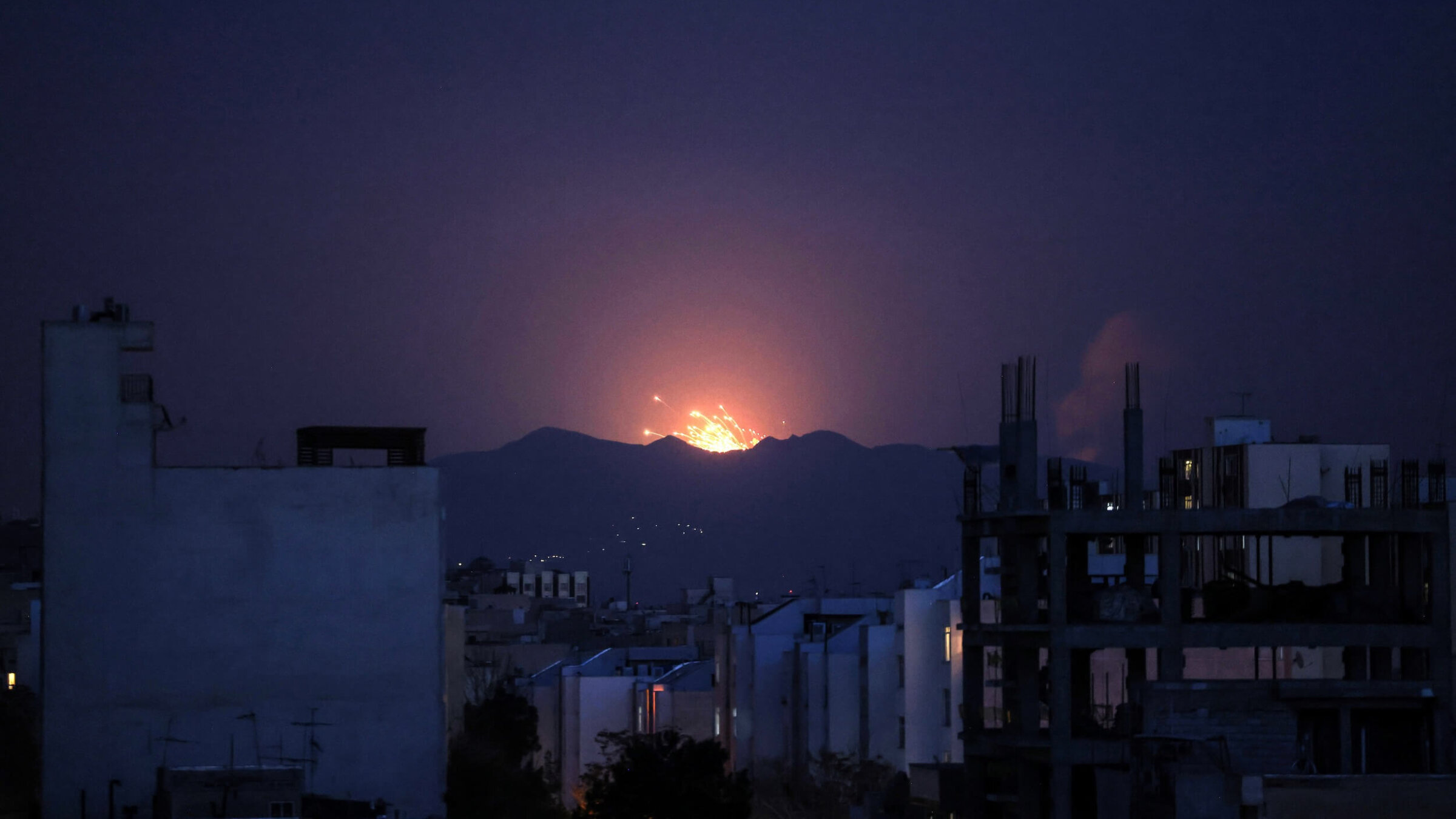
The sky is lit up at the site of an airstrikes in a central area of the Iranian capital Tehran on March 6. Photo by Atta Kenare/AFP/Getty Images

Senior Columnist Rob Eshman March 6, 2026
The lack of a clear, coherent reason for this war is bad for the Jews.
Overstatement? Consider that Tucker Carlson is now blaming Chabad — yes, Chabad — for the conflict. Yesterday the watchdog organization The Nexus Project released a series of posts on X clarifying how to have a “robust debate about the U.S.-Israel war with Iran” without veering into antisemitism — because certain parties seem to have come to the consensus that, to put it bluntly, the Jews did it.
Americans need a good reason to shed blood thousands of miles away, and the problem is that while President Donald Trump has taken the United States to war, neither he, Secretary of State Marco Rubio, nor anyone else in his administration has offered a convincing explanation as to why.
So pundits like Carlson are filling the void with poison. As I wrote last summer during the first U.S.-Israel attacks on Iran, if the war goes badly, fingers will point at Israel and its supporters. It’s clear, now, that the blame game is also going to generate a huge amount of antisemitism.
A default explanation
Why strike now? Is it because of the Iranian nuclear weapons program, the one that Trump previously boasted the U.S. “obliterated” last summer? Is it because the Iranian regime has taken American hostages, killed American service personnel and sponsored terror abroad?
All those things are true, but they’ve been true for decades. So why now?
Sen. Tom Cotton, defending the choice to go to war, said on Fox News that “Iran has been an imminent threat to the United States for 47 years.”
That stretch of the word “imminent” only underscored the, um, imminent need for a better reason.
The lack of one has left Israel and its American Jewish supporters as the default scapegoat. Rubio told reporters earlier this week that the U.S. attacked Iran because Israel had decided to do so, and the U.S. had to join in because Iran would then hit back at U.S. targets.
He and the president later tried to clarify that the U.S. was going to attack anyway, and Israel’s intentions only influenced the timing.
Few on the left or right, or around the world, are buying it.
“No war for Israel!” former Marine and Green Party Senate candidate Brian McGuinness shouted during a congressional committee hearing March 4, before Capitol police and Sen. Tim Sheehy dragged him out. (McGinnis claimed his arm was broken in the process.)
“It’s hard to say this, but the United States didn’t make the decision here. Benjamin Netanyahu did,” said Carlson, days before he pivoted to blaming Chabad. The left-leaning investigative outlet The Lever titled its piece on America’s Operation Epic Fury, “Operation AIPAC Fury.”
The China syndrome
The Israeli commentator Haviv Rettig Gur stepped into this mess with a thoughtful and convincing explanation: That the attack is part of a great power game, as the U.S. makes a bid to stop Iran from being a Middle East outpost of Chinese power.
“America is in this fight because of China,” Gur wrote in an essay in The Free Press earlier this week.
After decades of effective American-led economic sanctions, Gur explained, Iran has become economically dependent on China through oil exports, which fund roughly a quarter of Tehran’s budget and sustain its military and internal security. China, which receives 90% of Iran’s crude oil, has used it to build a petroleum reserve that hedges against a potential U.S. naval blockade.
Furthermore, China has armed Iran with advanced anti-ship missiles, hardened its cyber infrastructure, conducted joint naval exercises, and given it the wherewithal to control global trade through the Strait of Hormuz.
Gur isn’t alone in asserting that what matters to the U.S. isn’t Israel’s immediate needs, but rather the China-U.S. chessboard.
China, wrote Zineb Riboua, a scholar of Chinese-Middle East politics, “bet a decade of foreign policy on Khamenei’s ability to withstand American pressure, and the bet did not pay off.”
Gur, Riboua and others making this argument might be wrong. And their reasoning still raises questions of “why now?” that are hard to answer. But it’s striking that it sounds so much more coherent than anything that’s been offered by our government.
Why we fight
Right now, about 60% of Americans oppose the war. As it drags on, and casualties and costs mount, those polling numbers will get worse — especially without a clear rationale to explain why the suffering is necessary.
One casualty of every modern Mideast war is the standing of American Jews.
After the first Gulf War in 1991, the ADL recorded 1,879 antisemitic incidents — an 11% spike over the prior year. It was the highest number since tracking began, driven largely by “politically related antisemitism” in the war’s opening months.
After the second, far more unpopular Gulf War broke out in 2003, incidents climbed again — reaching 1,821 in 2004, the highest in nearly a decade. Never mind that 70-77% of American Jews opposed the Iraq War, a higher rate than any other major religious group.
Why? Because the right and left converged on the same target: Israel-supporting neoconservatives who supposedly dragged the U.S. into a war for Zionist interests. Researchers called the conspiracy a “Trojan horse” — age-old tropes about Jewish power and dual loyalty wheeled in as foreign policy critique.
And here we are again.
In the scheme of things, now, there are bigger worries. American service personnel, innocent Iranians and their Arab neighbors are in harm’s way, Israelis are once more locked down in shelters, facing the barrages of madmen.
But these sacrifices make it more, not less urgent for the administration to land on a coherent reason for this war, and a clear set of aims.
Just as the U.S. entered into World War II, the director Frank Capra made a series of propaganda films called “Why We Fight”. By then, the title was rhetorical. In early 1941, 68 % of Americans supported the campaign against Japan and Hitler. After the attack on Pearl Harbor on Dec. 7, 1941, support was nearly unanimous.
Now, appropriately for our polarized age, we are fighting over why we are fighting. And so much is riding on the answer.
This is a moment of great uncertainty. Here’s what you can do about it.
We hope you appreciated this article. Before you go, we’d like to ask you to please support the Forward’s independent Jewish news this Passover. All donations are being matched by the Forward Board - up to $100,000.
This is a moment of great uncertainty for the news media, for the Jewish people, and for our sacred democracy. It is a time of confusion and declining trust in public institutions. An era in which we need humans to report facts, conduct investigations that hold power to account, tell stories that matter and share honest discourse on all that divides us.
With no paywall or subscriptions, the Forward is entirely supported by readers like you. Every dollar you give this Passover is invested in the future of the Forward — and telling the American Jewish story fully and fairly.
The Forward doesn’t rely on funding from institutions like governments or your local Jewish federation. There are thousands of readers like you who give us $18 or $36 or $100 each month or year.
Support our mission to tell the Jewish story fully and fairly.