Why war with Iran puts the US-Israel alliance at risk
The American public is increasingly skeptical of Israel, and doesn’t understand why they’re at war
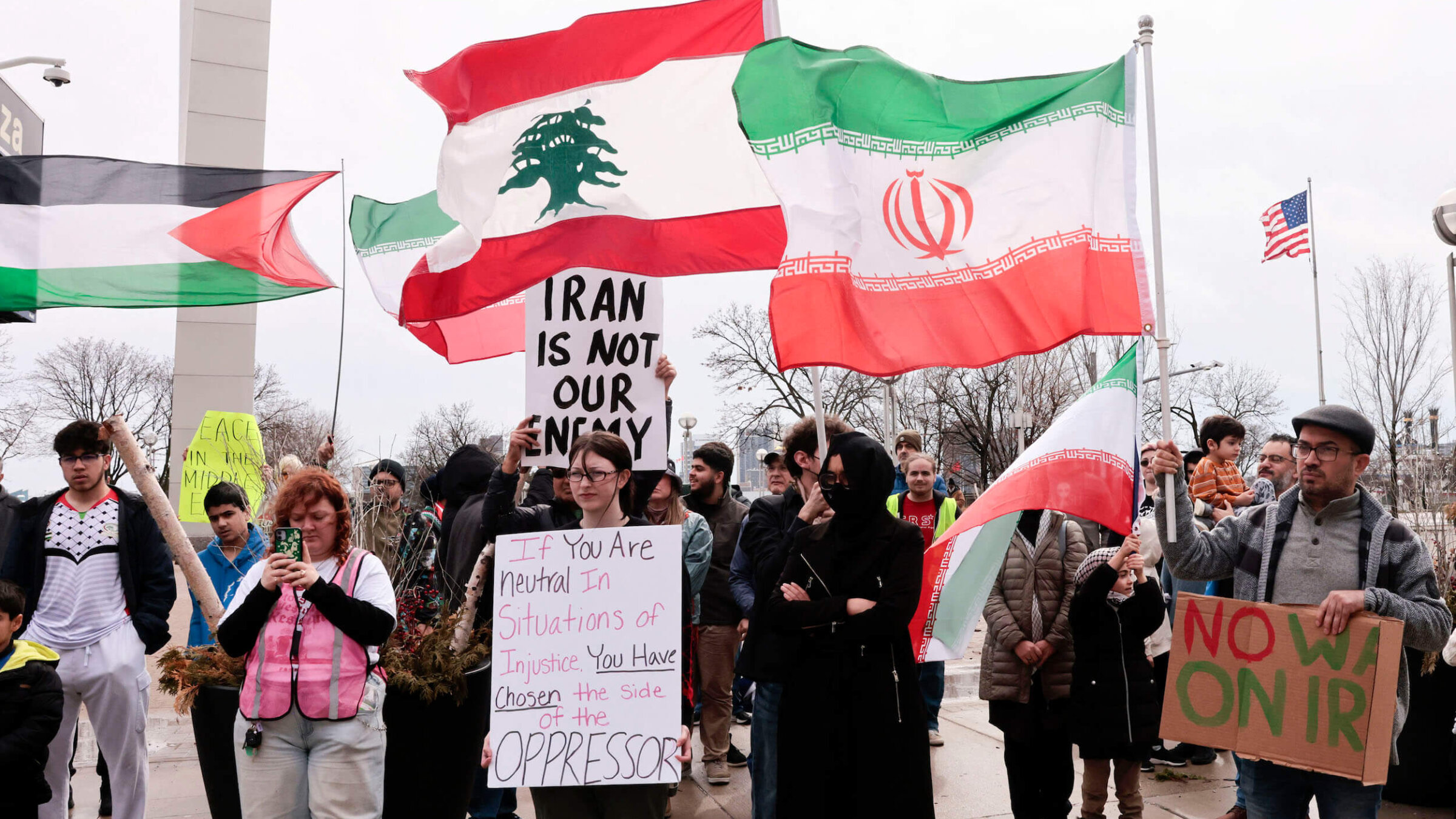
People gather for a “Hands off Iran, Lebanon and Palestine” rally and march in downtown Detroit, Michigan, on March 7. Photo by Jeff Kowalsky/AFP/Getty Images

Columnist Dan Perry March 7, 2026
The Iran war is strategically sound yet politically unsupported — an unstable foundation for a gamble that could reshape the Middle East. That creates danger for Israel, which needs the support of an American public that is rapidly drifting away.
For decades, the country’s greatest strategic asset has not been its military technology or intelligence capabilities — spectacular as those are — but rather the political, diplomatic and military backing of the United States. That relationship has not been merely transactional. It was supposed to rest on shared values and deep public support across the American political spectrum.
If that support erodes or disappears, Israel’s strategic environment will fundamentally change. To be blunt: It will not be able to arm its military. This creates a paradox. A campaign that has so far demonstrated extraordinary value for the Jewish state also stands a risk of fundamentally weakening it.
An alliance at its strongest
The conflict has showcased the depth of the current U.S.-Israel alliance. To many observers, and critically to Israel’s enemies, the operation has underscored not only Israel’s capabilities but also the reality that it stands alongside the world’s most powerful state.
The strikes have projected deep into Iranian territory, revealed astonishing intelligence penetration, and destroyed or degraded key threats. Israel’s enemies across the region have already been weakened by previous rounds of fighting since Oct. 7, and the current operation has reinforced the impression that Israel can reach its adversaries wherever they operate.
Moreover, Iran’s regime has managed to isolate itself to the point where most Arab countries are in effect on the side of Israel and the U.S. That projection — of an unbreakable and strong alliance — may ultimately be the most important strategic element of this war.
But therein lies the rub.
The political foundations of American support for Israel are eroding, which means the very element that currently strengthens Israel’s deterrence — American participation — may also be the one most at risk.
A just war, unjustified
Americans do not understand why their country is at war.
A Reuters/Ipsos survey conducted at the start of the conflict found only 27% of Americans supported the U.S. action, while 43% opposed it. Other surveys show similar results, with roughly 6 in 10 Americans against the military intervention.
In modern American history that is highly unusual. Most wars begin with a “rally around the flag” moment when public support surges. Even conflicts that later became controversial — from Afghanistan to Iraq — initially enjoyed majority backing.
This one did not — in part because the case for it has not been made clearly to the public.
That error is compounded by years of polarization in American politics; declining trust in institutions and leadership; and the record of President Donald Trump, who has spent years spreading conspiracy theories and demonstrating a remarkable indifference to factual truth. It is no exaggeration to say that many Americans do not believe a word he says — which is perhaps unprecedented.
When a president with that record launches a war, at least half the country assumes the worst. Even if the strategic logic is sound, the credibility deficit remains.
The tragedy is that the war is, in fact, eminently justifiable. The Islamic Republic has long since forfeited the moral legitimacy that normally shields states from outside force. It brutally suppresses its own population, jailing and killing protesters, policing women’s bodies, and crushing dissent with an apparatus of repression. Its foreign policy is not defensive but revolutionary. Through proxy militias it has destabilized Iraq, Syria, Lebanon and Yemen, as well as the Palestinian areas, in some cases for decades.
The regime has pursued nuclear weapons through a series of transparent machinations, deceptions and brinkmanship. Negotiations have repeatedly been used as delaying tactics while enrichment continued. Any deal that relieved sanctions would not simply reduce tensions; it would also inject new resources into a system dedicated both to repression at home and aggression abroad — one that is despised by the vast majority of its own people, as murderous dictatorships inevitably will be.
There is a doctrine in international law known as the Responsibility to Protect — the principle that when a state systematically brutalizes its own population, the international community may have the right, even the obligation, to act. By that standard, the Iranian regime has been skating on thin ice for years.
But with this clear rationale left uncommunicated, the politically dangerous perception has spread that the U.S. was reacting to Israel rather than acting on its own strategic judgment.
A perilous future
If Americans come to believe that Israel caused a costly war that they did not support in the first place, the backlash could be severe.
For centuries, one of the most persistent antisemitic tropes has been the accusation that Jews manipulate powerful states into fighting wars on their behalf. The suggestion that Israel can pull the U.S. into conflict feeds directly into that mythology. Once such perceptions take hold, they can be extremely difficult to reverse.
Even people who reject antisemitism outright can absorb a softer version of the same idea: that American interests are being subordinated to Israeli ones. In a political environment already marked by growing skepticism toward Israel, that perception risks deepening the erosion of support that has been underway for years.
Secretary of State Marco Rubio seemed to inadvertently feed such notions by suggesting in recent days that the U.S. had to attack Iran because Israel was going to do so “anyway,” and then America would have been a target. It was a short path from that to conspiracy theorists like Tucker Carlson blaming Chabad for the war.
A future Democratic president, facing a base that appears to have abandoned Israel, may feel far less obligation to defend it diplomatically or militarily. Even a Republican successor could prove unreliable if the party continues its drift toward isolationism.
That likelihood is compounded by studies showing that a large part of the U.S. Jewish community itself no longer backs Zionism. That process is driven by Israel’s own policies, including the West Bank occupation and the deadly brutality of the war in Gaza.
So the very war that is showcasing the best the U.S.-Israel alliance has to offer is also at risk of fundamentally damaging that partnership. Particularly if Prime Minister Benjamin Netanyahu — the rightful object of much American ire — manipulates the Iran campaign into an electoral victory this year, the alliance’s greatest success could also be its undoing.
This is a moment of great uncertainty. Here’s what you can do about it.
We hope you appreciated this article. Before you go, we’d like to ask you to please support the Forward’s independent Jewish news this Passover. All donations are being matched by the Forward Board - up to $100,000.
This is a moment of great uncertainty for the news media, for the Jewish people, and for our sacred democracy. It is a time of confusion and declining trust in public institutions. An era in which we need humans to report facts, conduct investigations that hold power to account, tell stories that matter and share honest discourse on all that divides us.
With no paywall or subscriptions, the Forward is entirely supported by readers like you. Every dollar you give this Passover is invested in the future of the Forward — and telling the American Jewish story fully and fairly.
The Forward doesn’t rely on funding from institutions like governments or your local Jewish federation. There are thousands of readers like you who give us $18 or $36 or $100 each month or year.
Support our mission to tell the Jewish story fully and fairly.