I love the Atlanta Jewish Film Festival. This year, it left me heartbroken
When we conflate Judaism with support for a specific government, we weaken our community
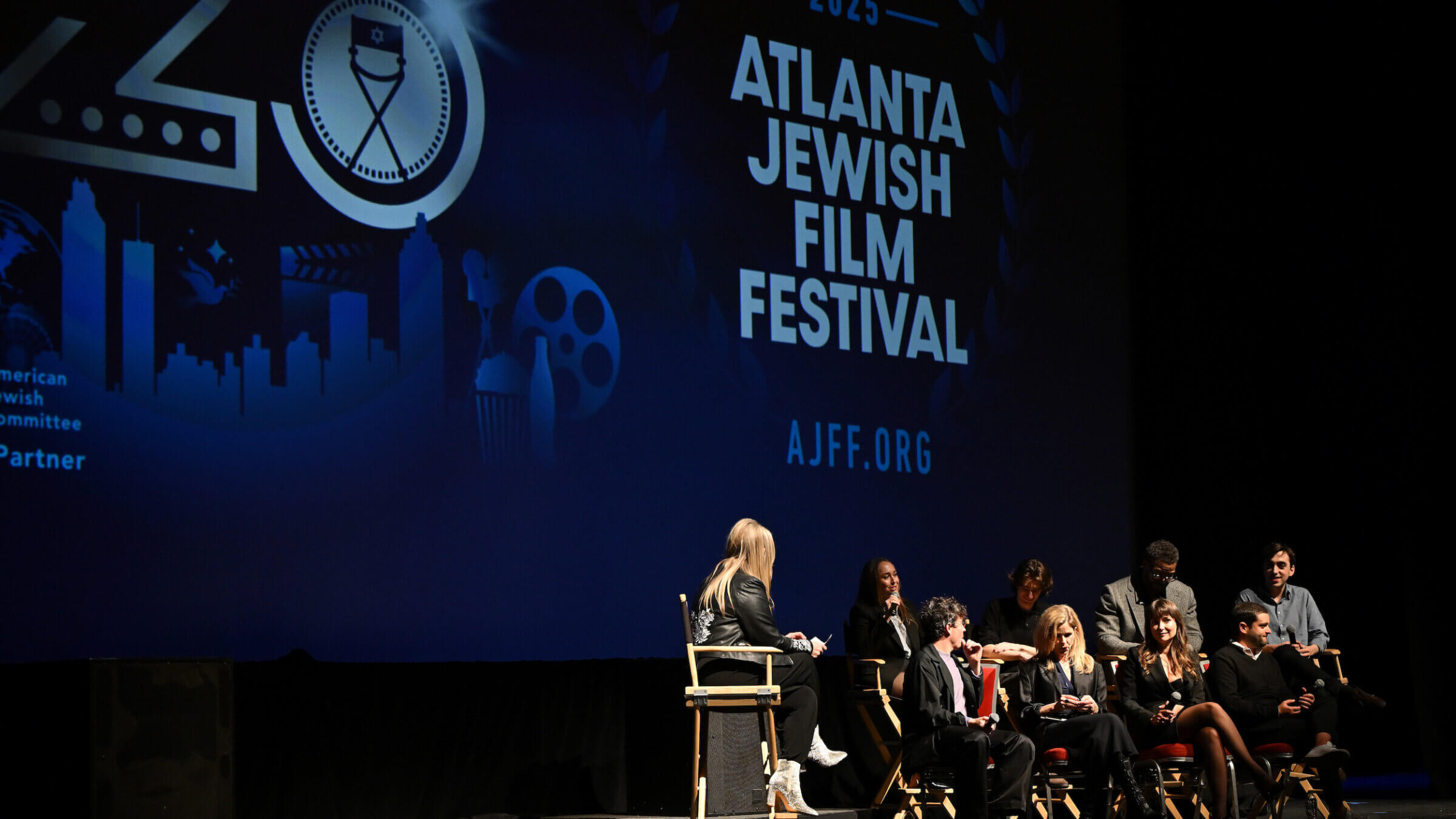
A panel speaks onstage during the 25th Atlanta Jewish Film Festival ” on Feb. 19, 2025 in Atlanta, Georgia. Photo by Derek White/Getty Images
I’ve heard Buffalo Springfield’s “For What It’s Worth” hundreds of times. But one recent Friday afternoon, returning from the grocery store with food for Shabbat dinner, was the first time I truly listened to the words.
“There’s battle lines being drawn,” the band sang. “Nobody’s right if everybody’s wrong / Young people speaking their minds / Are getting so much resistance from behind.”
Six decades later, those lines felt less like a period artifact than a live transmission.
I’ve spent most of my adult life working in and around Atlanta’s Jewish community, including six years on staff at the Atlanta Jewish Film Festival, leading community engagement and guest programming. So when the Israeli Consulate General to the Southeastern United States pulled its sponsorship of AJFF mid-festival last month — publicly rebuking the organization over its engagement with a Muslim Morehouse College student who had made social media posts criticizing Israel’s actions in Gaza — I felt it the way you feel a fracture in your own family.
What followed was even more painful to witness. This juror, by multiple accounts, was thoughtful, respectful, and described his role with the festival as an honor. The naming and public shaming he has been subject to in the past few weeks, as Jewish organizations issued statements of condemnation, have likely undone any understanding and bridge-building that had taken place over the course of his engagement with AJFF.
And AJFF, one of the largest Jewish film festivals in the world, found itself at the center of a communal firestorm — not for screening a controversial film, but for engaging with a young man of a different faith and perspective as part of a three-person jury evaluating human rights documentaries.
Reflecting on this now that this year’s festival has concluded, I’m troubled by what this incident shows about just how far the “battle lines” Buffalo Springfield mentioned have extended — and how dangerous they are. Sometime between the Hamas attack of Oct. 7, 2023 and today, something troubling took hold in parts of our community: the conflation of Jewish identity with unquestioning political loyalty to the current Israeli government.
The Talmud records that the rabbis preserved minority opinions precisely because truth is not always with the majority, and because a dissenting voice might one day be vindicated by circumstance. We are a people who have, for millennia, argued with God. Are we now going to stop arguing respectfully with each other?
And what does it mean for Atlanta — a city that styles itself the cradle of the civil rights movement — when its Jewish community responds to disagreement in this close-minded manner?
AJFF was built to advance a different set of goals. The festival’s mission has always rested on the belief that film is uniquely powerful as a vehicle for human connection — that sitting in the dark together, watching stories unfold, can open us to perspectives we might otherwise never encounter.
AJFF does not screen films as endorsements, nor does it require audiences to agree with what they see. Many screenings are followed by panel discussions designed to surface complexity, not resolve it. The festival’s explicit commitment to “foster intergroup understanding among Atlanta’s diverse cultural, ethnic and religious populations” is not a political statement — it is a pedagogical one.
Art doesn’t ask us to capitulate to another point of view. It asks us to be present with it long enough to recognize our shared humanity. As Robert Redford, honored during Sunday’s Academy Award in memoriam tribute, once said: “The glory of art is that it can not only survive change, it can lead it.”
Inviting a young Muslim student to evaluate films about human rights is not a provocation. It is that mission — AJFF’s mission — made real.
Organizations and individuals who are willing to engage in thoughtful, open-hearted dialogue with those whose experiences differ from their own — who resist the pull toward insularity and choose engagement instead — are doing some of the most important work in American civic life. That willingness, that courage, has the capacity to create lasting change for the better.
These are not radical ideas. They are deeply Jewish ones.
Hamas’s terror on October 7, 2023, was a cataclysmic rupture — a massacre that has legitimately shaken every Jewish person I know, including those who hold the most progressive views on Israeli policy. The grief and fear are real. The trauma is real. And antisemitism — actual antisemitism, not mere criticism of a government — is real and rising, and must be confronted without equivocation.
Just last week, a gunman rammed his vehicle into a synagogue in suburban Detroit in what the FBI called a targeted act of violence against the Jewish community. It is a reminder, as if we needed one, that the threats facing Jews in America are not hypothetical — they are physical, present, and demand our clear-eyed vigilance.
But vigilance and exclusion are not the same. Nor does the latter reflect the truth of the American Jewish community.
A recent poll from the Jewish Federations of North America found that while 88% of respondents affirm Israel’s right to exist as a Jewish, democratic state, only 37% identify as Zionists. These numbers do not reflect a collapse of Jewish values. They reflect a community grappling honestly and painfully with a situation that resists easy answers — which is exactly what Jewish communities are supposed to do.
That’s also what Judaism is about, at least the version I was raised in.
That Judaism tells us to welcome the stranger because we were once strangers ourselves. It instructs us that the most important commandment is to love your neighbor. It has, in my experience, made the Atlanta Jewish community one of the most generous, creative and genuinely pluralistic in the country.
The cancellation of individuals and organizations, the public shaming, the erosion of communal institutions that took decades to build — these are not expressions of Jewish strength. They are symptoms of fear. And fear, historically, has never served us well.
I do not have all the answers. My own views on Israel and Gaza have evolved, and I expect they will continue to. What I hold with confidence is this: if we retreat into camps of “Good Jew” and “Bad Jew,” defined not by ethical conduct or spiritual practice but by the volume of one’s political allegiance, we will lose something irreplaceable.
“Young people speaking their minds,” to quote Buffalo Springfield, are already showing signs of disengagement from Jewish institutional life. They will not be won back by litmus tests and boycotts. They will be won back, if at all, by communities that demonstrate the capacity to hold complexity without cruelty.
This is a moment of great uncertainty. Here’s what you can do about it.
We hope you appreciated this article. Before you go, we’d like to ask you to please support the Forward’s independent Jewish news this Passover. All donations are being matched by the Forward Board - up to $100,000.
This is a moment of great uncertainty for the news media, for the Jewish people, and for our sacred democracy. It is a time of confusion and declining trust in public institutions. An era in which we need humans to report facts, conduct investigations that hold power to account, tell stories that matter and share honest discourse on all that divides us.
With no paywall or subscriptions, the Forward is entirely supported by readers like you. Every dollar you give this Passover is invested in the future of the Forward — and telling the American Jewish story fully and fairly.
The Forward doesn’t rely on funding from institutions like governments or your local Jewish federation. There are thousands of readers like you who give us $18 or $36 or $100 each month or year.

Support our mission to tell the Jewish story fully and fairly.