Through missile strikes and sleepless nights, the persistent hope of being an Iranian Jew in Israel
My mother was forced out of her homeland. For the first time in four decades, I can imagine her return
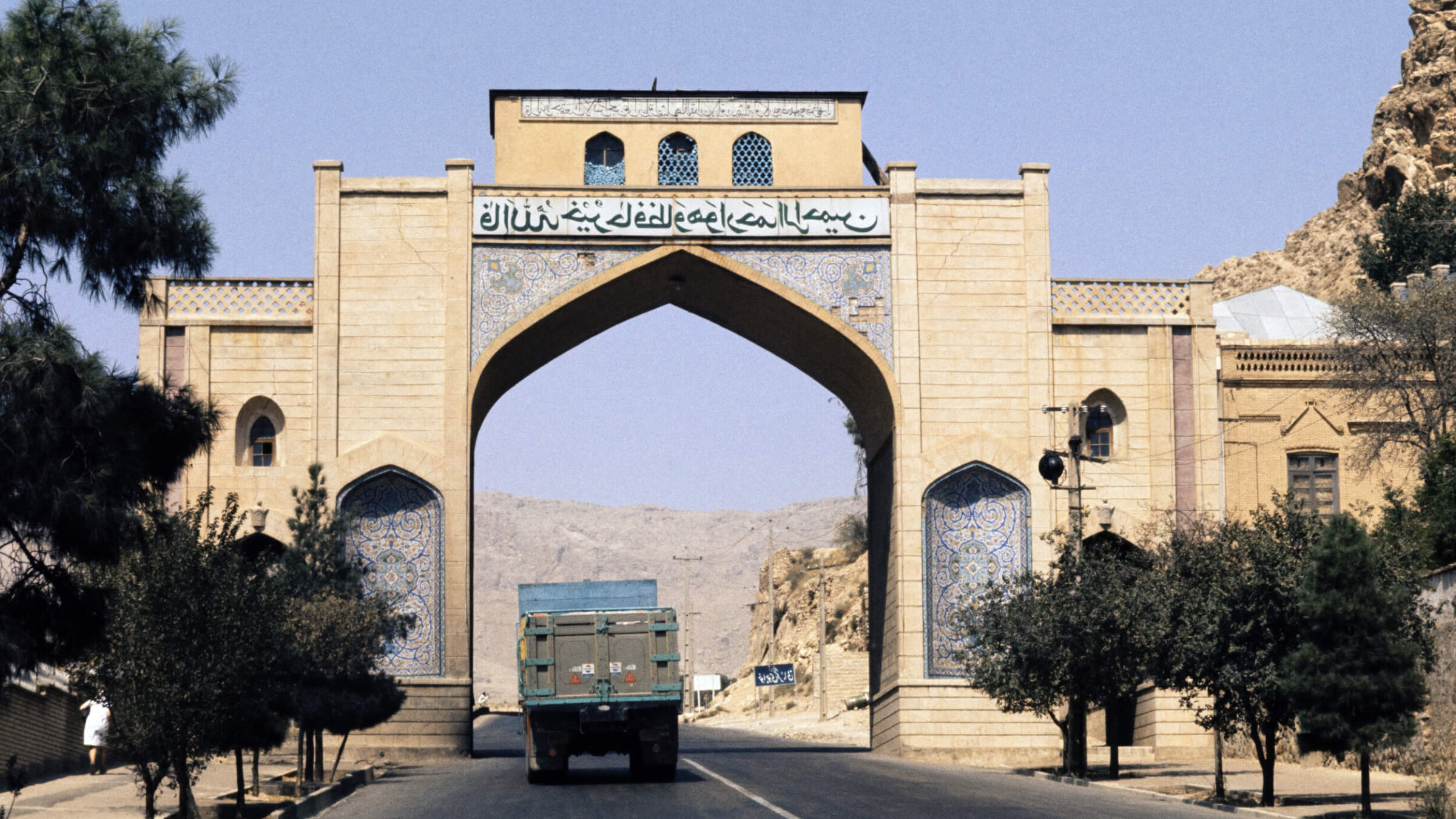
This picture taken in April 1976 shows the Qur’an Gate, northeast of the Iranian city of Shiraz. Photo by Jean-Pierre Prevel / AFP / Getty Images
For weeks, I lived in Tel Aviv as missiles streaked across the sky overhead. I heard sirens day and night, disrupting sleep and leaving me constantly bracing for the next alert. I ran to dozens of shelters across the city, waiting tensely as interceptions echoed overhead.
And yet, when I decided to leave Israel amid the ongoing war with Iran, I expected to feel relief. Instead, I felt a quiet, disorienting grief — as if I were stepping away from a moment I had spent my entire life waiting for.
For most of my life, Iran existed only in my mother’s memories. She was born and raised in Shiraz, Iran, one of hundreds of thousands of Jews that lived and thrived in Iran before the revolution. But as the war unfolded, I found myself thinking about it constantly — the life she had there, the one she was forced to leave behind, and the possibility it might not be lost forever.
My three identities — American, Iranian, and soon-to-be-Israeli — seemed to be converging in ways I never expected. For the first time in my life, I imagined what it might be like for all three to exist in the same physical reality — what if being American and Israeli did not mean being forever removed from my mother’s homeland? I imagined myself walking beside my mother through the tree-lined streets of Shiraz and bustling bazaars.
For most of my life that future belonged only to dreams. For the first time, it feels tangible.
A joyous Jewish life in Iran
Long before the Islamic Republic, Jews lived in Iran for thousands of years, creating a distinct culture of Judeo-Persian language, literature, and food. In photographs from Shiraz in the 1970s, my mother looks like many young women of the era. Long, wavy hair falls freely around her shoulders; she wears bell-bottoms and silky blouses in the European styles she admired, and a bright smile on her face.
She worked as an assistant for an Italian company; people of many diverse nationalities lived and worked in Iran at the time. She loved Shiraz with every ounce of her being. She loved her life and she loved her freedom.
In 1979, everything changed.
When the Iranian Revolution toppled the country’s monarchy, many people sensed that it was time to flee. Some left on the first flights out, but my mother stayed. For years, she navigated a shrinking life while holding onto hope that the turmoil would pass.
But the freedoms she once knew only vanished over time.
One day, seven years after the revolution, she was walking through a public square when a member of the morality police noticed that a small part of her hairline was visible beneath her hijab. He spat in her face, scolded her, and nearly arrested her for indecency. That was the moment that ended the waiting.
At 28, unmarried and knowing very little English, my mother decided to flee Iran alone. Leaving was not as simple as buying a plane ticket. After the revolution, the Islamic Republic restricted travel, particularly for religious minorities like Jews, and implemented strict exit visa requirements. She paid someone to smuggle her out of the country in disguise as a pilgrim traveling to Pakistan en route to Mecca.
Upon arriving in Pakistan, she spent three months in refugee housing for Iranian Jews. She lived in a crowded and unsanitary safe home, filled with rats and cockroaches. Given the proximity to Iran and that Jews were not particularly welcome in Pakistan, movement outside the facility was severely restricted.
Eventually she made it to Vienna, where HIAS resettled Jewish refugees. She waited there for months, pleading with the American embassy for entry to the United States, one of thousands of refugees awaiting resettlement. Almost a year after leaving Iran, my mother was granted asylum in the United States.
A sense of something missing
For the Iranian Jewish diaspora, the story of the rise of the Islamic Republic is not only one of political change. It is the story of families scattered across continents and futures permanently redirected by exile.
My mother built a life in America with urgency and survival in mind. Many of her choices were shaped by fear rather than possibility. She often says she is grateful for the life and family she built. But there is also a quiet absence in her story — the life she once expected in Iran, which never had the chance to unfold.
Children inherit many things from their parents: traditions, languages, recipes, and sometimes unfinished dreams. I grew up aware that my life contained possibilities my mother never had. I pursued an education she never had the opportunity to complete. I built a career that gave me financial independence. I traveled freely as an American, enjoying a life full of choices and novel adventures. And yet, something always felt unresolved.
Some of my earliest memories are of my mother listening to Iranian radio broadcasts from Los Angeles, which many in the diaspora call “Tehrangeles.” The morning broadcast always began with the national anthem of Iran from the time of the Shah. Commentators discussed Iranian politics, and the faint possibility that things in the country they loved might one day change.
At some point, my mother stopped listening. After decades in exile, she accepted that she would likely never return to her homeland.
The possibility of change
This war is certainly unsettling. But it has also brought a fragile, uneasy hope. For the first time in decades, the future of Iran’s regime seems uncertain enough that people like my mother dare to imagine change again.
I do not celebrate war. But change rarely comes without disruption.
My mother’s story is one of millions about the loss and misery inflicted by the Islamic Republic. So many people of so many different backgrounds fled Iran, carrying generations of memories and aspirations across unfamiliar continents. And so many more remained, living under oppression, under laws that restrict freedom, expression and basic human rights.
Most recently, tens of thousands died resisting that repression, fighting for the freedoms my mother once knew and cherished.
I know that many would say this war was undertaken unjustly, and that Iran’s future is not the responsibility of outside nations. But for me, and many like me, it is not so simple. After all, our futures were taken from us unjustly, too.
I left Israel for the time being, but I am grateful to have been there for the start of this strange and hopeful moment in history. Sitting in a shelter, listening to the sirens, I felt so close to what has always seemed impossible: a life in which Iranians across the diaspora are able to go home again. That hope is worth the sirens, sleepless nights, and waiting. It is a small price to pay for the promise we carry for healing from the past and securing a new future for generations to come.
This is a moment of great uncertainty. Here’s what you can do about it.
We hope you appreciated this article. Before you go, we’d like to ask you to please support the Forward’s independent Jewish news. All donations are still being matched by the Forward Board - up to $100,000 until April 24.
This is a moment of great uncertainty for the news media, for the Jewish people, and for our sacred democracy. It is a time of confusion and declining trust in public institutions. An era in which we need humans to report facts, conduct investigations that hold power to account, tell stories that matter and share honest discourse on all that divides us.
With no paywall or subscriptions, the Forward is entirely supported by readers like you. Every dollar you give is invested in the future of the Forward — and telling the American Jewish story fully and fairly.
The Forward doesn’t rely on funding from institutions like governments or your local Jewish federation. There are thousands of readers like you who give us $18 or $36 or $100 each month or year.

Support our mission to tell the Jewish story fully and fairly.