The moral degradation of Israel’s far-right is even worse than you think
And a horrifying speech this week proved it
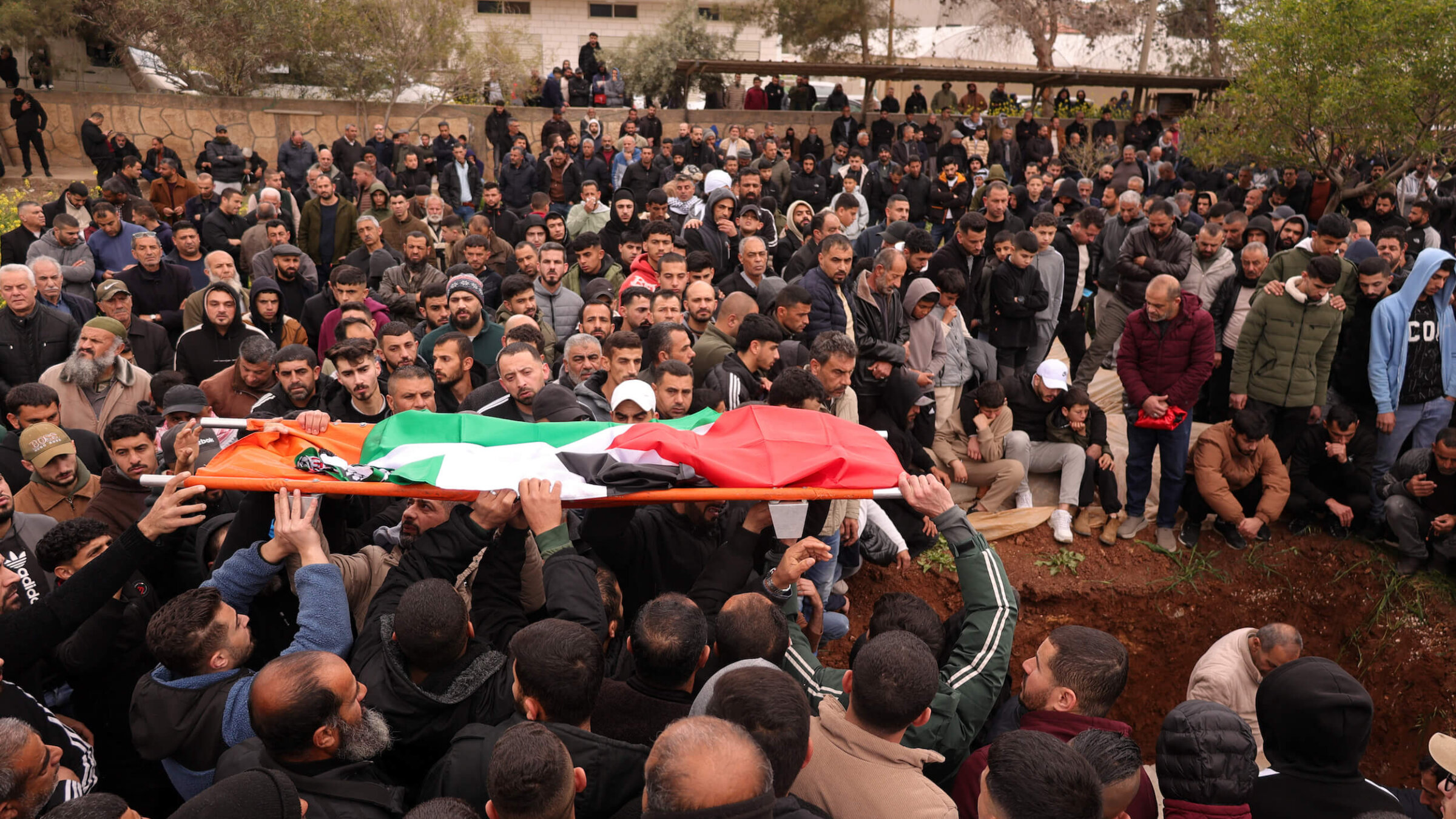
Palestinian mourners carry coffins during the funeral of four members of the Bani Odeh family, who were killed by undercover Israeli soldiers in the occupied West Bank on March 15. Photo by Mohammad Nazzal / Middle East Images via AFP

Columnist Dan Perry March 27, 2026
This week, an Israeli Knesset member said something that should have been shocking, horrifying and unanimously condemned.
“I stand behind IDF soldiers in every situation,” said Yitzhak Kroizer, a member of the ultranationalist Otzmah Yehudit Party. Even if the “collateral damage is children or women — it does not matter to me.”
“In Jenin, there are no innocent civilians,” he added. “In Jenin, there are no innocent children.”
Kroizer was referring to a genuine tragedy: The killing of almost an entire Palestinian family by Israel undercover forces on March 15, near the village of Tammun. The forces opened fire on the family’s car as they returned from a shopping trip. Waed Bani Ohde, her husband Ali, and two of their young children Othman, 7, and Mohammed, 5, were killed. Two sons survived. The army says the car accelerated toward the forces; Palestinian witnesses say the IDF gave no warning before attacking.
It is tempting to dismiss statements like Kroizer’s as the rhetoric of the extreme. Indeed, I often find myself making that point when talking to people inclined to think the worst of Israel: They do not represent the majority, and not even the immoral government of Prime Minister Benjamin Netanyahu.
But that, while true, is becoming a little too pat.
For it is also true that as time goes, as the wars continue and hearts harden, what Kroizer articulated is a moral framework that is steadily taking hold in the Israeli right.
That’s why the statements were not condemned by anyone associated with the government. And, indeed, Israeli far-right activists responded to the deaths with social media posts rejoicing in the death of the unarmed “terrorists.”
No senior Israeli official apologized for the shooting. No one said publicly that even if the soldiers believed they were acting under threat, the killing of two children demands something more than a routine internal review.
No official has even conceded that this type of event might contribute to agitation and instability in the West Bank, and perhaps spark another uprising. Set empathy aside; even enlightened self-interest is beyond the current Israeli government.
Yes, an investigation has been opened. But military investigations almost never lead to concrete action against the troops. A Guardian report this week revealed that no Israeli citizen has been prosecuted for a killing in the West Bank since 2020, despite a radical uptick in violence; settlers and police have already killed 10 Palestinian civilians this month alone.
The undercover soldiers, especially, are something like the real life version of the international hit Fauda, widely admired for their counter-terrorism activity. There is little appetite for throwing the book at them.
So while it’s tempting to chalk this up as just another tragedy in a long list of tragedies on both sides, it is actually much more: a devastating manifestation of something fundamental — not just a personal tragedy but a national one.
That’s a tragedy I’ve seen unfolding slowly, since even before the Hamas attack of Oct. 7, 2023.
I’ve seen it in the rhetoric of far-right leaders like cabinet ministers Itamar Ben-Gvir and Bezalel Smotrich. But I’ve also seen it firsthand, as when I found myself on wartime television panels where I was besieged by right-wingers enraged at my assertion that innocents have been killed during the war in Gaza. I challenged one of them about whether this idea would include a two-week old baby.
“OK, maybe not the baby!” he conceded, unhappily.
The descent of part of Israeli society into this unforgivable lack of compassion is, some have argued, an inevitable outcome of indefinite control over the Palestinian territories. For years, warnings that rule over millions of disenfranchised Arabs would mutate Israel’s character were treated as excessive, even hysterical.
Israel was not a colonial power in the classic sense, its defenders argued; it was a democracy under siege, navigating impossible dilemmas. The West Bank may be “occupied” but that was justifiable because of the threat its near proximity posed. Israel’s actions might be harsh, but they were necessary, the argument went. It was said that the country’s moral core, despite pressures, would remain intact.
The initial signs after this latest tragedy are not exactly reassuring. Far from condemning Kroizer, as they rightly should have, the cabinet convened this week to offer his party a great gift: the legalization of 30 illegal settlement outposts, including some in “Area A,” which is supposed to be under full Palestinian control.
Israel did not begin this way. Its founding story was deeply bound up with an acute awareness of the need to maintain morality. The early Zionists envisioned a country that would be a “light unto the nations.”
As occupation has become an entrenched reality, most Israelis have wanted to look away; the problem is too complicated. This position may not be possible for much longer. The moral rot is too extreme. But the good news is that it has not infected everything and everyone. Israel’s public broadcaster devoted a segment to the Palestinian family’s tragedy, characterizing Kroizer’s statements as a disgrace.
The humanistic ideas through which Israel once judged itself have eroded. We must now hope that they won’t entirely vanish.
This is a moment of great uncertainty. Here’s what you can do about it.
We hope you appreciated this article. Before you go, we’d like to ask you to please support the Forward’s independent Jewish news this Passover.
This is a moment of great uncertainty for the news media, for the Jewish people, and for our sacred democracy. It is a time of confusion and declining trust in public institutions. An era in which we need humans to report facts, conduct investigations that hold power to account, tell stories that matter and share honest discourse on all that divides us.
With no paywall or subscriptions, the Forward is entirely supported by readers like you. Every dollar you give this Passover is invested in the future of the Forward — and telling the American Jewish story fully and fairly.
The Forward doesn’t rely on funding from institutions like governments or your local Jewish federation. There are thousands of readers like you who give us $18 or $36 or $100 each month or year.
Support our mission to tell the Jewish story fully and fairly.