Why the ‘No Kings’ marches reminded me of Germany in 1933
Americans should heed what happened in Germany before the Weimar Republic’s final parliamentary election
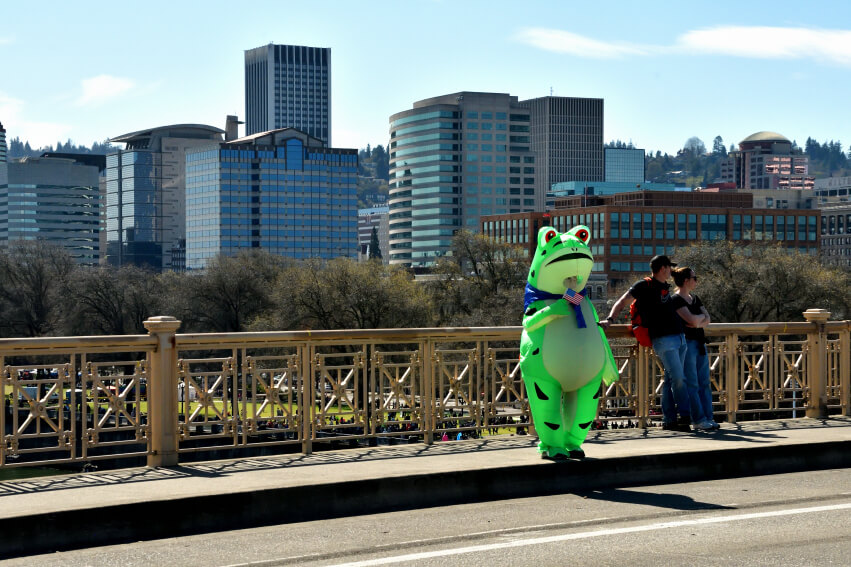
A frog looks on at the ‘No Kings’ march in Portland on March 28. Photo by Terrence Petty

Terrence Petty March 31, 2026
Germany’s parliamentary election on March 5, 1933 was the most fateful in the nation’s history, securing Hitler’s hold on power and launching 12 years of despotic rule and, eventually, a world war.
Like Germany nearly a century ago, as the United States enters the campaign season for our midterm elections, we too stand at destiny’s threshold. The outcome will determine whether Donald Trump can continue his assaults on democratic institutions, or whether he is checked by a Congress he has rendered virtually powerless since beginning his second term.
The moods of Germans in the spring of 1933 and Americans in the spring of 2026 are strikingly similar — a shroud of foreboding hangs over defenders of democracy. Yet beneath the gloom runs a pulse of defiance. In the United States, that defiance took visible form this past Saturday, when millions joined anti-Trump No Kings marches and rallies across the country.
As impressive as the Saturday protest was, America’s protectors of the republic would do well to heed what happened in Germany in the run-up to the two parliamentary elections of 1932 and the Weimar Republic’s final parliamentary election in March 1933 — moments when democratic hopes briefly rose, only to be extinguished.
In America under Trump, Indivisible has emerged as the most visible national organization in the anti-Trump resistance. During the Weimar Republic, its counterpart was a broad pro-democracy coalition called the Reichsbanner, led by the Social Democrats. Over the past century, memory of the Reichsbanner has nearly vanished, which is a shame given its dauntless devotion to democracy in the face of constant danger.
During the Weimar Republic’s final election campaigns, multitudes of Germans — rank upon rank, singing and chanting — marched through Berlin and other cities and towns across the country, gathering at rallies where orators denounced the fascists and vowed to defend the republic.
“1932 will be our year, the year of final victory of the republic over its enemies,” declared Karl Höltermann, the Reichsbanner’s national leader.
As the Weimar Republic was attacked by extremists on the right and left in its early years, and after Hitler’s abortive Beer Hall Putsch in 1923, the Social Democrats, the German Democratic Party, and the Center Party joined forces in 1924 to create a pro-republic defense organization, which they called the Reichsbanner.
In 1931, the Nazis, the German National Peoples’ Party, the veterans’ association Stahlhelm, and other anti-democratic forces joined to form the Harzburg Front. The Reichsbanner and its allies countered by marshaling Germany’s democratic constituencies — workers, veterans, liberals, Catholics — into a coordinated force known as the Iron Front.
As the Great Depression threw millions out of work, street violence intensified, cracks widened, and fragile coalition governments collapsed. The ranks of the Nazi and Communist parties swelled. Votes for Nazi candidates in the July 1932 election more than doubled — from 6.4 million to 13.1 million — making Hitler’s party the largest in the Reichstag with 230 seats, about 100 more than the Social Democrats, although short of a majority.
Enthusiasm for Hitler waned as Germany’s economic crisis eased, reflected in the November 1932 election. The Nazi bloc fell from 230 to 196 seats. It was a blow, but they remained the largest party.
The Reichsbanner’s years of defending democracy hurtled toward an ignominious end as Hitler used the burning of the Reichstag as a pretext to suspend civil liberties, the Nazis won a slim majority of parliamentary seats in coalition with the Nationalists in the March 5, 1933 election, and the last nail was driven into the republic’s coffin 14 days later when the parliament voted to give Hitler complete power.
During these tumultuous months defenders of democracy were intimidated, beaten, murdered and tortured, and many wound up in concentration camps, including Reichsbanner members. Höltermann fled to Britain, where he lived out the rest of his life in exile, dying in 1955.
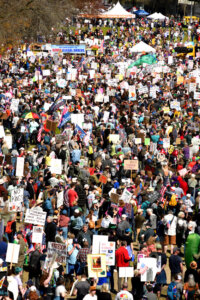
This past Saturday’s No Kings protests looked nothing like the anti-Hitler demonstrations led by the Reichsbanner nearly a century ago. But the posters carried by anti-Trump activists, their anti-fascist slogans, the frogs, unicorns and other creatures cavorting among the marchers, and above all, the dauntless defiance, all came from the same impulse that drove the defenders of the Weimar Republic.
As in communities across the nation, Saturday’s rally and march here in Portland, Ore. was truly impressive. There were so many people in the march that they simultaneously filled two bridges spanning the broad Willamette River dividing downtown from the east side.
A drum corps of anti-Trump activists was so precise in close-order drill that they might have surprised out-of-town visitors who think of Portland as a hipsters’ paradise. But the Portlandia stereotype was rescued by a guy on a unicycle riding in front of the drum corps — wearing a frog costume and juggling tennis balls.
Equally striking were three 13-foot puppets created by an Indivisible Oregon arts team and towed along the parade route — Donald Trump stuck in an oil barrel and holding a Boeing 747 in one of his tiny hands, Stephen Miller dressed as Dracula, and RFK Jr. as a mad scientist with a giant worm coming out of his head.
Although the Saturday nationwide protests appeared peaceful, confrontations broke out that night outside Portland’s ICE facility and at the Los Angeles Metropolitan Detention Center. Federal officers in Portland used tear gas to move protesters away from the gates, and in Los Angeles, authorities arrested dozens during a brief clash outside the detention center.
What’s next?
Indivisible co-founder Ezra Levin — sort of a Karl Höltermann of the 21st century — said plans are in the works for a general strike on May 1 to protest government policies that favor billionaires over workers. It is an idea inspired by a January 2026 general strike in Minneapolis, shuttering more than 700 businesses, to demand a halt to an escalation of federal immigration enforcement that led to the shooting deaths of two activists. Labor unions, religious organizations, community advocacy groups, teachers and students were among those involved.
“The next major national action of this movement is not just gonna be another protest. It is a tactical escalation,” Levin said at the No Kings rally in Saint Paul. “It is an economic show of force, inspired by Minnesota’s own day of truth and action,” .
I wish Levin well. But I worry.
General strikes are extremely rare in the United States. And there are reasons for that. Before Minneapolis, the last one occurred in Oakland, Calif., in 1946, when 100,000 workers staged a two-day walkout. Over the decades, as labor muscle has weakened, general strikes have become more difficult to organize. While workers have the right to strike, the Taft-Hartley Amendments of 1947 prohibit strikes organized for political purposes or directed at secondary targets..
A nationwide general strike in Germany in 1920 indicates some potential pitfalls.
In March 1920, when right-wing officers attempted to overthrow the republic in the far-right Kapp Putsch, the nation’s democratic forces responded with a general strike so vast that it quickly brought the coup to its knees. But the victory came at a steep price. Instead of unifying Germans around the defense of their republic, the strike widened the fissures already running through the nation.
As I was riding the bus to Portland’s protest on Saturday, I thought back to Karl Höltermann and the Reichsbanner. And I reflected on this fact: Germany’s anti-Hitler movements failed because not enough Germans thought democracy was worth preserving. Back then, democracy was not a historic tradition in Germany, unlike our 250 years of experience.
If we rescue our democracy, it will be because enough of us chose to.
This is a moment of great uncertainty. Here’s what you can do about it.
We hope you appreciated this article. Before you go, we’d like to ask you to please support the Forward’s independent Jewish news this Passover. All donations are being matched by the Forward Board - up to $100,000.
This is a moment of great uncertainty for the news media, for the Jewish people, and for our sacred democracy. It is a time of confusion and declining trust in public institutions. An era in which we need humans to report facts, conduct investigations that hold power to account, tell stories that matter and share honest discourse on all that divides us.
With no paywall or subscriptions, the Forward is entirely supported by readers like you. Every dollar you give this Passover is invested in the future of the Forward — and telling the American Jewish story fully and fairly.
The Forward doesn’t rely on funding from institutions like governments or your local Jewish federation. There are thousands of readers like you who give us $18 or $36 or $100 each month or year.
Support our mission to tell the Jewish story fully and fairly.