Jewish communities can help save trans lives — here’s how
Clergy from all movements are coming together to insist on stronger policies to support LGBTQ+ Jews
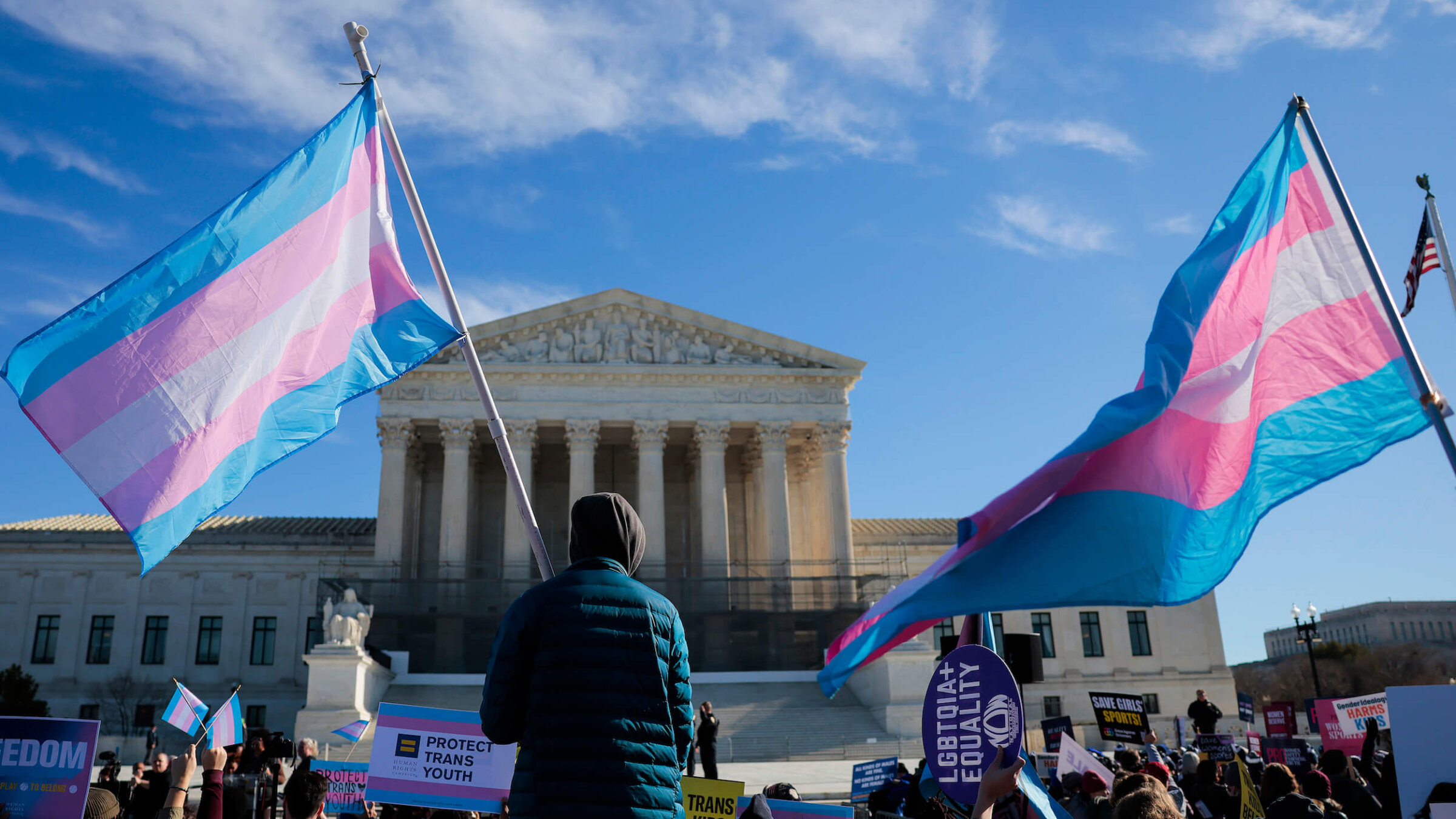
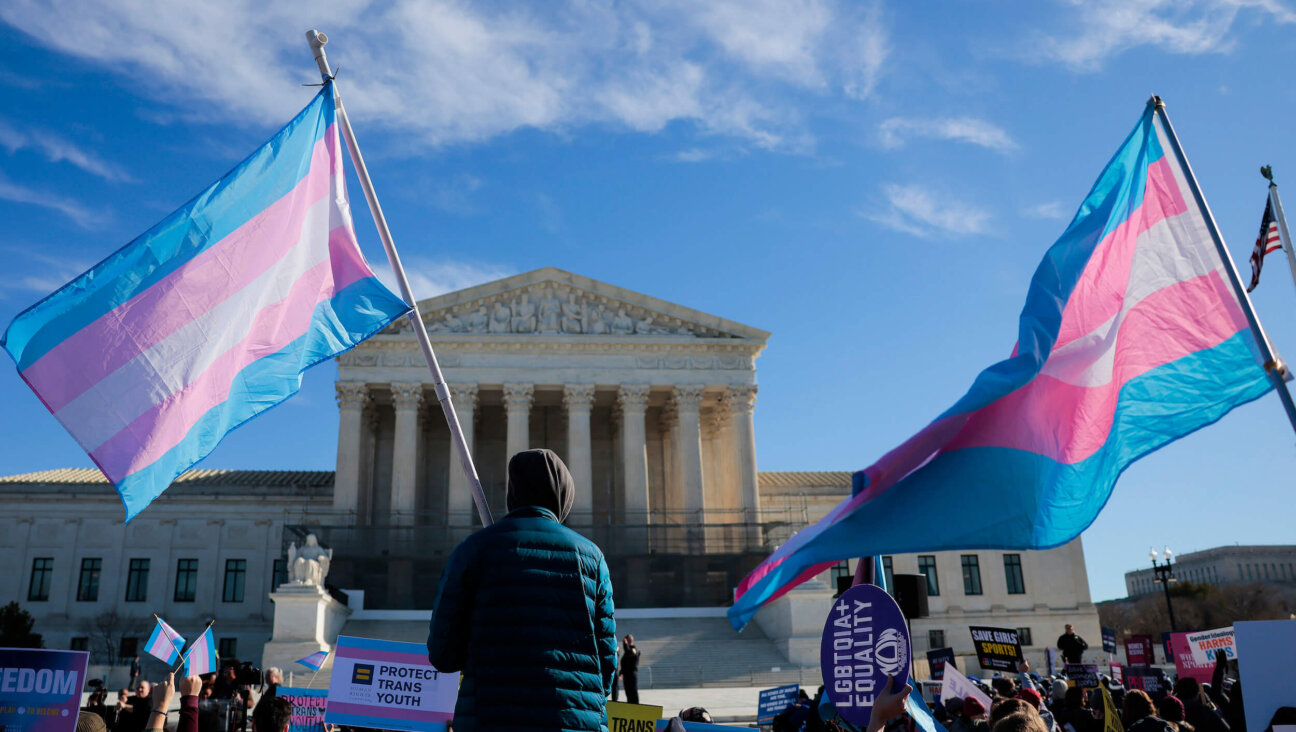
Protesters supporting transgender rights gather outside the Supreme Court on Jan. 13. Photo by Heather Diehl/Getty Images
In the 16 months since the 2024 election, the lives of hundreds of thousands of transgender, nonbinary and intersex people in the United States have been upended. A new survey shows that, during that time period, 9% of the country’s transgender population moved from one U.S. state to another over concerns for their personal safety. And just today, as we celebrate Transgender Day of Visibility, the Supreme Court released a decision that harms transgender people, as well as the entire LGBTQ+ community, by striking down a state law that protected LGBTQ+ youth and their families from so-called conversion therapy, a dangerous, disproven practice.
Jews have a religious obligation to protect transgender lives; a key tenet of our faith is the belief that to save a life is to save the whole world. Research shows that religious groups can play a particularly significant role in the lives of transgender youth. With the support of such groups, trans kids experience dramatically lower rates of depression and suicide. Conversely, when social support is stripped away, the risks rise.
That’s why more than 1,000 rabbis, cantors, and other spiritual leaders representing all major Jewish denominations — Orthodox, Conservative, Reform, Reconstructionist and Renewal — from 48 U.S. states and the District of Columbia recently signed an open letter publicly declaring that Jewish tradition compels us to support the full equality of transgender, nonbinary and intersex people.
The letter was spearheaded by Keshet, the leading national Jewish organization dedicated to LGBTQ+ equality, and the Religious Action Center for Reform Judaism — the organizations for which we respectively work. For us, the need for Jews to make a strong statement of support for the trans community was urgent.
In recent years, almost every state in the U.S. has proposed or passed legislation to take away the rights of transgender, nonbinary and intersex people. In the first quarter of 2026 alone, politicians in 42 state legislatures have introduced a staggering 740 laws targeting transgender people. At this horrifying rate, they’re on track to surpass last year’s 1,022 anti-trans bills, proposed in 49 states.
Only some of these bills will become law. But all of them aim to take away rights and erase transgender people from public spaces — by ending gender-affirming healthcare, restricting restroom use, forcibly outing students at school, banning books, and more. Kansas passed a particularly terrifying example of this sort of legislation in February, with a law that revoked the IDs of transgender people — passed in the dead of night, and put into effect the very next day.
Jewish communities are painfully aware of the dangers of policies and laws that try to legislate minority groups out of the public square. That clarity gives us a particular mandate to combat such efforts.
So many American Jews have ancestors whose lives were shaped by exclusionary laws, scapegoating, censorship and attempts to erase us from public life. So many of us who immigrated to this country have firsthand experience of that same torment. This strategy of disenfranchisement and persecution has appeared repeatedly throughout Jewish history, often preceding profound tragedy.
As Jewish leaders, we see echoes of those dangerous patterns today in rhetoric that portrays LGBTQ+ people as a threat to society. We know, from our own history, that these are not the actions of a functioning democracy.
Our congregants and community members have been asking us what they can do to support our trans youth in their circles. And LGBTQ+ Jews want to know how Jewish organizations are working to stand up for their existence, dignity and safety. We must answer both questions more vigorously and decisively.
Even as we work to protect and advance LGBTQ+ rights in the public square, we have the power — and the responsibility — to make our Jewish communities safe havens. We have a unique role to play.
There are things all of us can do to create Jewish communities of belonging and affirmation for our transgender, nonbinary and intersex community members:
- Commit to using the names and pronouns that LGBTQ+ members use for themselves.
- Push your Jewish community leaders to take proactive steps to turn your community into a safe and affirming space for all transgender and LGBTQ+ people.
- Establish gender-neutral restrooms. Then, create and post a policy that encourages people to use the restroom, locker room or other gendered facilities that align with their gender.
- Implement anti-harassment, anti-bullying and non-discrimination policies that affirm the dignity and safety of all community members.
The rights and lives of our neighbors are in our hands. As many of our political leaders fail to protect members of our community, we must lead by example to build a world of affirmation and belonging for all.
This is a moment of great uncertainty. Here’s what you can do about it.
We hope you appreciated this article. Before you go, we’d like to ask you to please support the Forward’s independent Jewish news this Passover. All donations are being matched by the Forward Board - up to $100,000.
This is a moment of great uncertainty for the news media, for the Jewish people, and for our sacred democracy. It is a time of confusion and declining trust in public institutions. An era in which we need humans to report facts, conduct investigations that hold power to account, tell stories that matter and share honest discourse on all that divides us.
With no paywall or subscriptions, the Forward is entirely supported by readers like you. Every dollar you give this Passover is invested in the future of the Forward — and telling the American Jewish story fully and fairly.
The Forward doesn’t rely on funding from institutions like governments or your local Jewish federation. There are thousands of readers like you who give us $18 or $36 or $100 each month or year.
Support our mission to tell the Jewish story fully and fairly.