The stories of Passover and Pittsburgh share a common humanity
In a divided world where hate makes us less safe, Moses’ courage can inspire our own
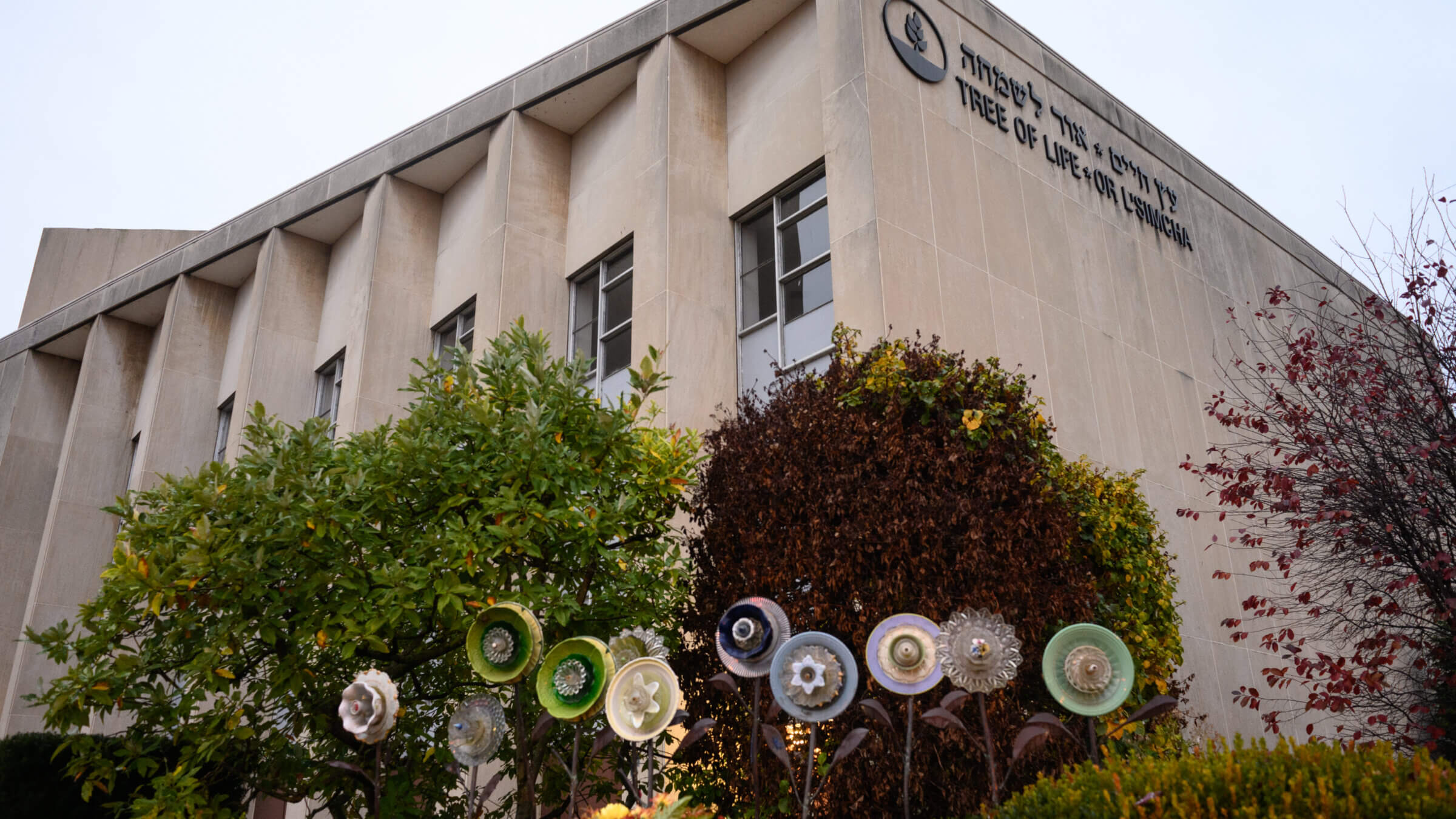
The Tree of Life synagogue on the fifth anniversary of the attack, Oct. 27, 2023, in Pittsburgh, Pennsylvania. Photo by Justin Merriman/Getty Images
At the heart of the Passover story is an act of courage that feels both ancient and urgent.
Before the plagues, before the parting of the Red Sea, a man named Moses made a brave choice. Saved and raised by the Pharaoh’s daughter, he could have looked away from the suffering of others. But instead, Moses recognized his connection to and the humanity of the Israelites, insisting that Pharaoh let his people go.
We often tell the Passover story as one of liberation, and it is. But it is also a story about the risk of crossing divides in society and the tension between extending an open hand or isolating yourself.
That tension is not confined to ancient Egypt: it persists within the Jewish community today. In the wake of the 2018 Pittsburgh synagogue shooting, much of the conversation understandably focused on security, accountability and the urgent need to confront antisemitism directly. The intensity and urgency of that conversation has only increased as Jewish Americans face more hate than ever in our post-Oct. 7 reality. Security and accountability are essential. But on its own, hardening our institutions is not enough. We must also engage in the hard work of educating and building connections across lines of difference.
Hate festers in the absence of relationships across those boundaries, and confronting it requires human connection. When we build compassionate, healthy communities, we begin to heal the persistent societal wounds, such as antisemitism and hatred, that divide us.
In the days and weeks following the attack in Pittsburgh, something remarkable happened: communities that could have remained distant instead drew closer. Muslim neighbors raised money to help cover the cost of funerals and Christian congregations opened their doors, providing the Tree of Life Congregation a safe place for worship services and to gather in community. In those dark days, Pittsburghers, and people from near and far, prayed, cried and raised their voices in song together. They modeled a response to hate rooted in shared humanity.
Passover asks something similar of us. Each year at the Seder table, we are instructed not simply to retell the story but to see ourselves within it, to remember what it felt like to be strangers in a strange land. The Passover Haggadah commands us to welcome the stranger as we were once strangers in the land of Egypt.
The story is a call to action, asking us to recognize the common roots that unite us all. If we are to truly embrace the stranger, then our work must extend beyond our own community and bring people of different backgrounds together to cultivate mutual understanding and learn more about our neighbors. That mandate guides our work at The Tree of Life. We are building a new institution rooted in Pittsburgh with national impact, dedicated to inspiring courageous action and creating compassionate communities. We are bringing people together to engage with one another and to stay connected even when it is hard.
Our programs focus on inquiry, connection, and community engagement, remembering our past and celebrating Jewish tradition and joy. For example, the Holocaust Center of Pittsburgh, one of our core programs, worked closely with Lily Sassani, a local Girl Scout, to develop a Holocaust Education patch, which is now available to all Girl Scouts. The LIGHT Education Initiative, our cornerstone education program, hosts the Eradicate Hate Student Summit, which in 2025 brought together 450 attendees and, with the support of the Grable Foundation and Benedum Foundation, offered $1,000 grants to 34 schools in southwestern Pennsylvania to design and deliver programming on their campuses.
We’re also sharing the story of what happened on Oct. 27, 2018, the history of antisemitism in America and our work to uproot hate in a traveling exhibition visiting communities across the country, beginning in Pittsburgh and next headed to Broward County, Florida, home to Parkland, another community sadly shaped by tragedy. The exhibition offers a peek into what we will be doing in Pittsburgh at the site of the deadliest antisemitic attack in United States history.
Empathy and understanding are powerful antidotes to hate. Developing both is slow, but important. Beloved Squirrel Hill resident Mr. Rogers knew this and exemplified it. He famously responded to racist ideas of his time, not through loud condemnation but by modeling a different way forward. Amid contentious debates over segregated pools, he invited a Black character, Officer Clemmons, to join him in cooling his feet in a small wading pool and sharing a towel. He didn’t argue; he demonstrated.
We are not naive, nor do we think there is a single answer to the challenges and divisions we all face. What we do know, however, is that at the same time that antisemitism has increased exponentially in recent years, divides are deepening and isolation is rising. Pew Research suggests that approximately eight in ten Americans say they cannot even trust people of different political opinions to agree on basic facts.
When antisemitism is rising and trust is waning, the instinct is often to pull back; to ignore the forces of good at work and hide behind walls. Imagine if Moses had remained in Midian, continuing his exile. Ours would be a very different story.
Instead, Moses stepped out in faith and sought community. For the truth is, liberation is not only about moving past a place of discomfort, grief and hardship. It is about what we choose to build afterward and who we bring along the way. Only by recognizing our common humanity and building bridges across lines of difference can we bring about the better future that the youngest people seated at our Seder tables deserve.
This is a moment of great uncertainty. Here’s what you can do about it.
We hope you appreciated this article. Before you go, we’d like to ask you to please support the Forward’s independent Jewish news this Passover. All donations are being matched by the Forward Board - up to $100,000.
This is a moment of great uncertainty for the news media, for the Jewish people, and for our sacred democracy. It is a time of confusion and declining trust in public institutions. An era in which we need humans to report facts, conduct investigations that hold power to account, tell stories that matter and share honest discourse on all that divides us.
With no paywall or subscriptions, the Forward is entirely supported by readers like you. Every dollar you give this Passover is invested in the future of the Forward — and telling the American Jewish story fully and fairly.
The Forward doesn’t rely on funding from institutions like governments or your local Jewish federation. There are thousands of readers like you who give us $18 or $36 or $100 each month or year.
Support our mission to tell the Jewish story fully and fairly.