Australia’s Yiddish community is thriving, not reviving
Yiddish has been sustained as a language there for more than 100 years
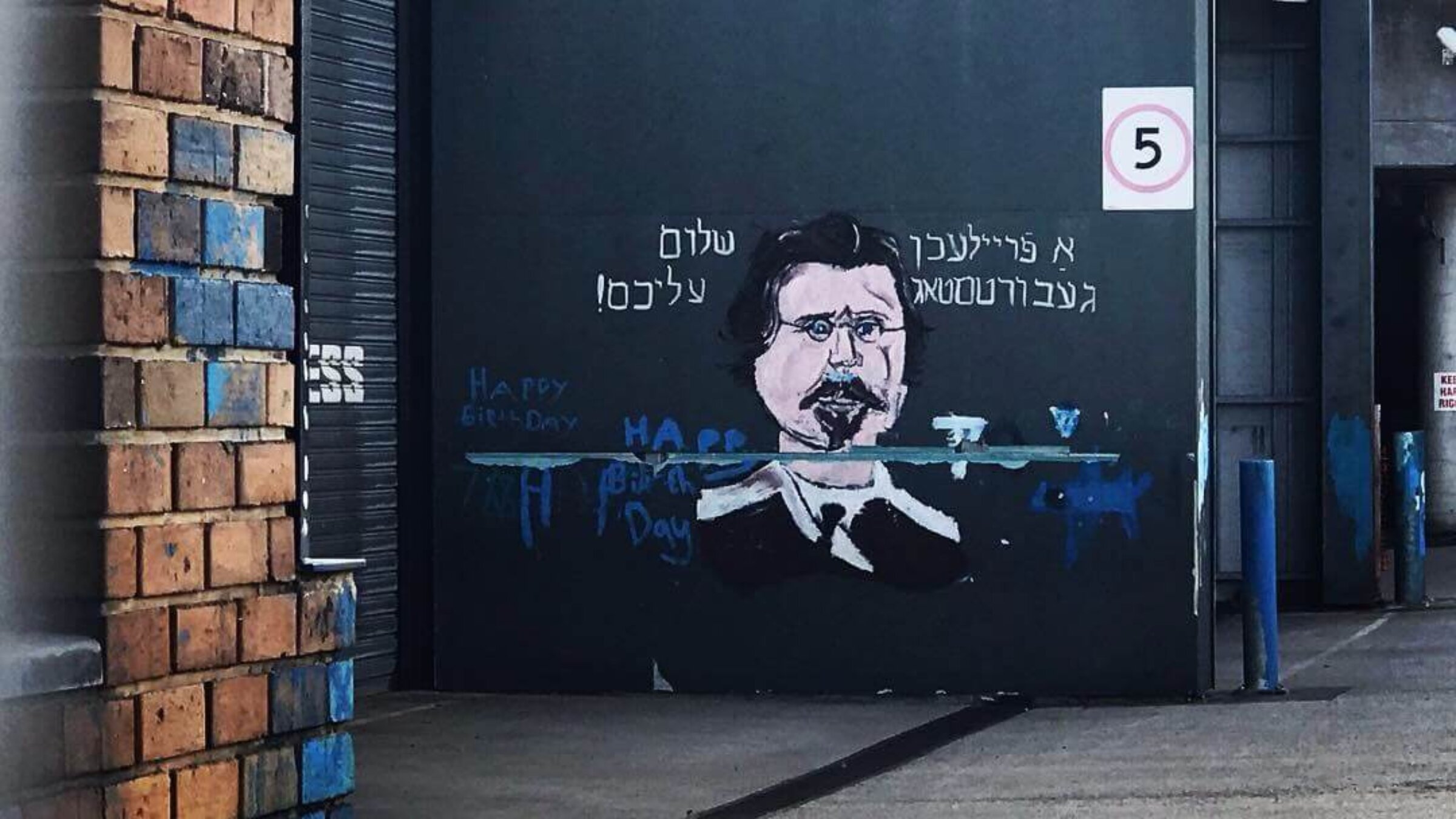
A mural celebrating the writer Sholem Aleichem in Melbourne, Australia. Photo by Maia Evrona

By Maia Evrona December 17, 2025
As a professional translator of Yiddish literature, I was surprised by the characterization of the Australian Jewish community’s connection to the Yiddish language in the recent Forward piece “Australia’s Jewish community is defined by Holocaust survivors, Yiddishkeit and immigrants.”
Australia’s Jewish community has indeed been shaped by the Yiddish language. This is why, when I was a Yiddish Book Center translation fellow, I used the small travel stipend that came with the fellowship to visit Melbourne, the center of Australian Yiddishkayt.
What I was surprised by in the Forward‘s article, (which cites a Vice article from 2019 as its source) was the characterization of Yiddishkayt in Australia as a “revival,” with “young people who view it as a ‘language of protest’ leading the charge.”
What is remarkable about the Melbourne Jewish community’s connection to the Yiddish language is not that it has been revived, but rather that it has been sustained, for over a hundred years, thanks in large part to the role the Jewish Labor Bund has played in shaping the Jewish community of Melbourne. The Kadimah Jewish Cultural Center and Yiddish Library has a name that literally means “forward” in Yiddish and Hebrew. They have been leading the charge for 110 years. The particular young people mentioned in the Forward‘s article are new arrivals.
One might think, reading this piece, that teaching Yiddish as a subject at Sholem Aleichem College was a recent development, rather than the central reason for the founding of the school over 40 years ago, with earlier Bundist-modeled Yiddish-language Sunday schools preceding it.
In addition to Sholem Aleichem college, there is also the SKIF youth group, which Melbournian Bundist families have been sending their children to since 1950. When I visited Melbourne in 2019, I attended SKIF’s annual Warsaw Ghetto Uprising Commemoration, which featured children and teenagers reciting poetry and texts from the Warsaw Ghetto in the original Yiddish, a sharp contrast to the recent Yiddish learners profiled in the Vice article the Forward piece linked to, one of whom had only recently learned that bagel was a Yiddish word.
This is not to shame newer learners of Yiddish. We all have to start somewhere. I welcome everyone, Jewish and not, who decides to learn, but Yiddish is not only a language of protest. It is first and foremost a language of life, one that I hope will continue to be sustained in Australia following this horrific attack.
This is a moment of great uncertainty. Here’s what you can do about it.
We hope you appreciated this article. Before you go, we’d like to ask you to please support the Forward’s independent Jewish news this Passover. All donations are being matched by the Forward Board - up to $100,000.
This is a moment of great uncertainty for the news media, for the Jewish people, and for our sacred democracy. It is a time of confusion and declining trust in public institutions. An era in which we need humans to report facts, conduct investigations that hold power to account, tell stories that matter and share honest discourse on all that divides us.
With no paywall or subscriptions, the Forward is entirely supported by readers like you. Every dollar you give this Passover is invested in the future of the Forward — and telling the American Jewish story fully and fairly.
The Forward doesn’t rely on funding from institutions like governments or your local Jewish federation. There are thousands of readers like you who give us $18 or $36 or $100 each month or year.
Support our mission to tell the Jewish story fully and fairly.