How my father felt about Halloween
While my mother helped us prepare costumes and sent us out trick-or-treating, my father felt very differently about the holiday.
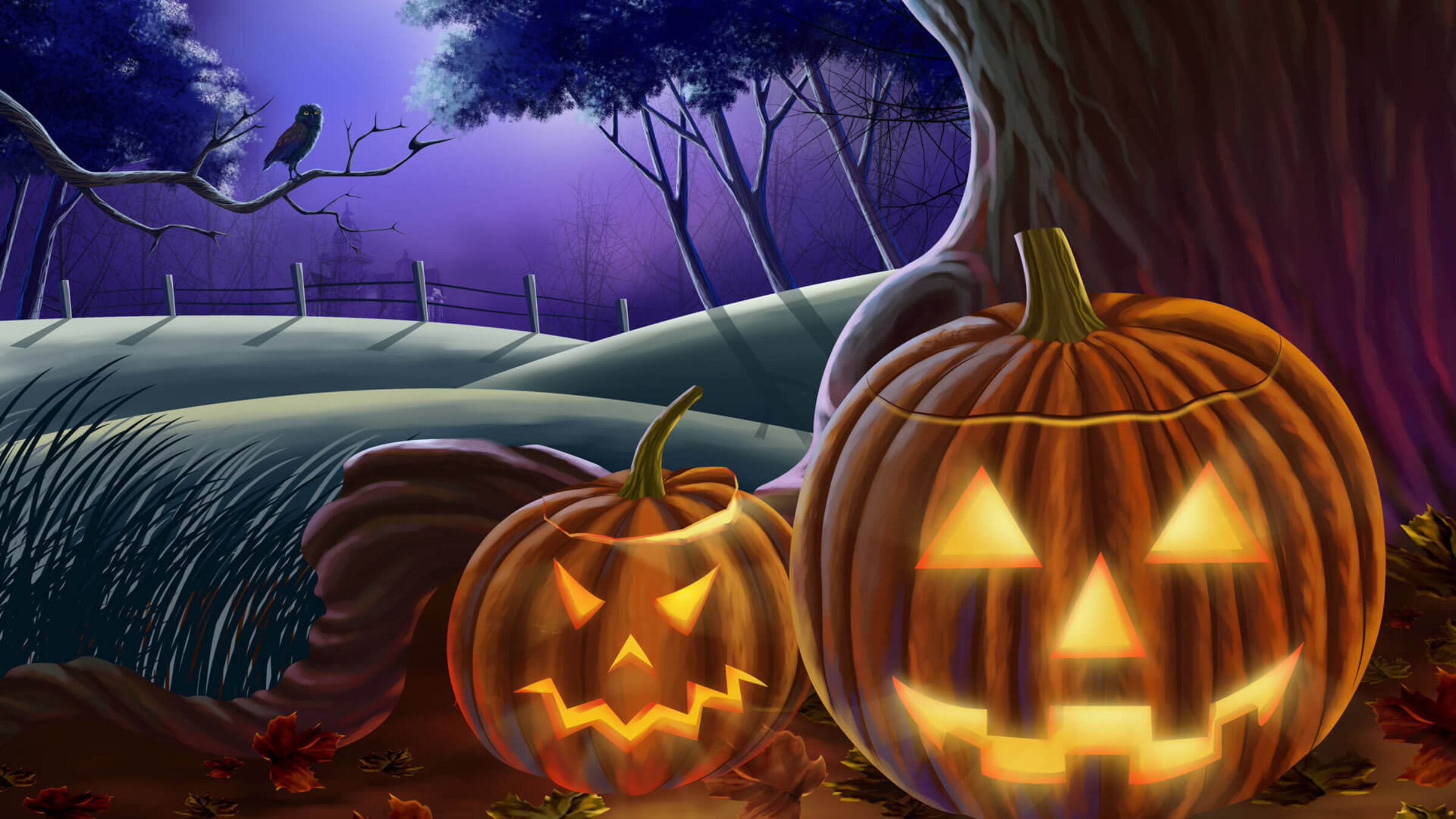
Photo by goodfon.com

By Rukhl Schaechter October 30, 2022
When I was a little girl, my family lived on a tree-lined street filled with many other families on Georgia Avenue in East New York, Brooklyn. Every day my sister and I spent most of our after-school hours outside, playing with other kids on our block: Jewish and non-Jewish, white and black. We were especially close to a Yiddish-speaking Hasidic girl our age called Shprintse, whose family lived across the street.
As Halloween drew near, our mother helped us put together some sort of costume: a princess, a ballerina, a scarecrow or whatever other ideas we came up with. Then, on Halloween night, she gave us large bags to fill up with candy and off we went trick-or-treating.
In 1966, when I was 9 years old, we moved to Bainbridge Avenue in the Bronx and started attending a Yiddish school — the Sholem Aleichem Shul 21 — across the street every day after public school. When Halloween rolled around, my mother continued to help us prepare for it. Then, one Halloween evening, as we came back from trick-or-treating, eager to start feasting on the goodies we’d collected, I heard my parents arguing in the kitchen. Curious, I tiptoed to the dining room and was surprised at what I heard.
“Halloween is not a Jewish holiday!” my father, a Holocaust survivor, said in Yiddish.
“What’s the big deal?” my mother responded. “It’s just a secular American holiday, and all American kids celebrate it!”
“I don’t care. Our children are Jewish and shouldn’t be celebrating some goyish holiday that worships evil spirits.”
After the bickering died down, my parents called us into the dining room and asked us to sit down. As my mother remained silent, my father said: “There will be no more celebrating Halloween. It’s not a Jewish holiday, it’s named after a Christian saint, it celebrates foolish notions and gives you cavities.”
I tried to protest but it was clear his mind had been made up. I burst into tears and ran up to my room. “He’s such an idiot!” I ranted.
Fast forward to the 1980s when I had three children of my own. Whenever Halloween rolled around, I recalled my parents’ argument but was surprised to see how much I’d changed. After attending public school all my life, I had decided that I much preferred sending my three sons to Jewish day school, hoping that their being immersed in a Jewish environment all day would avoid their getting Halloween envy, like I had.
Once, though, one of my boys, while watching Halloween ads on TV, came over to me and said that dressing up in costumes and going trick-or-treating looked like fun. I smiled, reminded him that we were Jewish, and that we do all that on Purim. “It’s kind of like when your friend has a birthday,” I said. “You wish him a happy birthday, but you understand that the celebration and the gifts are his, not yours.”
“Oh,” he said and went back to his TV show. No crying, no calling me an idiot. I breathed a sigh of relief, seeing that for my son, Halloween, like Christmas, was simply something we didn’t do.
This is a moment of great uncertainty. Here’s what you can do about it.
We hope you appreciated this article. Before you go, we’d like to ask you to please support the Forward’s independent Jewish news this Passover. All donations are being matched by the Forward Board - up to $100,000.
This is a moment of great uncertainty for the news media, for the Jewish people, and for our sacred democracy. It is a time of confusion and declining trust in public institutions. An era in which we need humans to report facts, conduct investigations that hold power to account, tell stories that matter and share honest discourse on all that divides us.
With no paywall or subscriptions, the Forward is entirely supported by readers like you. Every dollar you give this Passover is invested in the future of the Forward — and telling the American Jewish story fully and fairly.
The Forward doesn’t rely on funding from institutions like governments or your local Jewish federation. There are thousands of readers like you who give us $18 or $36 or $100 each month or year.
Support our mission to tell the Jewish story fully and fairly.