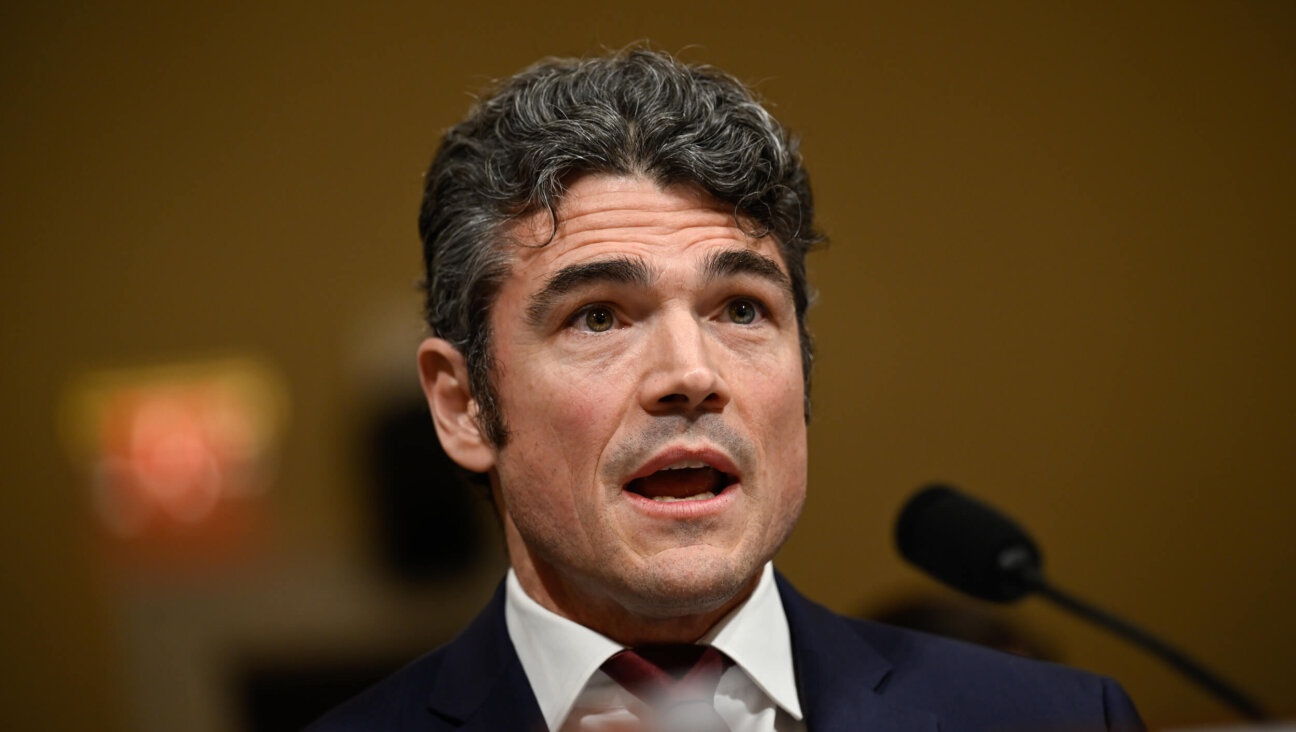
VIDEO: Israeli soldier on the front singing a Yiddish fighting song
Yonatan was inspired to sing the “The Partisan Hymn” as his tank was rolling down the dusty road to the front

Graphic by Angelie Zaslavsky

By Forverts Staff October 12, 2023
The Forward has received a Whatsapp clip taken this week by a reserve soldier in Israel singing “The Partisan Hymn,” a well-known Yiddish fighting song, while riding in a tank on a dusty road on Israel’s northern front.
Yonatan, a young man in his 30s, sent the Whatsapp clip to Daniel Galay, the director of the Yiddish cultural center, Beit Leivik, in Tel Aviv, who then forwarded it to the Forward. “Yonatan is a real Yiddishist,” Galay said. “He performs Yiddish songs frequently for us, accompanying himself on the accordion.”
“The Partisan Hymn,” known in Yiddish as “Dos partizaner lid,” expresses the defiant resistance and resilience of the Jewish people. It was composed in 1943 by Hirsh Glik, a young member of the underground resistance movement in Vilna. Glik said he was inspired to write the song upon hearing news of the Warsaw Ghetto Uprising. According to many accounts, Glik was captured and executed by the Nazis in July 1944.
In the clip, we hear Yonatan singing the first of the four stanzas of the song, translated here below. (You can read the translation of the entire song here.)
Never say that you are walking the final road,
Though leaden skies obscure blue days;
The hour we have been longing for will still come,
Our steps will drum – we are here!
This is a moment of great uncertainty. Here’s what you can do about it.
We hope you appreciated this article. Before you go, we’d like to ask you to please support the Forward’s independent Jewish news this Passover.
This is a moment of great uncertainty for the news media, for the Jewish people, and for our sacred democracy. It is a time of confusion and declining trust in public institutions. An era in which we need humans to report facts, conduct investigations that hold power to account, tell stories that matter and share honest discourse on all that divides us.
With no paywall or subscriptions, the Forward is entirely supported by readers like you. Every dollar you give this Passover is invested in the future of the Forward — and telling the American Jewish story fully and fairly.
The Forward doesn’t rely on funding from institutions like governments or your local Jewish federation. There are thousands of readers like you who give us $18 or $36 or $100 each month or year.
Support our mission to tell the Jewish story fully and fairly.