You don’t need to be religious to enjoy the weekly Torah portion
Even atheists can enjoy these Yiddish poems and their translations, related to the Torah reading
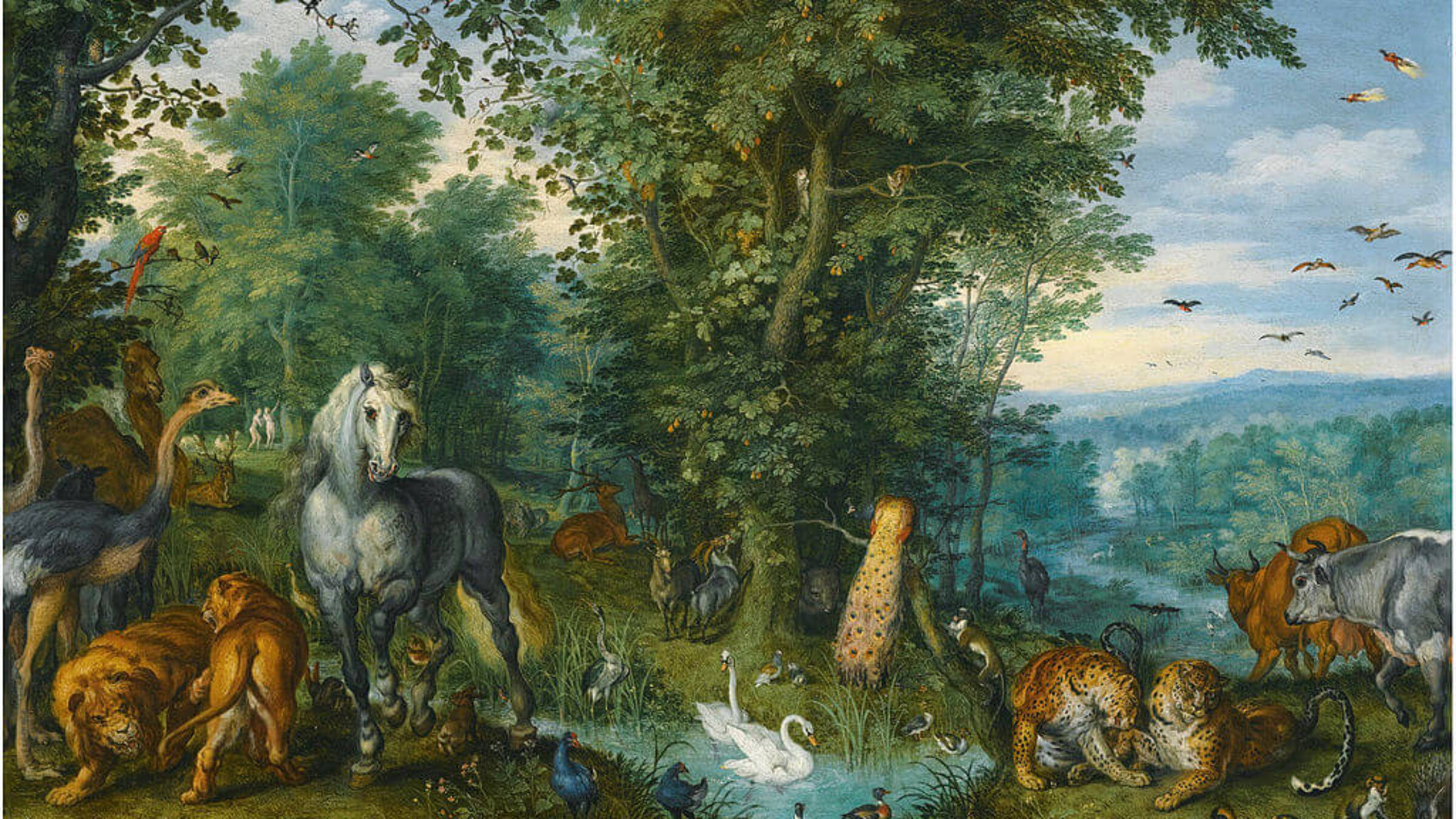
On Simchat Torah, Jews complete the Torah reading cycle and go back to the first chapter — Genesis. Above: The Garden of Eden with the Fall of Man, painted by Jan Brueghel the Elder, 1613. Courtesy of Wikimedia Commons

By Rukhl Schaechter October 10, 2025
Every Shabbos, Jews in synagogues of all denominations hear the cantor, rabbi or a layperson chant that week’s Torah portion from an open scroll.
But Yiddish scholar Sheva Zucker says you don’t need to be an observant Jew, or even believe in God, to enjoy the weekly Torah portion, known in Yiddish as the parshe or the sedre.
Zucker has a blog that includes an online collection of Yiddish poems and some prose — complete with English translation, transliteration and audio recording — that were either inspired by a Torah portion or whose meaning could be illuminated by it. The poems in the collection, which she calls Parshe Poetry, were written by over three dozen renowned poets and writers, including Yankev Glatshteyn, Itsik Manger, Kadye Molodowsky and Rokhl Korn.
“Even though Modern Yiddish poetry is generally thought of as created by heretics, atheists and agnostics, the Khumesh [the Hebrew Bible] remains a powerful force in their writings,” Zucker said. “It was generally not hard to find Yiddish poems that were either inspired by the sedre or shed new light on it, in ways that should interest and entice both believers and non-believers.”
As Jews celebrate the holiday of Simchat Torah by completing the annual Torah reading cycle and going back to the Bible’s first chapter — Genesis — Parshe Poetry provides several exceptional works of verse related to that chapter’s timeless stories. One of them — a delightfully satirical one by Itzik Manger — retells what happens when Eve gives Adam the apple from the Tree of Knowledge. Whether you read the original Yiddish poem or its English translation by Leonard Wolf, you’ll get some true insight into how Manger, a secular Jew, viewed his people’s ancient sacred texts.
This is a moment of great uncertainty. Here’s what you can do about it.
We hope you appreciated this article. Before you go, we’d like to ask you to please support the Forward’s independent Jewish news this Passover.
This is a moment of great uncertainty for the news media, for the Jewish people, and for our sacred democracy. It is a time of confusion and declining trust in public institutions. An era in which we need humans to report facts, conduct investigations that hold power to account, tell stories that matter and share honest discourse on all that divides us.
With no paywall or subscriptions, the Forward is entirely supported by readers like you. Every dollar you give this Passover is invested in the future of the Forward — and telling the American Jewish story fully and fairly.
The Forward doesn’t rely on funding from institutions like governments or your local Jewish federation. There are thousands of readers like you who give us $18 or $36 or $100 each month or year.
Support our mission to tell the Jewish story fully and fairly.