Menachem Daum was not your typical Orthodox Jewish filmmaker
In his films, the late director strove to find common ground between Jews and non-Jews, especially Catholic Poles.
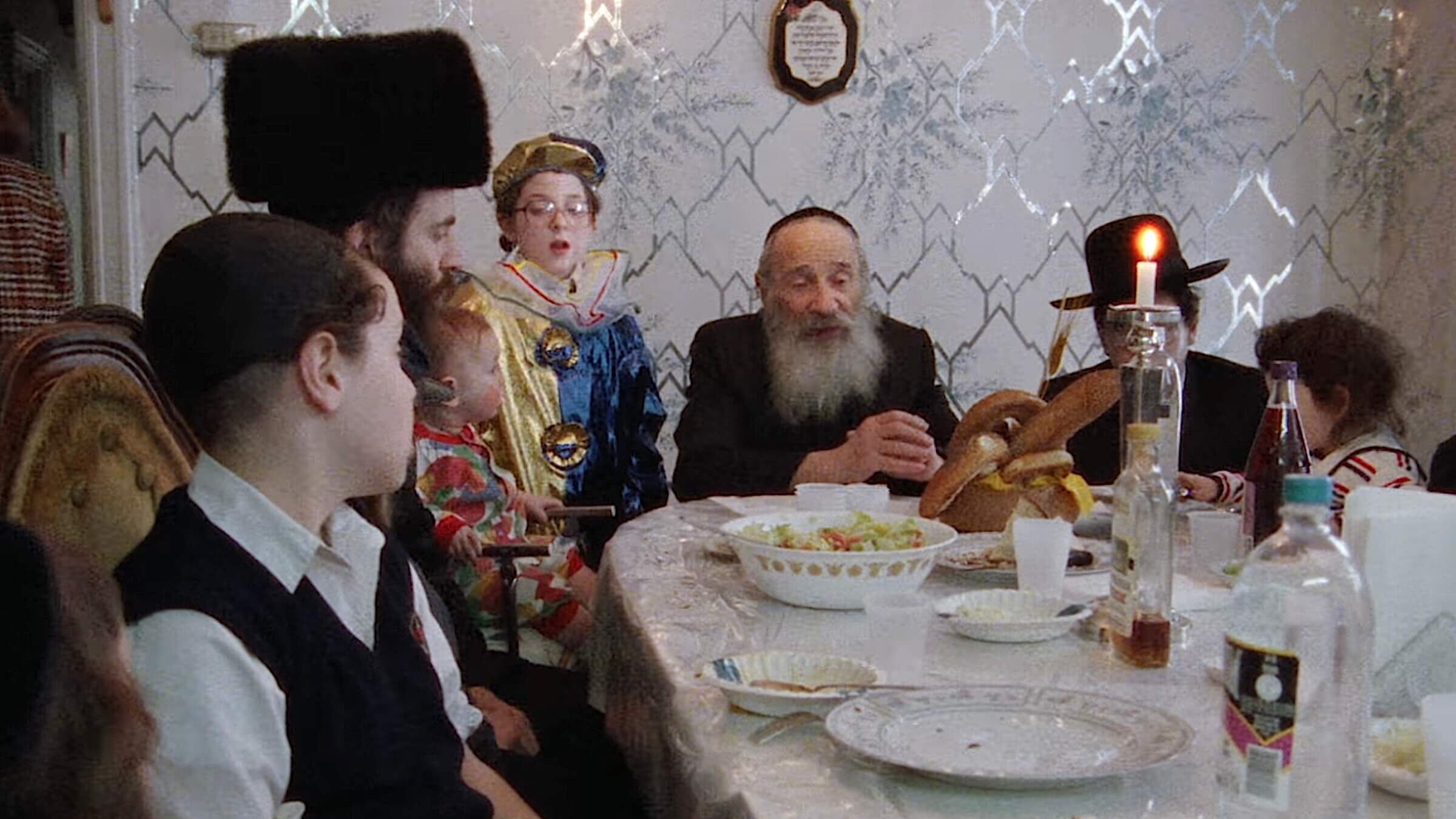
A scene in Yiddish of a Hasidic family celebrating Purim. Courtesy of Oren Rudavsky
By Rukhl Schaechter January 27, 2026
Menachem Daum (1946-2024) was not your typical Orthodox Jewish filmmaker. In his work, the late director often strove to find common ground between Jews and non-Jews, Orthodox and secular Jews, Polish Catholics and Jews (which he wrote about in these pages) and even between Palestinians and Holocaust survivors.
Fordham University is hosting a free retrospective of his films at Lincoln Center in New York. Called “Hidden Sparks,” the retrospective kicks off with Daum’s 1997 work A Life Apart: Hasidism in America — the first in-depth documentary portrait of Hasidim in New York City, produced and directed by an insider who knew the community intimately. The film is narrated by Leonard Nimoy.
In the documentary, we see a grandfather chatting in Yiddish with his children and grandchildren at home on Purim; a lively scene at the local butcher’s, and a young African-American’s unexpected reaction to a group of Hasidic men engaged in the tashlikh ritual in Brooklyn.
The film will be followed by a panel discussion that includes anthropologist Ayala Fader; filmmaker Oren Rudavsky (Daum’s frequent co-producer and co-director) and Daum’s wife, Rifke Daum.
On Tuesday, Feb. 3, 2026, Fordham will also host a screening and discussion of Hiding and Seeking: Faith and Tolerance after the Holocaust — a documentary that follows Daum as he travels with his two grown sons to the Polish village of Dzialoszyce to track down the Christian farmers who hid their family from the Nazis.
What’s fascinating about the film is the obvious reluctance of his sons, married yeshiva students, to go on the trip at all, poking fun at their father’s liberal attitude towards the Poles — and then seeing their reaction when they finally meet the now-aging children of those farmers.
As Daum put it: “A Life Apart was our attempt to humanize Haredim for outsiders. Hiding and Seeking is our attempt to humanize outsiders to the Haredim.”
The post-screening discussion for Hiding and Seeking will include the Polish-born historian Natalia Aleksiun, filmmaker Oren Rudavsky, and Daum’s son, Tzvi Dovid Daum. To register for the film, go here.
The retrospective also includes the 2026 film The Ruins of Lifta (2016), a documentary centered around the only Arab village abandoned in the 1948 Arab-Israeli war that wasn’t destroyed or repopulated. It will be followed a week later by a conversation with Israeli historian Hillel Cohen about the legacy of The Ruins of Lifta.
There will also be a screening of portions of Menachem Daum’s unfinished film Memory Keepers, about a group of non-Jews — mostly Christian Poles — working to restore and preserve Jewish cemeteries in Poland.
The film retrospective, which takes place at the McNally Amphitheater in Manhattan, runs from Jan. 27 — Feb. 17. For more information and to register, go here.
This is a moment of great uncertainty. Here’s what you can do about it.
We hope you appreciated this article. Before you go, we’d like to ask you to please support the Forward’s independent Jewish news this Passover. All donations are being matched by the Forward Board - up to $100,000.
This is a moment of great uncertainty for the news media, for the Jewish people, and for our sacred democracy. It is a time of confusion and declining trust in public institutions. An era in which we need humans to report facts, conduct investigations that hold power to account, tell stories that matter and share honest discourse on all that divides us.
With no paywall or subscriptions, the Forward is entirely supported by readers like you. Every dollar you give this Passover is invested in the future of the Forward — and telling the American Jewish story fully and fairly.
The Forward doesn’t rely on funding from institutions like governments or your local Jewish federation. There are thousands of readers like you who give us $18 or $36 or $100 each month or year.
Support our mission to tell the Jewish story fully and fairly.