Rediscovering the ‘Dybbuk’ composer Henokh Kon
Kon, who also composed the score for the restored film ‘Al Khet,’ infused Hasidic melodies with modernist expressionism
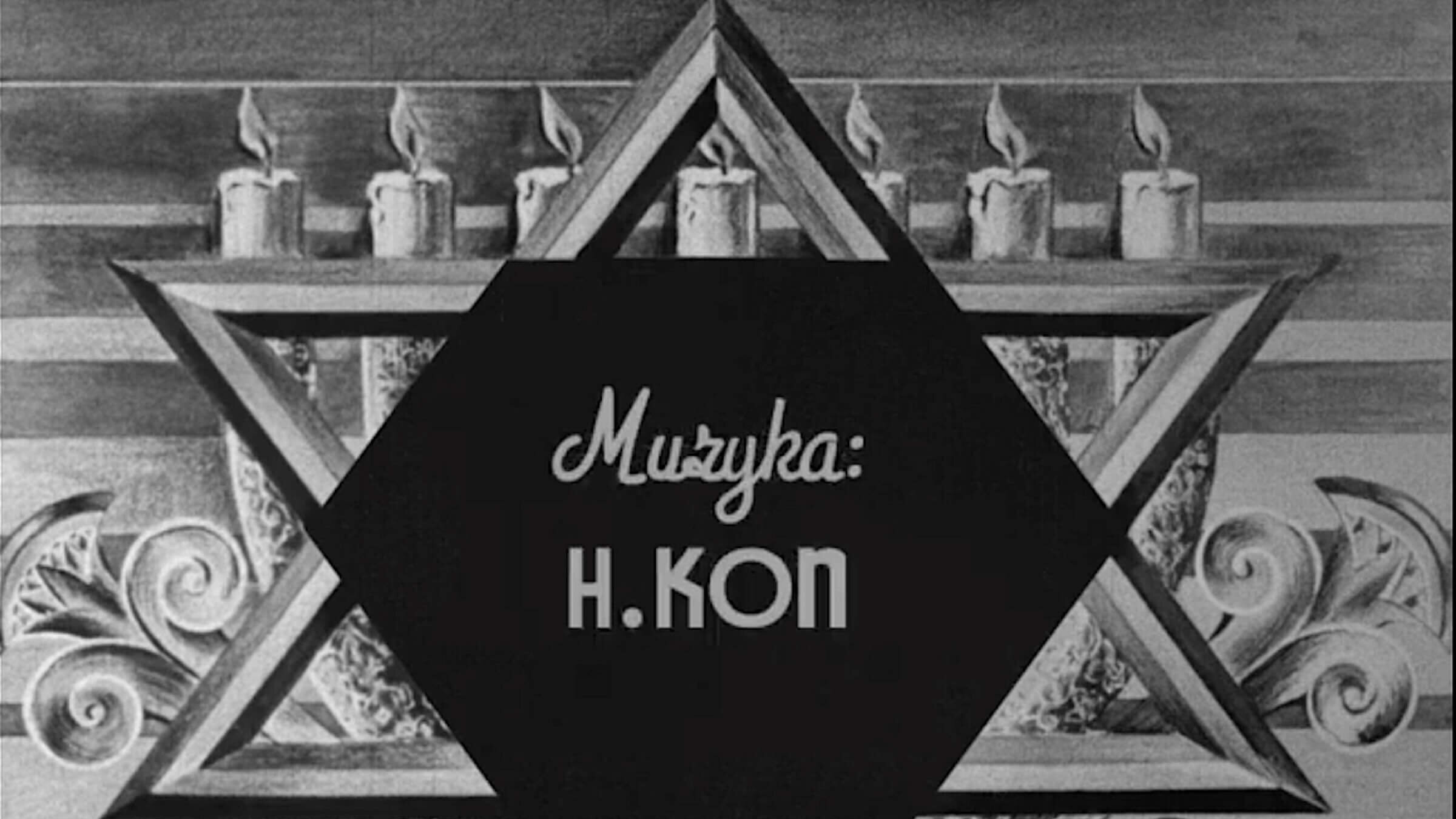
The film credit for Henokh Kon in the 1937 film ‘The Dybbuk’ Courtesy of the National Center for Jewish Film
When the 1936 Polish Yiddish feature Al Khet (I Have Sinned) screened at the New York Jewish Film Festival last month after a decades-long restoration process, seeing the film was cause for celebration.
Hearing the soundtrack was my greatest joy. It was scored by one of my favorite Yiddish composers, Henokh Kon, who created the music for the 1937 film classic The Dybbuk. In his heyday between the world wars, Kon was already renowned as a prolific creator of catchy songs and sophisticated multi-genre instrumental repertoire, even years before his first film commissions.
My ears perk up for Kon’s distinctive, eclectic sound textures (as well as ingenious folk-stylized song repertoire) — from the iconic dance sequences of The Dybbuk, to angst-driven passages in the Bundist quasi-documentary Mir Kumen On (called Children Must Laugh in English), to darkly ironic background cues for the low-budget Freylekhe Kabtsonim (Jolly Paupers).
I heard a signature sonic palette: Brightly dissonant chords, off-kilter rhythmic patterns on moody drums, frantic flurries of plucked violins, haunting exotic double-reed instrumental leads (played by the oboe’s English horn cousin, or by bassoon) alternating with more klezmer-standard clarinet, flute or fiddle.
Kon soundtracks often juxtapose traditional Jewish modal scales with more angular chromatic passages. An opening scene in Al Khet features a lovely subdued range of his orchestration punctuated by a triangle chiming downbeats as though to clarify the air during a montage of shtetl vistas. Later in the film, Kon crafts a vibrant, sultry tune for Ruth Turkow (the real-life daughter of actor-directors Zygmund Turkow and Ida Kaminska) to sing from her parlor keyboard: “Zing zhe mir a lidele” (“Sing me a little song”) with a tango lilt.
I admire Kon the alchemist, infusing Hasidic melodies with both modernist expressionism and baroque techniques, as well as Kon the entertainer, gifted at popular singable hits. (He also set “Yosl Ber” — a humorous song about a Jewish soldier — and even led a Warsaw jazz band for a secular New Year’s Eve Jewish ball.)
Kon was equally in demand for dramatic and satirical stage projects in an ever-shifting constellation of visionary writers, artists, production teams and performers that propelled Yiddish cultural movements of the 1920’s and ’30s.
Like many artists involved in interwar Jewish Poland’s kleynkunst (cabaret-style entertainment) and experimental performance scenes, Kon had himself grown up “between two worlds” (which, by the way, was the original title of the Dybbuk author An-sky’s groundbreaking play). Born in 1890 into a religious household in the Polish industrial city of Lodz, Kon was sent at age 12 to live with his grandfather, a rabbi in Kutno, since his family hoped the boy would become a yeshiva scholar.
Instead, intrigued by listening to klezmer musicians and badkhns (wedding entertainers), Kon followed a more creative path, and was sent as a teenager to Berlin to study at a royal music academy for several years. But homesickness for his Jewish roots led him back to Poland.
Arriving in Warsaw in 1912, he found creative encouragement and connections through the literary salons hosted by the classic Yiddish writer Y.L. Peretz and the Yiddish playwright and actress Tea Arciszewska. Peretz insisted that Kon compose settings for his poetry, and later Kon scored the premiere of Peretz’s groundbreaking expressionist stage play A Night in the Old Market.
In the cultural upheaval and ferment following WWI, Kon garnered various commissions from the Vilna Troupe, but more regularly partnered with the charismatic writer and impresario Moishe Broderzon for a series of collectivist performance projects, often with a leftist political edge.
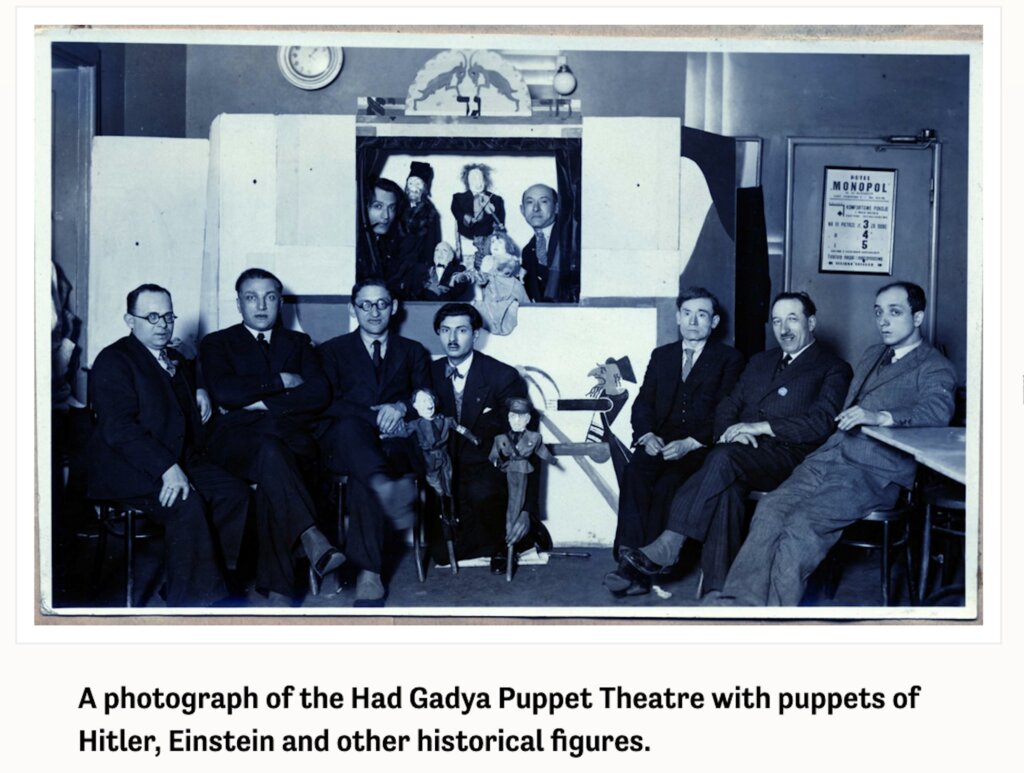
All these productions used titles referring to radically reimagined Jewish culture. Their popular 1922 puppet parody company “Khad Gadye” — a Passover reference — was followed in 1924 by their ambitious yet low-budget, biblically-based modernist opera Bas-Sheve (Bathsheba, King David’s lover and future wife). When a lead singer fell ill, Kon sang his bass part from behind the piano.
Two visionary variety-show format “revue” theater collaborations by Broderzon and Kon came next. The first collaboration was the mid/late 1920’s variety theater collective Azazel (Scapegoat), famously rhyming with shlimazel which you hear in Broderzon and Kon’s “Azazel Shimmy” — a song that all of Jewish Warsaw used to hum. The Yiddish actress and playwright “Totshe” Arciszewska, whom Kon knew before WWI, was another key player in this group.
Broderzon next established the theater collective Ararat, the acronym for the Artistic Revolutionary Revue Theater, but also referring to Mt. Ararat, the place where Noah’s ark landed after the flood, signifying a fresh start.
From the later 1920’s til the early 1930’s in the legendary Ararat kleynkunst ensemble, Kon became well-acquainted with several cultural figures he would also soon write for in celluloid format. Dzigan and Schumacher, the comedy duo, first brought together for Polish-Yiddish audiences through live shows with Ararat, played supporting roles in the film Al Khet, adding humor to the screen melodrama.
The following year the pair starred in Freyklekhe Kabtsonim, scripted by Broderzon, the same guy who had introduced them via Ararat — and set in Lodz, where their comedy team had started with Kon and Broderzon’s collaboration.
Most significantly for Kon himself, the dancer Judyta [Judith] Berg joined Ararat. Kon encouraged her choreographic innovations, accompanying her solo dance concerts and using his established celebrity to draw elite Warsaw audiences for her in 1934. By the time the prestigious cinematic version of The Dybbuk was cast, Berg was not only recruited as choreographer, she also performed in white skull mask and tallis for the toytn-tants (Dance of Death) accompanied by Kon’s evocative music, the indelible Dybbuk scene for which she and Kon are best known. Kon and Berg became a romantic couple as well, though it’s not clear whether they ever married.
Like Kon, Berg had grown up influenced by Hasidic culture around her and then studied in Germany. At various Jewish celebrations, her grandmother led women’s dancing and told Judith about older traditional dance forms like the toytn-tants, while her brother would hold open the door so she could watch the men’s group dancing.
Later Berg went to Dresden, Germany, for intensive classes with modern dance pioneer Mary Wigman. (During the rise of Hitler, Judith and other Jewish dance students left Wigman’s school and Germany altogether.) In the late 1930’s, she and Kon escaped the Nazis separately, but Berg’s niece Yvette Metral told me she recalled seeing Kon once in 1948-49 when he came to visit her aunt at the dance school Berg established for Jewish survivor children in Wroclaw.
Kon’s legacy is being rediscovered in numerous recent cultural explorations. “Bas-Sheve,” the opera he wrote with Broderzon, was performed in 2019 at Yiddish Summer Weimar, based on a rediscovered partial piano score, with major arranging and re-imagining by klezmer performer Josh Horowitz and added libretto portions devised by the writer and Yiddish translator Michael Wex. This piece will soon be performed again by the UCLA Philharmonia.
Also in recent years, much research and revival effort has focused on two works for which Kon composed, presented by the avant garde leftist theater troupe Yung teater, both based on landmark American trials which galvanized political movements. One show, called “Boston,” is about Sacco & Vanzetti, and the other, “Mississippi,” is about the Scottsboro Boys. Small wonder that a quote from the leftist anthem “Internationale” found its way into Kon’s score for Mir Kumen On (the Bundist film already under threat by Polish censors).
Last December brought us the diasporic Yiddish puppet show The Trial of Modicut, directed by Yael Horowitz, who gave a conference presentation on Kon, Broderzon and their Azazel Shimmy in 2025. Splendid music for the Modicut show was performed by the duo of Raffi Boden (cello/music director) and Ira Temple (accordion), which at one point featured a gorgeous adaptation of one of Kon’s most recognizable orchestrated Dybbuk motifs, graced by a fluffy puppet sheep.
While my musician friends who took part in the puppet show seemed unaware of the composer’s name, the spirit of his creation lives on in their fusion of conservatory training, deep klezmer chops, respect for cultural ancestors and antic humor aimed at serving the creative proletariat.
This is a moment of great uncertainty. Here’s what you can do about it.
We hope you appreciated this article. Before you go, we’d like to ask you to please support the Forward’s independent Jewish news this Passover. All donations are being matched by the Forward Board - up to $100,000.
This is a moment of great uncertainty for the news media, for the Jewish people, and for our sacred democracy. It is a time of confusion and declining trust in public institutions. An era in which we need humans to report facts, conduct investigations that hold power to account, tell stories that matter and share honest discourse on all that divides us.
With no paywall or subscriptions, the Forward is entirely supported by readers like you. Every dollar you give this Passover is invested in the future of the Forward — and telling the American Jewish story fully and fairly.
The Forward doesn’t rely on funding from institutions like governments or your local Jewish federation. There are thousands of readers like you who give us $18 or $36 or $100 each month or year.
Support our mission to tell the Jewish story fully and fairly.