Patrizia von Brandenstein’s Designs On David Mamet
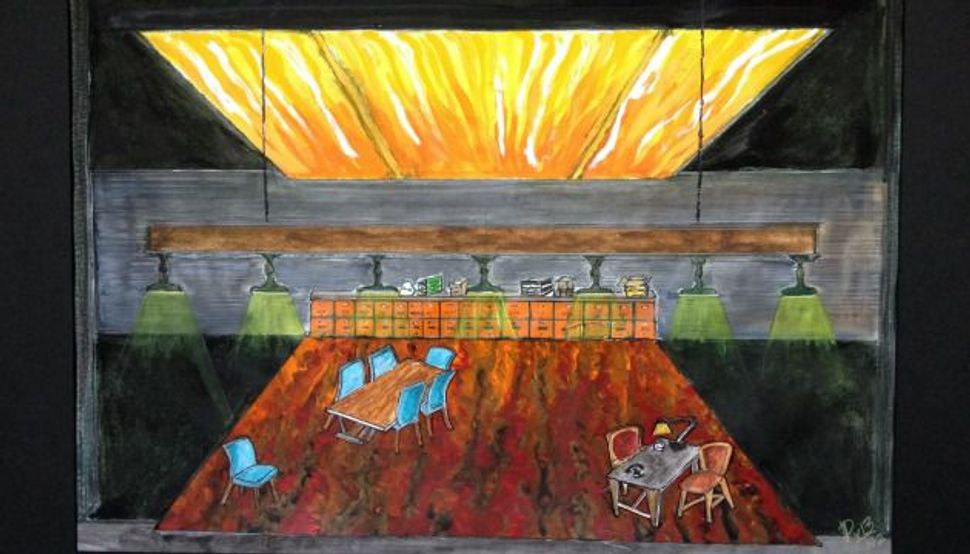
Mamet in Color: Patrizia von Brandenstein?s original color scheme for ?The Anarchist? was much more vibrant than the one that David Mamet ultimately approved. Image by Courtesy Patrizia von Brandenstein

By Adam Langer December 21, 2012
For Academy Award-winning designer Patrizia von Brandenstein, the process of designing “The Anarchist” began with a series of exchanges with the drama’s author David Mamet. A visual consultant on the Mamet-scripted film “The Untouchables,” von Brandenstein more recently designed a not-yet-aired HBO biopic about Phil Spector that Mamet wrote and directed.
“Mamet and I got along famously. I’ve always admired his ability both to abstract ideas and to physicalize abstract thought,” von Brandenstein told me when I met her in November in her Chelsea apartment a week before “The Anarchist” opened. She shares the apartment with her husband, designer Stuart Wurtzel (“Hester Street,” “Hannah and Her Sisters”).
At the beginning of their collaboration on “The Anarchist,” which starred Patti LuPone as an imprisoned terrorist and Debra Winger as a sort of warden, Mamet encouraged von Brandenstein to contemplate the concept of prison. “He told me that there are all kinds of prisons,” she said. “He said, ‘Solzhenitsyn writes about some and Hemingway writes about some and I write about some, but there are many different kinds and people often make them for themselves. Sometimes, long before they go to prison, they are in a prison of their own creation.’”
She began by researching old office furniture. “I would mail him my sketches and he would say ‘nope, nope, nope, think again,’” she said. “Sometimes, he would send me a book which had nothing to do with the subject of his play, at least not apparently. We talked a lot about the works of Dawn Powell.”
Occasionally, von Brandenstein and Mamet discussed politics — she calls herself an “old lefty” and Mamet a “Goldwater Republican,” but says these differences didn’t affect their working relationship. “I’ve worked with big-time crazies, I don’t care what their politics are,” she said. “Mamet’s very intellectual and he has found comfort in faith. As a secular Jew, I don’t really understand that in the modern world, but I can applaud people with that kind of commitment.”
As von Brandenstein continued working on “The Anarchist,” her designs became more abstract. “I found myself losing more and more of what was real,” she said. “Finally, I thought of a huge wall — nothing so common as brick or cinder block — a wall that was both concrete and abstract. Ultimately, we ended up with a wall of file cabinets across the back of the stage.”
As far as colors were concerned, Mamet gave von Brandenstein a book of airplane colors, suggesting she study World War II planes. She sketched orange file cabinets, a red floor, a golden yellow ceiling, and turquoise chairs. But ultimately, Mamet decided the colors were too vibrant and would detract from the play — an apt metaphor, perhaps, for the Broadway production itself, which suggested an artwork from which all color had been leeched.
“Everything became gray and brown. All that was left was the turquoise chairs,” von Brandenstein said. “It killed me to give up that red floor. But the more I think about it, the more I think Mamet was right. His characters are both imprisoned in a way, and that’s expressed very well by the lack of color.”
This is a moment of great uncertainty. Here’s what you can do about it.
We hope you appreciated this article. Before you go, we’d like to ask you to please support the Forward’s independent Jewish news. All donations are still being matched by the Forward Board - up to $100,000 until April 24.
This is a moment of great uncertainty for the news media, for the Jewish people, and for our sacred democracy. It is a time of confusion and declining trust in public institutions. An era in which we need humans to report facts, conduct investigations that hold power to account, tell stories that matter and share honest discourse on all that divides us.
With no paywall or subscriptions, the Forward is entirely supported by readers like you. Every dollar you give is invested in the future of the Forward — and telling the American Jewish story fully and fairly.
The Forward doesn’t rely on funding from institutions like governments or your local Jewish federation. There are thousands of readers like you who give us $18 or $36 or $100 each month or year.

Support our mission to tell the Jewish story fully and fairly.