Seeing Double in Deadwood
The HBO drama “Deadwood” chronicles its namesake: the historic gold-rush town of 1877, legendary for its alleged frontier lawlessness and for such infamous characters as “Wild Bill” Hickok and Calamity Jane. A rarity among Westerns, “Deadwood” depicts the gold rush’s multiracial and multiethnic community, including a tip of the hat to the “pioneering” Jews of the frontier. Created and executive produced by David Milch of “NYPD Blue” fame, “Deadwood” was nominated for 11 Emmys and two Golden Globes in its first season. Most recently, the American Film Institute ranked it one of the 10 best television shows of 2005.
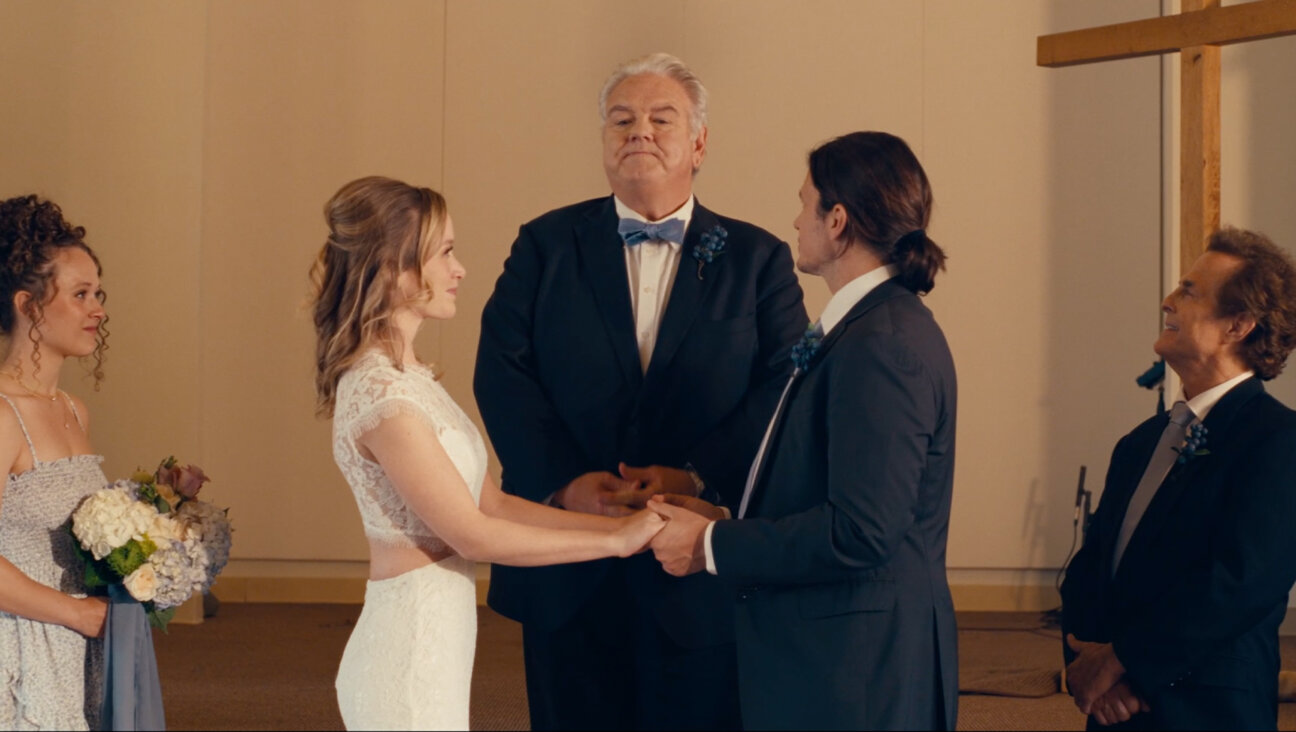
Sol Star, the show’s token Jewish character, comes to Deadwood with his partner, Seth Bullock, the Western’s ubiquitous reluctant sheriff. Making money off fools sifting for gold, the two set up a hardware store and sell the tools of the gold trade. A single man, Star is infatuated with one of the town whores, Trixie. Unlike other men in the community, Star treats Trixie with respect, teaching her to read and write. Characterized for his politeness, business decorum, good prices and honest dealings, Star is a rare likable guy in Deadwood. Where profanity and violence run rampant, his politeness is noted.
Ultimately, Star is a Jewish man whom we all know. He is courteous, passive and fit to be a good husband. His very presence on “Deadwood” broadens the American West beyond cowboys and Indians, John Wayne or even Clint Eastwood, while simultaneously taking the American Jew out of Jerry Seinfeld’s or Woody Allen’s New York. But while Sol Star is certainly new, is he fresh?
In contrast to many of the other shows discussed in this section, “Deadwood” — with just two seasons under its belt — is a veritable newbie. Yet, even given its relative newness, Sol remains a frustratingly one-dimensional character. Many of the others come on to the little screen with back stories of how and why they came to such a dangerous, lawless territory. Star does not. Instead, the viewer must be content knowing that his origins are in Vienna — and, like his people before him, he grubs for money. The lack of depth even extends into the Jewishness that is essential to his character; the sole way that viewers understand his marginalized identity is by his constant dodging of anti-Jewish slurs — most of which concern money. Indeed, while “Deadwood” is a new approach to the standard Western, its slant on the Jew is old and tired: Take Sol out of lawless Deadwood, and he boils down to a brand of Jew that is on television at any given time of day.
Creator and executive producer Milch appeared on a panel discussion at New York’s 92nd Street Y to discuss Jews and the West. He explained that Sol Star appealed to him because of what he terms Sol’s “secret identity.” “I felt I encountered in Sol Star a paradigm of of doubleness,” Milch said. “Even contemporary Jewish people have a double feeling. The extent to which we acknowledge our Jewishness is varying.”
Sol’s Jewish identity is in fact hidden, but one of the beauties of television has been the window it offers into these secret parts of characters’ lives. Still, the show is young. Hopefully, when we sit down to the next season of “Deadwood,” it will do for Sol what it has done for its other characters and for American history more generally –– make him complicated.
Haley Michaels Pollack is a graduate student of American history at the University of Wisconsin, Madison.
This is a moment of great uncertainty. Here’s what you can do about it.
We hope you appreciated this article. Before you go, we’d like to ask you to please support the Forward’s independent Jewish news this Passover. All donations are being matched by the Forward Board - up to $100,000.
This is a moment of great uncertainty for the news media, for the Jewish people, and for our sacred democracy. It is a time of confusion and declining trust in public institutions. An era in which we need humans to report facts, conduct investigations that hold power to account, tell stories that matter and share honest discourse on all that divides us.
With no paywall or subscriptions, the Forward is entirely supported by readers like you. Every dollar you give this Passover is invested in the future of the Forward — and telling the American Jewish story fully and fairly.
The Forward doesn’t rely on funding from institutions like governments or your local Jewish federation. There are thousands of readers like you who give us $18 or $36 or $100 each month or year.

Support our mission to tell the Jewish story fully and fairly.