US and Iran agree to ‘fragile’ 2-week ceasefire; Israel says deal does not extend to Lebanon
Israelis have been told to remain alert and ready to reach bomb shelters
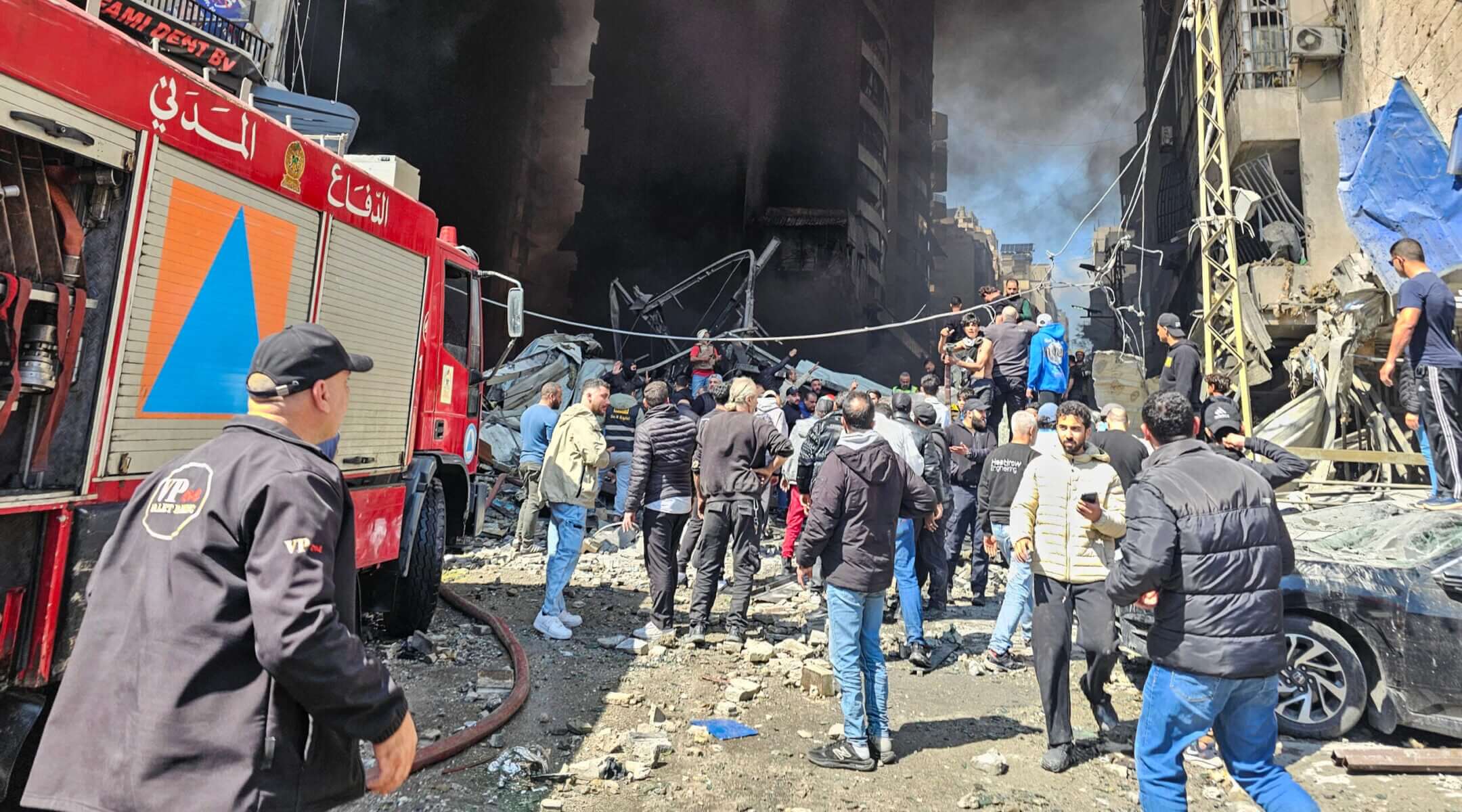
First responders and residents stand amid rubble at the site of an Israeli airstrike in Beirut’s Corniche al-Mazraa neighborhood on April 8, 2026. Photo by AFP via Getty Images
(JTA) — Israel struck Hezbollah targets in Lebanon on Wednesday as a tenuous ceasefire took hold in its monthlong war with Iran, which it has conducted jointly with the United States.
U.S. President Donald Trump and the prime minister of Pakistan, which brokered the truce talks, announced the two-week halt in hostilities late Tuesday, as Trump’s deadline for Iran to open the Strait of Hormuz or risk annihilation neared. Vice President JD Vance called “fragile” as Iranian officials said they would keep their “finger on the trigger” in case of further attacks.
Israel said it would abide by the truce but said the deal did not extend to Lebanon, where Hezbollah, an Iranian proxy, is based — despite comments by Pakistan’s prime minister asserting the opposite.
Hezbollah joined the Iran war shortly after the United States and Israel launched it with a wave of strikes on Feb. 28; it has since pummeled northern Israel with hundreds of rockets, causing damage, disruption and death.
Israel’s Home Front Command, the military unit advising civilians, said there would be no immediate changes to guidelines barring large gatherings and that Israelis should still be prepared to find shelter in the case of sirens warning them of incoming missiles.
Israeli Prime Minister Benjamin Netanyahu reportedly urged Trump not to agree to a ceasefire, arguing that pausing attacks meant to curb Iran’s nuclear threat would carry risks. On Wednesday, after the ceasefire set in, Trump said on Truth Social that there would “no enrichment of Uranium, and the United States will, working with Iran, dig up and remove all of the deeply buried (B-2 Bombers) Nuclear ‘Dust,’” signaling a commitment to reining in Iran’s nuclear program.
Trump also said the United States had concluded that Iran “has gone through what will be a very productive Regime Change.” Trump cited regime change as one of multiple evolving goals of the war. After the assassination of Iran’s supreme leader, Ayatollah Ali Khamenei, on the war’s first day, Iran appointed his son Mojtaba to take his place; Mojtaba, a hardliner, was injured and may remain comatose, U.S. intelligence reportedly believes.
This article originally appeared on JTA.org.
I’m personally matching all gifts to the Forward, up to $36,000. Can I match your gift now?

Hello, fellow Forward reader! I’m Joel Brown, a Forward reader and supporter for more than 15 years, and currently the chair of the board of directors.
I’m an avid Forward reader because it ticks so many of my essential boxes: excellent journalism, Jewish focus and diverse viewpoints. In today’s political climate, what I most appreciate is the Forward’s independence — made possible by the generosity of its membership.
The Forward is committed to bringing you unbiased, nuanced Jewish news. From my position as board chair, I see an exciting future as we expand our position as the definitive independent voice of contemporary American Judaism.
— Joel Brown, Forward board chair
Support our mission to tell the Jewish story fully and fairly.