At Eurovision, Israel’s near triumph shows the limits of tolerance
Amidst booing on the streets of Vienna and accusations of manipulation, Israel finished second and I felt something close to relief.
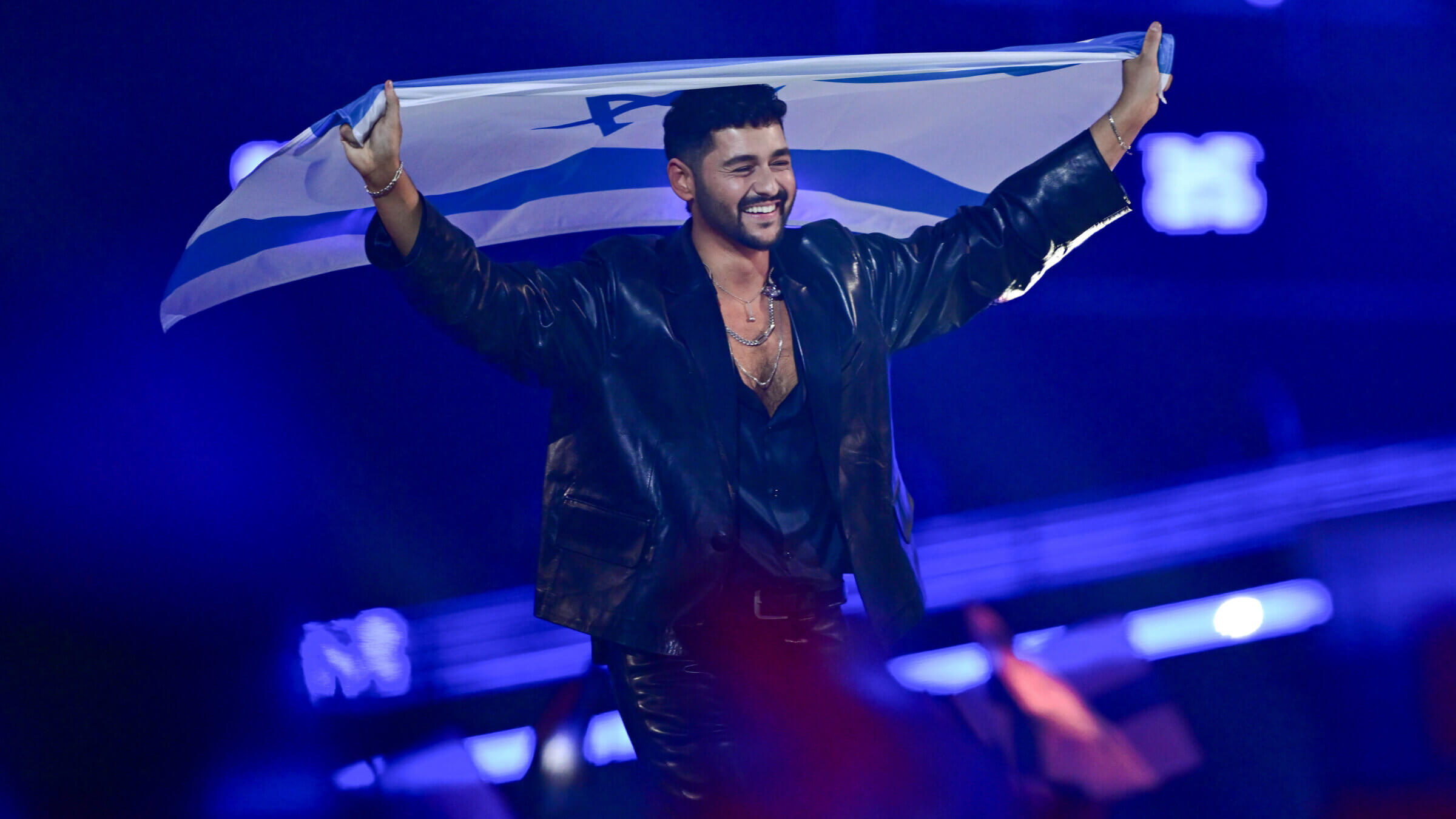
Noam Bettan representing Israel walks into the grand final carrying the Israeli flag during the Grand Final of the 70th Eurovision Song Contest at Wiener Stadthalle on May 16, 2026. Photo by Christian Bruna/Getty Images

By Anna Goldenberg May 17, 2026
VIENNA — A kaffiyeh was blocking my view, and it bothered me less than I would have expected.
It was around 9:30 p.m., and I was standing outside Vienna’s city hall, where the city had erected a “Eurovision village.” The pan-European singing competition was taking place in the former Habsburg capital, grand architecture framing massive public viewing screens.
Security was tight. Visitors weren’t allowed to bring bags inside the area, and we were patted down by two separate guards before we were allowed to enter. In August 2024, a foiled terror attack led to the cancellation of three Taylor Swift concerts, an international embarrassment authorities were keen not to repeat.
And then there were the protests over Israel’s participation.
The day before, an anti-Israel solidarity concert had featured a video call with Unorthodox author Deborah Feldman, who said she was protesting the “whitewashing” of a genocide. A separate “song protest” reportedly escalated from chants of “One love” to “Death, death IDF.” Earlier that day, demonstrators had marched along Vienna’s main shopping boulevard. By the time evening rolled around, a group of clowns had gathered outside the parliament, practicing creepy, Joker-like laughs and holding signs that said “United by Genocide,” a play on the Eurovision Song Contest’s slogan. “United by Music.”
For a contest that insists on being apolitical, Eurovision had become unmistakably political.
I didn’t care much for the music, but world events were unfolding here in Vienna, and I wanted to see them up close.
Israeli singer Noam Bettan was the third to perform. As he got on stage and started singing “Michelle,” a couple of people in the crowd I was standing in started shouting “Free Palestine” at the screen. The chants weren’t loud enough to drown out the performance
Then, someone in front of me raised a kaffiyeh, stretching it between both hands and waving it in the air. It blocked my view. I considered asking him to lower it. But did I really want to risk a confrontation? Instead, I stepped sideways – slightly annoyed, but telling myself this was the price of tolerance.
Only later that night did I begin to wonder whether tolerance was, in fact, a shared value.
Back home, I watched the voting. Just before 1 a.m. the audience vote catapulted the Israeli act into the lead. In the previous two years, Israeli entries had also performed strongly with viewers, placing first and second in the public vote without winning overall. The reasons have been debated: diaspora support, savvy promotion, or simply songs that fit the Eurovision formula — catchy, theatrical, sung with a powerful voice. (Israel has won the competition four times, most recently in 2018.)
Israel’s promotional efforts have drawn criticism, but no evidence of manipulation has emerged, and the public broadcaster KAN has responded quickly to European Broadcasting Union reprimands.
It didn’t matter. Social media filled with accusations that Israel had cheated. In the arena, just before Bulgaria’s points were announced, the booing aimed at Israel’s entry grew so loud it was clearly audible on the broadcast.
Bulgaria won, Israel came in second, and I felt something close to relief. At a time when several countries had already stayed away and others were wavering, it seemed less like a celebration than a breaking point. I wouldn’t want to witness what would happen if Eurovision were to be held in Israel next year.
It had been easy to move when the kaffiyeh blocked my view. One step to the side, and the problem was gone. However, there was no stepping aside from what came later. Freedom of speech is about making space, but it can also be used to close it.
I’m personally matching all gifts to the Forward, up to $36,000. Can I match your gift now?

Hello, fellow Forward reader! I’m Joel Brown, a Forward reader and supporter for more than 15 years, and currently the chair of the board of directors.
I’m an avid Forward reader because it ticks so many of my essential boxes: excellent journalism, Jewish focus and diverse viewpoints. In today’s political climate, what I most appreciate is the Forward’s independence — made possible by the generosity of its membership.
The Forward is committed to bringing you unbiased, nuanced Jewish news. From my position as board chair, I see an exciting future as we expand our position as the definitive independent voice of contemporary American Judaism.
— Joel Brown, Forward board chair
Support our mission to tell the Jewish story fully and fairly.