How can I live freely as a Jew in a world where strangers rip my mezuzah off my doorframe?
Jewish life began to be more defined by fear long before the Oct. 7 attack
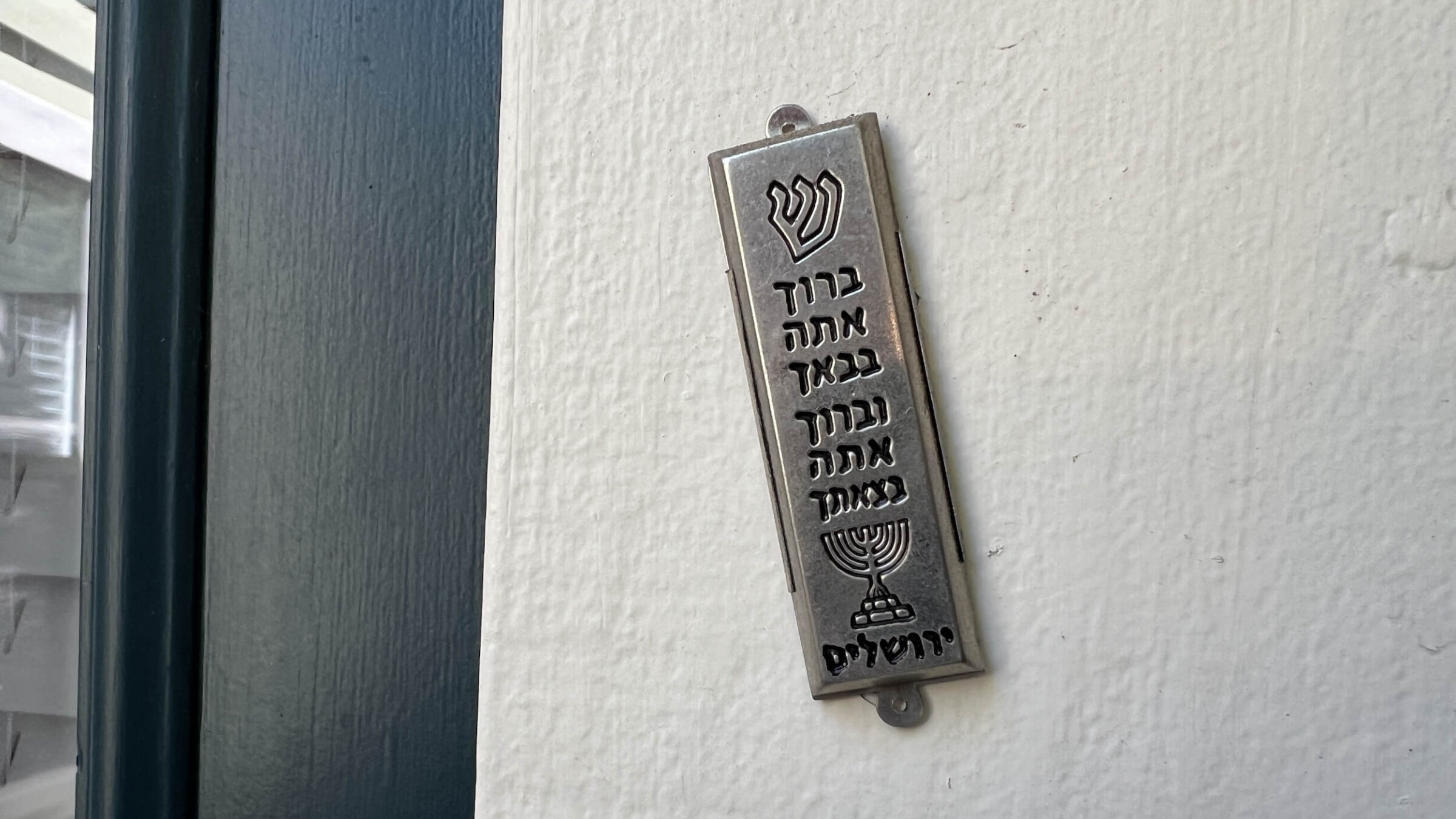
A mezuzah attached to a door frame. Photo by Smith Collection/Gado/Getty Images
Twice, the mezuzah on my front door was ripped off.
The first time, I was shocked. The second time, I made a decision that still pains me. I did not put it back up.
This was before the Hamas attack of Oct. 7, 2023.
That is the part I keep coming back to. The fear did not begin after the Hamas attacks. It was already there, intruding with the quiet calculation of whether a small Jewish symbol on my home made me less safe.
A mezuzah is not a political statement. It makes no argument about a government or a war. It is a sacred object, a marker of memory, a tiny declaration that says: Jews live here. I thought about that mezuzah again recently when the Anti-Defamation League released its annual audit showing that antisemitic physical assaults in the United States reached record highs in 2025. That increase reflects something many Jews already feel in daily life: the slow erosion of ease, the daily calculation of whether to speak up or stay quiet — things I have felt since the first time my mezuzah was violently torn off my doorframe.
Since then, the realm in which I feel safe as a visibly Jewish person has been shrinking from all directions.
After the Oct. 7 attack, the bulletin boards in my apartment building began filling with calls to boycott Israel. Campaign flyers for a Jewish political candidate who came to speak there were defaced with Hitler mustaches. I learned to scan the walls before I scanned my mail.
This was not happening on a campus quad or in some distant place. It was happening where I live.
Then, among my mother’s things, I found a Star of David necklace from the 1930s — marcasite set against black onyx, delicate and old. A boyfriend had given it to her when they were both 14.
I put it on in Florida, where I spend much of my time caring for my mother. I loved wearing it. It felt like more than jewelry. It felt like inheritance, memory, and a small way of carrying my family with me.
But when my mother knew I was going back to New York, she told me to take it off.
My mother is 102. She is not easily frightened. She has lived long enough to know when the temperature in the room has changed. She was not making a political argument. She was trying to protect her daughter.
I still wear that Star of David. But I admit I am selective. In New York, there are moments when I leave it visible and moments when I tuck it under my shirt. That calculation itself tells me something about the world I am moving through.
Recently, in a private Facebook group for women essayists, I shared a personal piece I had written for the United Kingdom-based Jewish Chronicle about how Oct. 7 changed life for my mother and me. It was not a political manifesto. It was a reflection on fear, Jewish identity, aging and visibility.
And still, I was attacked by other writers.“What about Gaza?” I was asked. The message was clear: even my personal Jewish pain had to pass a political test before it could be acknowledged.
That is the narrowing.
This ugliness is coming from more than one direction now. It stems from old conspiracy theories on the right and newer moral certainties in some of the progressive spaces where I once felt most at home. Different language brings about the same result: Jews become less human, less particular, less entitled to fear.
That collapse is what frightens me most: the definitional collapse between Jew and Israeli; Israeli and Israel’s government; Jewish symbol and political provocation; mezuzah and target.
As Jews like me reckon with that collapse, we must reckon with how much we’ll go along with it.
Right now, too often, Jews are being asked to choose between our own safety and our compassion for others. We should be able to prioritize both. I am a Zionist. I believe in the right of the Jewish people to a homeland. I also believe Palestinians are human beings who deserve freedom, dignity, and protection from suffering.
These beliefs should not cancel each other out. They should make us more careful, more humane, more committed to truth.
Yet now we must choose between speaking about antisemitism and being accused of indifference to other hatreds. That is no way to live.
Since Oct. 7, I have found myself going to synagogue on Shabbat, something I never did before. I was a High Holiday Jew. Now I seek out rooms where I do not have to explain why this moment feels frightening. I have learned where I feel seen. I have learned who can hold my fear without turning it into an argument.
The mezuzah I did not put back up is small. It fits in the palm of my hand.
But what it represents is not small: memory, faith, survival, home, and the right to be visibly Jewish without fear.
When I did not put it back up, I told myself I was being practical. But now — after Oct. 7, the bulletin boards, my mother’s warning, and the explosive allegations I’ve seen travel through respected media without sufficient care or verification — I understand it differently.
I was not just protecting a doorframe. I was learning to shrink.
Did you know that only 2% of Forward readers donate to support our nonprofit newsroom? That 2% make it possible for millions to read the Forward without a paywall or subscription — removing any barriers to the full and fair Jewish story.
But while the Forward is free to read, it isn’t free to produce. Big stories — like deep dives into the antisemitism data, political scoops or reporting trips to college campuses — take months of research and fact-checking. All while we keep you informed of what you need to know each day.
— Rachel Fishman Feddersen, Forward Publisher & CEO
Support our mission to tell the Jewish story fully and fairly.