Who’s responsible for deadly antisemitism? Everyone will hate the answer
A new report makes clear how profoundly both the left and the right have failed to address a growing crisis
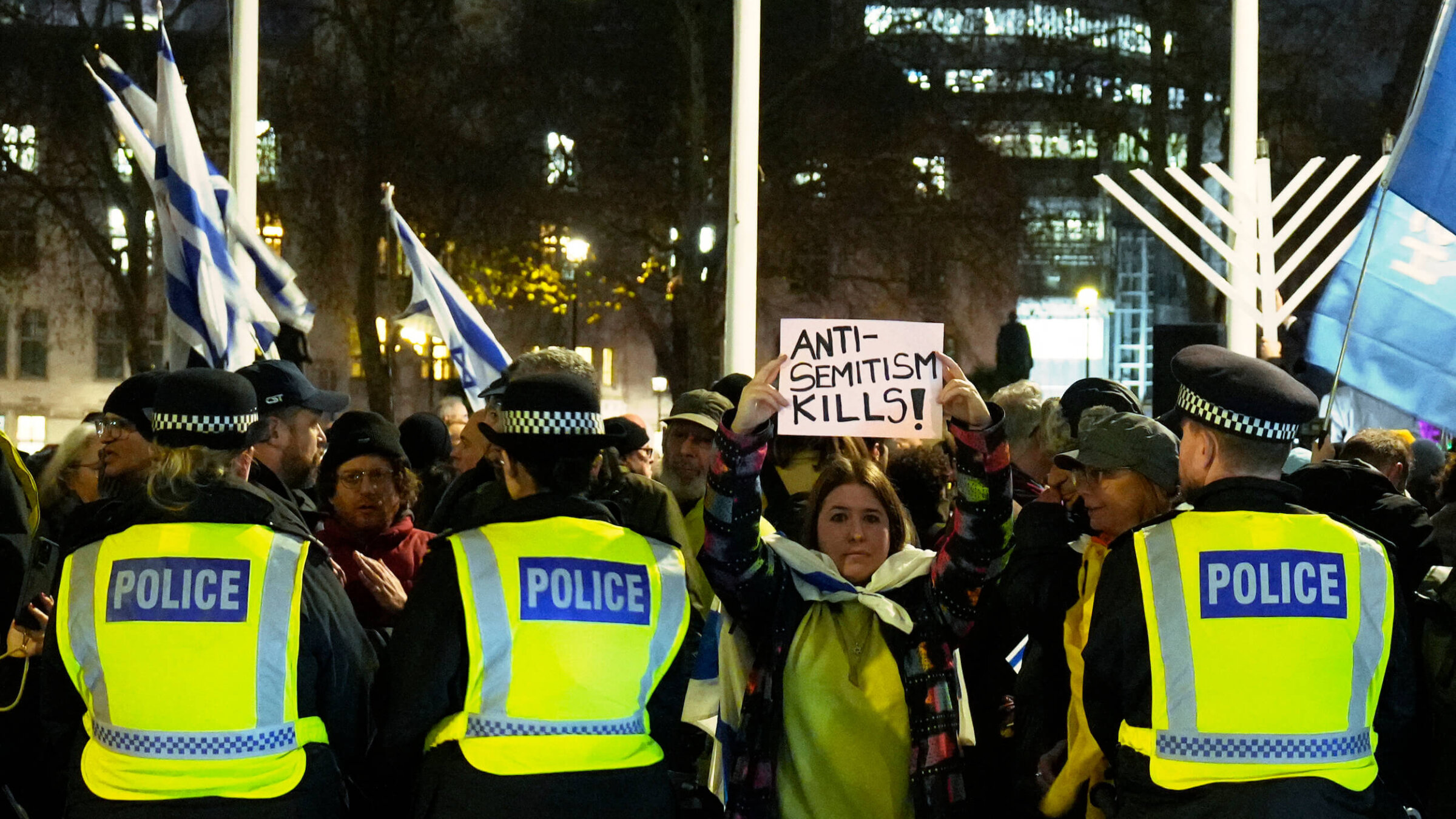
Police officers guard a Hanukkah candle-lighting organized by the Campaign Against Antisemitism and Chabad in London on Dec. 15, 2025. Photo by Carlos Jasso / AFP / Getty Images
Joel Swanson April 17, 2026
Twenty Jews outside of the state of Israel were murdered for being Jewish in antisemitic attacks across three continents in 2025, the highest death toll among diaspora Jews in more than 30 years. In every country surveyed, antisemitic incidents of all kinds — including beatings, vandalism, threats and online harassment — remain dozens of percentage points higher than they were in 2022, before the Gaza war began.
This information, released in a report from Tel Aviv University on the eve of Yom HaShoah earlier this week, should haunt everyone, regardless of political affiliation.
Neither left nor right is wholly responsible; instead, the report concludes that “rather than a backlash to a specific geopolitical crisis, high levels of antisemitism have become a normalized feature in societies with large Jewish minorities.”
What the left should hear
There is a strain of progressive opinion, particularly vocal since the Hamas attack of Oct. 7, 2023, that dismisses accusations of antisemitism as, essentially, a political weapon — a tool wielded by pro-Israel voices to silence legitimate criticism of Israeli government policy, shut down protests and conflate opposition to political Zionism with hatred of Jews.
There is some truth to this narrative. But the Tel Aviv University report reveals it has severe limitations, as well.
The Bondi Beach massacre did not happen because a government defined antisemitism too broadly. The synagogue attackers in Manchester, England did not gun down worshippers because someone misapplied the IHRA definition. The victims of attacks in Boulder, Colorado and Washington, D.C. were not statistics manufactured by an advocacy group. Twenty Diaspora Jews died violent deaths because antisemitism remains a lethal force in the world — a truth that the left, across the globe, needs to do a significantly better job addressing.
The physical assaults, murders, firebombings, and other acts of concrete violence chronicled in the report cannot be rationalized away as mere criticism of Israel. In Canada, incidents rose from roughly 2,000 in 2022 to 6,800 in 2025. In Australia, the total number of reported antisemitic incidents rose from 472 in 2022 to 1,750 in 2025 — nearly a fourfold increase in three years, including multiple arson attacks on synagogues, in addition to the Bondi Beach shooting.
The tendency among some progressives to dismiss most antisemitism complaints as presumed to be in bad-faith unless proven otherwise has real costs. When allegations of antisemitism are reflexively treated as a political tactic, it becomes easier to ignore actual antisemitism, even when it’s claiming lives and burning down religious buildings.
To be clear, there are real and important questions about how to define antisemitism, and where the line between good faith criticism of Israel as a nation-state and antisemitism against Jews as a people falls. Those questions must continue to be asked.
But when Jewish institutions are targeted and a primary political reflex on the left is to search for Israeli wrongdoing that might have “provoked” the attack, the victims are abandoned.
What the right — and the Israeli government — should hear
The Tel Aviv University report challenges progressive denial. But it challenges the Israeli government and its defenders just as directly.
The report’s authors write that Israeli politicians at the highest levels have “expanded the scope of the term ‘antisemitism,’ including through cynical and hasty declarations, drained it of meaning, and damaged the struggle against Jew-hatred.”
The government, they conclude, “has not contributed in any meaningful way to the cause” of fighting antisemitism against diaspora Jews.
This is not a minor complaint buried in a footnote. It is a central finding of the most authoritative antisemitism report on the planet, published by an Israeli university.
Consider what that behavior looked like in practice. When gunmen massacred 15 Jews at Bondi Beach in December, Israeli Prime Minister Benjamin Netanyahu’s immediate political instinct was to blame Australian Prime Minister Anthony Albanese’s government, specifically its decision to recognize Palestinian statehood at the United Nations.
“Your call for a Palestinian state pours fuel on the antisemitic fire,” Netanyahu declared — a response that made it seem like an act of violence motivated by the Islamic State was somehow part of the legitimate pro-Palestinian movement. As former Australian Prime Minister Malcolm Turnbull pointed out, the vast majority of the world’s nations recognize Palestinian statehood. Were they all complicit in Bondi?
This pattern of using the word “antisemitism” as a cudgel against any policy position that Israel’s government dislikes — whether it is recognizing Palestinian statehood, criticizing settlement expansion or questioning IDF military operations — has a corrosive effect on the fight against actual antisemitism. When the term is deployed reflexively and politically, it trains audiences to be skeptical of the label. It gives ammunition to exactly those who want to dismiss Jewish fear as manufactured. It is, in the deepest possible sense, counterproductive.
The Tel Aviv University report goes further, recommending that Israel’s Ministry for Diaspora Affairs and Combating Antisemitism be dissolved entirely, with its funding transferred instead to Israeli embassies and consulates. The author’s argument: only professionals embedded in local communities, working alongside law enforcement and educators, can actually make a difference in combatting antisemitism. Grand declarations from politicians in Jerusalem motivated more by their own domestic political considerations than by the safety of the Jewish diaspora cannot.
A need for discipline
What this report ultimately demands, from the left and the right alike, is a discipline that both sides have conspicuously failed to practice: the discipline of treating antisemitism as a separate issue from the issues of Israel, Zionism and Palestinian rights.
These issues do overlap. But they are fundamentally individual. Antisemitism is hatred of Jews as Jews, a prejudice that has existed for millennia, operates independently of any particular government’s behavior, and kills people without asking victims what they think about Israeli settlements.
The contemporary state of Israel is a nation-state which commits specific actions, many of which are worthy of criticism.
Conflating the two, in either direction, produces disaster.
On the right, treating any political position unfavorable to Israel as presumptively antisemitic weaponizes Jewish suffering for political ends and corrupts the language we need to name and fight real hatred. On the left, treating the existence of real Jew-hatred as essentially a cover story for Zionist advocacy abandons Jewish communities to violence, and prevents the kind of serious policy response that could actually reduce harm.
The people killed at Bondi Beach were not symbols in a geopolitical argument. They were not collateral in a debate about international law or protest rights. They were Jews who had gathered to celebrate Hanukkah. Their deaths — and those of the other diaspora Jews killed last year — demand better than either cynical exploitation or willful minimization by either side.
The Tel Aviv University report, to its considerable credit, refuses both postures. It counts the dead honestly. It honestly holds the Israeli government accountable. It refuses to let anti-Jewish violence be erased, and it also refuses to let that violence be used as a political instrument. In doing so, it models the intellectual honesty that this moment desperately requires.
The question is whether anyone on either side of this exhausting divide is willing to listen.
Did you know that only 2% of Forward readers donate to support our nonprofit newsroom? That 2% make it possible for millions to read the Forward without a paywall or subscription — removing any barriers to the full and fair Jewish story.
But while the Forward is free to read, it isn’t free to produce. Big stories — like deep dives into the antisemitism data, political scoops or reporting trips to college campuses — take months of research and fact-checking. All while we keep you informed of what you need to know each day.
— Rachel Fishman Feddersen, Forward Publisher & CEO
Support our mission to tell the Jewish story fully and fairly.