Proposal to ban Israeli products roils a Brooklyn members-only grocery
Park Slope Food Coop battle spills into politics and pulpits ahead of long-brewing boycott vote
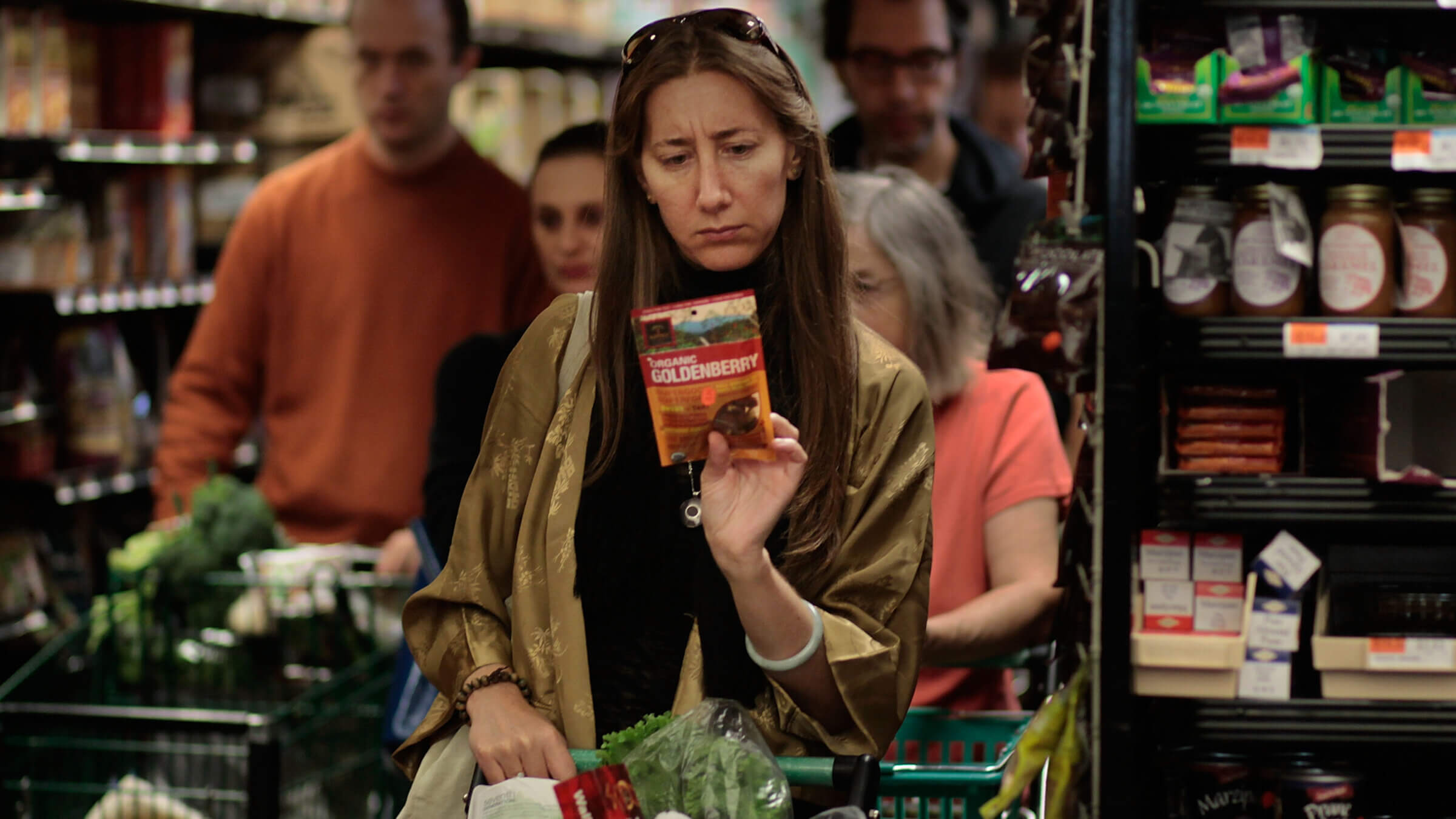
A woman carefully reading the label on a product at the Park Slope Food Coop. Photo by Getty Images

By Mira Fox May 20, 2026
Pink chalk outlines an approximately 20-foot-long rectangle on the sidewalk outside the Park Slope Food Coop, demarcating a sort of free speech zone to separate two camps of activists from the business of the organic grocery store within.
Inside the pink line, two opposing groups have taken root in recent weeks, building up to a long-brewing May 26 vote over a proposal to boycott Israeli products that has riven the Brooklyn institution’s roughly 16,000 members.
When the Forward visited last Friday, members of the group, PSFC for Palestine, were handing out fliers and urging members to vote yes. The other group, Coop4Unity, was handing out opposing fliers urging shoppers to “bring back cooperation” and “stop polarization” — that is, to vote against the Boycott, Divestment and Sanctions resolution.
It is a largely symbolic measure, given that the Coop only carries a handful of items imported from Israel; at least one, Al Arz tahini, was founded by an Israeli Arab in Nazareth. (It was bought in 2022 by the Sugat Group, an Israeli company.) Yet the fight is resonating beyond the coop, spurring a sharp sermon from a progressive rabbi and the larger attention of the boycott-Israel movement.
The pink lines forced the groups close enough together that some members there to shop or work were confused, calling over their shoulders to someone trying to hand them a flier “I’ve already signed on,” before realizing they meant to direct their comment at the other group.
One older member walked up to a man handing out fliers against the boycott wearing a hat emblazoned with the logo for the Maccabi Tel Aviv football club, which features a large Star of David. “I think I disagree with everything you’re doing,” the shopper told the man in the Tel Aviv hat in a serious tone, before realizing that they were in fact on the same side of the issue.
Still others seemed deeply frustrated by the drama’s very existence. “It’s a grocery store!” shouted one woman over her shoulder as she walked in the doors.
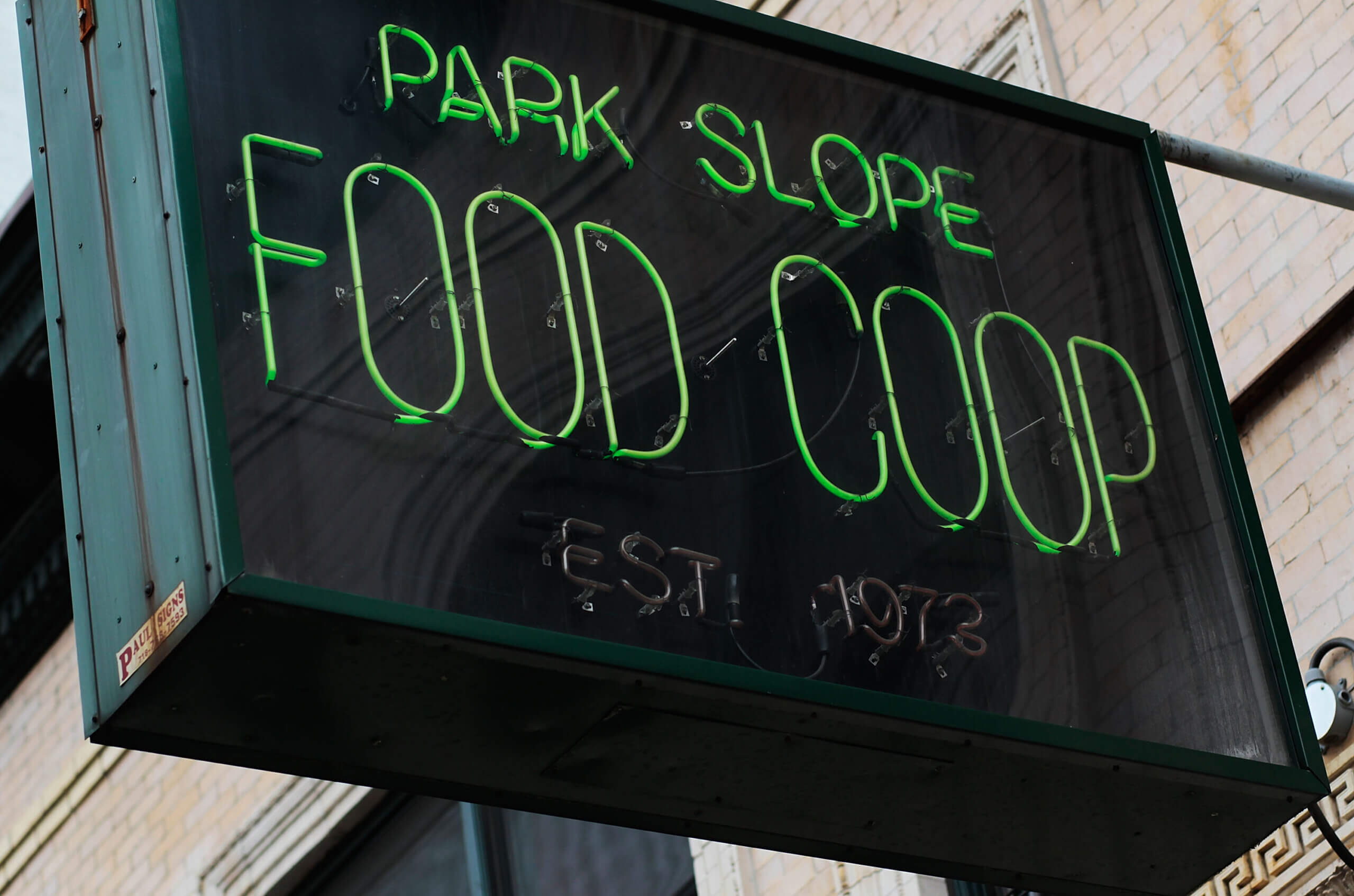
It’s not just a grocery store, though. The Coop, long a charmingly eccentric neighborhood institution, has a certain outsized cultural power. It has been spoofed by the likes of Broad City and The Daily Show. And it has become a microcosm of the debates over Israel that are splintering the wider progressive movement.
This is far from the first time the Park Slope Food Coop has been embroiled in exactly this issue; in 2012, when the coop first voted on a BDS motion — which was a vote on whether to even hold a vote on BDS — the line to get in was so long it took almost an hour for everyone to file in. The proposal didn’t pass then, but has come up in various forms regularly since.
Boycotts are par for the course at the Coop. The store, which is open only to members who must work shifts in order to shop, has regular general meetings where members can bring issues up for discussion and voting, whether politics or loudspeaker volume. They have endorsed numerous product boycotts in the past, including from South Africa during apartheid, Chile under Pinochet, U.S.-produced grapes in solidarity with United Farm Workers and Domino sugar in solidarity with striking workers.
But since Oct. 7, the temperature of the debate has risen to a new level of animosity that blew up publicly with remarks by a member during the Coop’s most recent general meeting.
“We can’t keep making the same mistakes between what we did with the Nazis and what we did with other hateful groups,” said the participant, during discussion on the vote. “Jewish supremacism is a problem in this country and we will move forward as a country with or without this Coop.”
People at the meeting applauded.
The remarks stunned and disturbed some Jewish members.
“To hear everyone start clapping was pretty jarring. To hear that in real life — to feel all the horrible antisemitic and anti-Zionist abuse that you get on line in real life,” said Ramon Maislen, who attended the meeting and is part of Coop4Unity. “It’s a hostile environment for Jewish members.”
The Coop’s staff, among the few paid to run the operation amid the thousands of volunteers, say the stakes spill over into the survival of the Coop itself.
“Conflicts much bigger than the Coop are playing out in General Meetings,” wrote Joe Szladek, the Coop’s current general manager, in an email to membership, “putting real strain on our governance and on the Coop as a whole.”
The vote
The Coop has always been a political project for many of its members, and its 53-year history has been punctuated by animated debates over decisions from whether to start selling meat (yes) and beer (yes, but only if it’s warm), to whether to accept credit and debit cards (debit yes, credit no).
The Israel boycott resolution has two prongs: One would require the Coop to boycott Israeli-made products “until Israel complies with international law in its treatment of Palestinians.” It is paired with a measure to lower the voting threshold to pass boycott measures from a 75% supermajority to a simple 50% plus one majority.
This, some Coop members contend, is against the Coop’s fundamental ethos of cooperation and a machination to ensure the boycott passes.
One of the Coop’s co-founders, Joe Holtz, opposes the boycott. Holtz retired in 2025 after 50 years as the store’s general manager, one of its few paid roles, and is now hoping to step back into leadership — he is running for the Coop board because, as he wrote in his election statement, “the historic governance system is frankly not working well anymore.”
Other Coop4Unity members say the fight is about the Coop’s health. If members feel the Coop has become too political, longtime member Barbara Mazor said, they will leave, putting the Coop in danger of losing revenue and not meeting payroll.
“The question isn’t what you do think about BDS and what do you think about Israel-Palestine,” she said. “We’re fiduciaries!”
Others, including Alyce Barr — who joined the Coop at age 23 in 1978, just five years after its founding, and is a member of PSFC for Palestine — believe the opposite is true. Barr pointed out that the supermajority has only been required for boycotts since 2016, and arose as a reaction to previous debates over BDS. And, she said, the near-100% agreement on past boycotts was the result of an in-person voting requirement that meant only a small, motivated group was voting at all, hardly representing the entire membership.
“Saying that all the members agreed and that every other boycott was a supermajority and now all these people who support Palestine are making a new thing — it’s a bubbe meise, a lie.”
Tensions erupt
The Coop fight has spilled over into the larger community. Rep. Dan Goldman, running for reelection, condemned the proposal as a form of antisemitism.
On a recent Shabbat, Rabbi Rachel Timoner, a Coop members who leads Parks Slope’s large Reform synagogue, Congregation Beth Elohim, gave a sermon forcefully exhorting against the BDS resolutions, even as she repeatedly emphasized her own support for Palestinian rights and said some members might support the Coop’s boycott.
She asked attendees at the service to meet her after to discuss how to get out the vote against BDS, saying she will resign if the resolution passes, and predicted that many other Jewish members will too. Timoner was struck by the “Jewish supremacism” comment, comparing it to Nazi rhetoric.
“Why is this petty, annoying fight in our neighborhood grocery store worth so much time and effort?” she said in her sermon. “Because it is part of something much larger. In the end it is about antisemitism. A real and rising threat which ultimately carries existential danger both for Jews and every society in which it takes hold.”
Barr called the rabbi’s remarks “fearmongering.” As for the rhetoric of Jewish supremacy, Barr referred me to a statement on the term put out by Jewish Voice for Peace, which defines the term narrowly as the belief that “Jews are superior to other groups, in this case Palestinians,” and refers to its promulgation by far-right Jewish groups like the Jewish Defense League, founded by Meir Kahane.
As a Jew — one who grew up in the Borscht Belt in a town where a cross was burned on the borders — Barr said she does not see how something being sold, or not sold, at the Coop would make her unsafe. She said that she has felt upset for years at seeing Israeli products on the shelves, yet hasn’t quit over an issue in nearly 50 years of membership.
“We can have a conscience, we can disagree,” Barr said. “One way or another, we can go on and be a Coop.”
I’m personally matching all gifts to the Forward, up to $36,000. Can I match your gift now?

Hello, fellow Forward reader! I’m Joel Brown, a Forward reader and supporter for more than 15 years, and currently the chair of the board of directors.
I’m an avid Forward reader because it ticks so many of my essential boxes: excellent journalism, Jewish focus and diverse viewpoints. In today’s political climate, what I most appreciate is the Forward’s independence — made possible by the generosity of its membership.
The Forward is committed to bringing you unbiased, nuanced Jewish news. From my position as board chair, I see an exciting future as we expand our position as the definitive independent voice of contemporary American Judaism.
— Joel Brown, Forward board chair
Support our mission to tell the Jewish story fully and fairly.