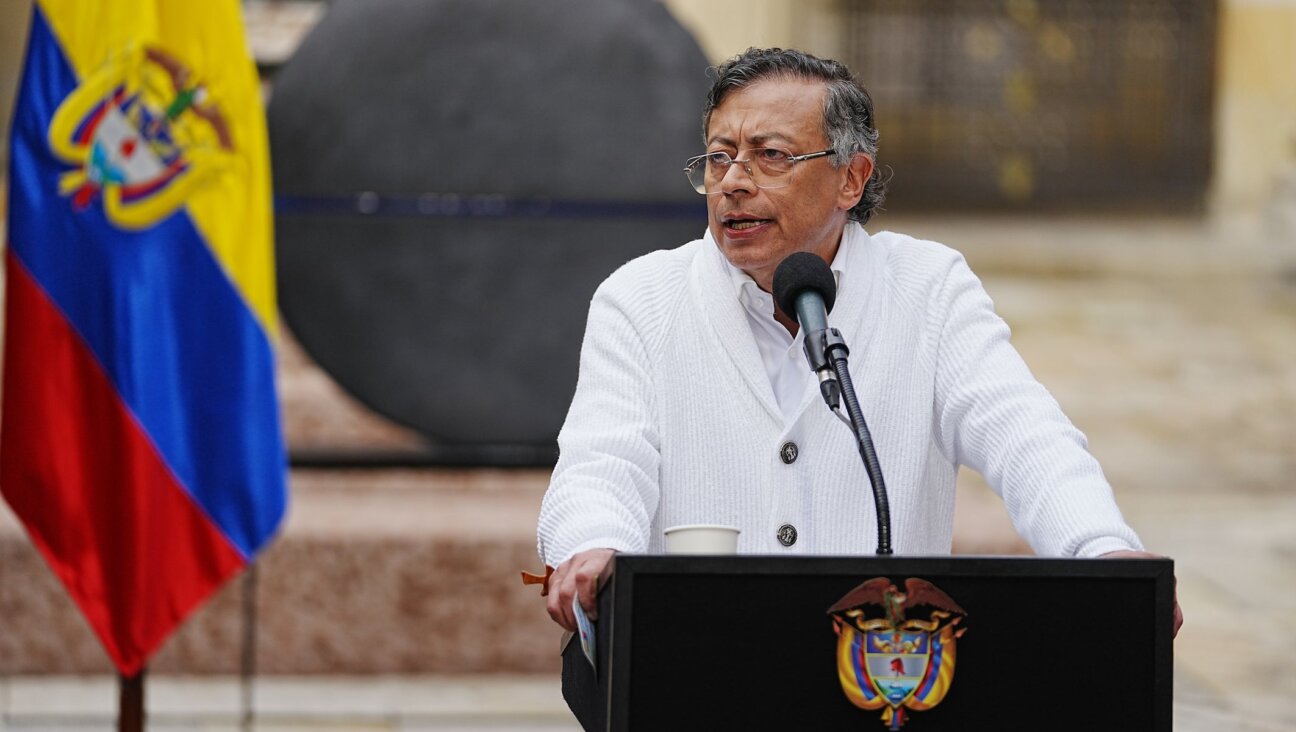
Colombian President Gustavo Petro sparks outcry over tweet reading ‘Heil Hitler’
Two dozen Latin American lawmakers condemned Petro’s comment, arguing that references to Naziism “must not become a rhetorical tool.”
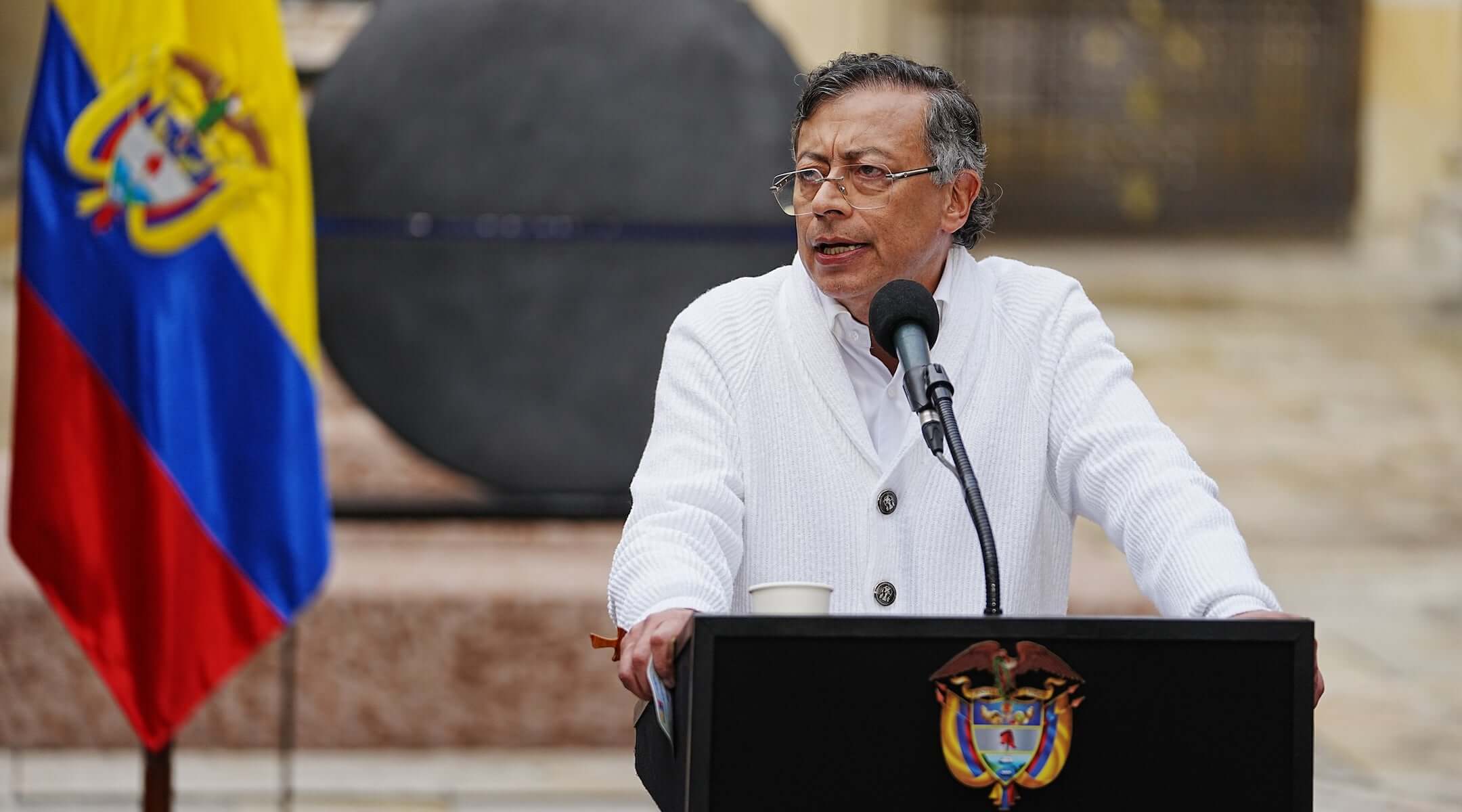
Colombian President Gustavo Petro casts his vote during the presidential election on May 31, 2026 in Bogota, Colombia. (Andres Rot/Getty Images)
(JTA) — Colombia’s outgoing president, Gustavo Petro, sparked fierce condemnation from Israeli and Latin American leaders after he tweeted the phrase “Heil Hitler” Sunday in response to an op-ed endorsing a candidate in the country’s upcoming presidential election.
Petro, a left-wing president in the final weeks of his term ahead of the country’s June 21 runoff election, posted the Nazi phrase in response to an op-ed supporting right-wing presidential candidate Abelardo de la Espriella.
Petro subsequently defended his use of the Nazi slogan, arguing that he was critiquing the language used by the op-ed’s author, which he said included “fascist phrases.”
His defense came after criticism from Israeli leaders and others who said the “Heil Hitler” comment was inappropriate.
Israel’s ambassador to the United Nations, Danny Danon, called on the Colombian leader to “come to your senses and apologize” before Wednesday, when he is slated to preside over a debate at the United Nations Security Council.
“President of Colombia, @petrogustavo, whatever is going on in your personal life, there are lines that must never be crossed,” Danon wrote in a post on X. “Using Nazi slogans is a disgraceful low from which there is no coming back.”
Israel’s Foreign Ministry also decried the post, writing on X that it was a “total loss of moral compass and an indelible stain on Colombia’s legacy.”
The episode comes amid shifting norms about the use of Holocaust analogies and language in political discourse. After being considered out of bounds for a long time, people on both the right and the left have increasingly shed those norms amid growing political polarization and extremism around the world.
The “Heil Hitler” post was not the first time Petro has landed in hot water for invoking the Holocaust. In the wake of Oct. 7, Petro drew backlash from Jewish and Israeli leaders for likening the actions of Israel to Nazi Germany. On social media, he has repeatedly called political rivals Nazis, including last month when he wrote in a post on X that Israel’s national security minister, Itamar Ben-Gvir, had behaved like a “true Nazi” after he posted videos taunting detained activists from a Gaza-bound aid flotilla.
In 2024, Petro also severed diplomatic ties with Israel, accusing the country of commiting genocide in Gaza, an accusation Israel has denied. Espriella, who was endorsed by President Donald Trump, has vowed to renew diplomatic ties with Israel.
On Monday, 24 Latin American lawmakers signed onto a statement condemning Petro’s rhetoric, warning that his repeated use of references to Naziism risked distorting Holocaust memory.
“The use of references to Nazism must not become a rhetorical tool to discredit political or ideological positions. Democratic leaders have a responsibility to promote a respectful public debate that is conscious of the weight of words,” the statement read.
The statement was initiated by the Coalition of Latin American Legislators Against Antisemitism, which is led by the Combat Antisemitism Movement. The signatories included lawmakers from Argentina, Brazil, Chile, Colombia, Costa Rica, Ecuador, Guatemala, Honduras, Mexico, Panama, Paraguay, Peru, the Dominican Republic and Uruguay.
Shay Salamon, CAM’s executive director of Latin American affairs, said in a statement that Petro’s invocation of the phrase reflected a “troubling record of antisemitic expressions and conduct” by the Colombian leader.
“When a leader uses the authority of his office to stigmatize the Jewish people or trivialize their historic suffering, silence is no longer an option,” Salamon said.
I’m personally matching all gifts to the Forward, up to $36,000. Can I match your gift now?

Hello, fellow Forward reader! I’m Joel Brown, a Forward reader and supporter for more than 15 years, and currently the chair of the board of directors.
I’m an avid Forward reader because it ticks so many of my essential boxes: excellent journalism, Jewish focus and diverse viewpoints. In today’s political climate, what I most appreciate is the Forward’s independence — made possible by the generosity of its membership.
The Forward is committed to bringing you unbiased, nuanced Jewish news. From my position as board chair, I see an exciting future as we expand our position as the definitive independent voice of contemporary American Judaism.
— Joel Brown, Forward board chair
Support our mission to tell the Jewish story fully and fairly.