Floyd Mayweather showered cash on Jewish causes — and now he’s suing their ‘Robin Hood’ alleging $175 million got diverted
High-flying middleman Jona Rechnitz tells the Forward ‘holy work’ brought him and the boxer to Israel after Oct. 7
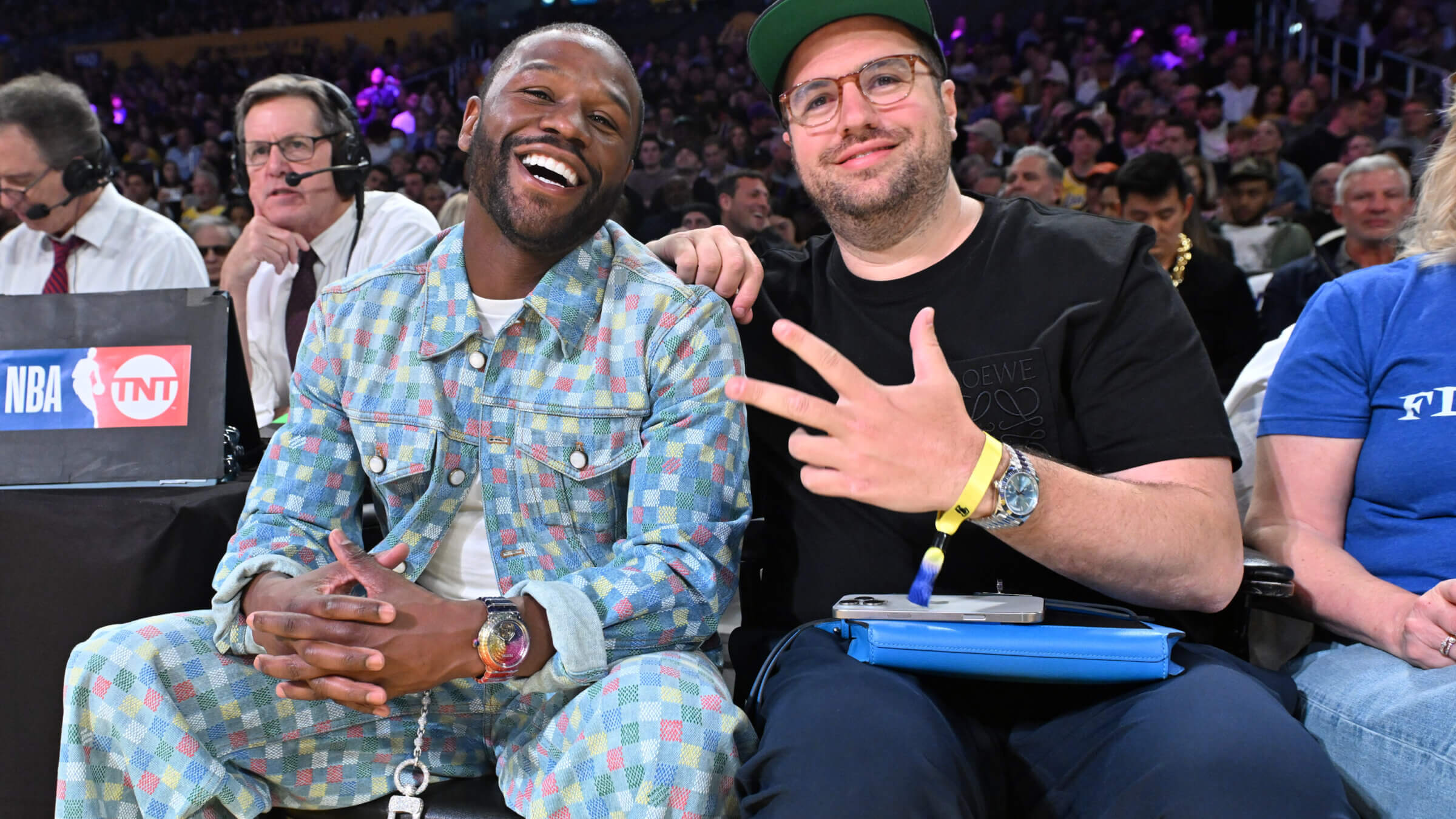
Floyd Mayweather, Jr. (L), and his business partner Jona Rechnitz, seen together at a Lakers game in April 2025, are now at odds in a $175 million lawsuit. Photo by Allen Berezovsky/Getty Images

By Louis Keene May 27, 2026
They made for an odd photo: The diminutive boxing legend with a platinum grin and diamond chain, and the Orthodox macher who sported a black velvet yarmulke.
But when Floyd Mayweather, Jr., appeared in public in recent years — at LA Lakers games, promotional appearances and repeated trips to Israel — he was rarely without his jeweler, friend and business adviser, Jona Rechnitz.
For a few Jewish groups, the partnership was a gold mine.
With Rechnitz in his inner circle, Mayweather donated more than $1 million to Israeli and Jewish institutions that included United Hatzalah, Magen David Adom and Aish. And when Rechnitz and Mayweather traveled to Israel after Oct. 7, they were welcomed as heroes.
Now the relationship has come to a screeching halt with a lawsuit Mayweather filed last week in a Manhattan court, alleging Rechnitz defrauded him of $175 million in jewelry consignment funds, diverted settlement proceeds and unauthorized loans against his properties.
That their relationship collapsed in a big-money dispute did not shock anyone familiar with their histories. Mayweather had a long record of domestic violence incidents, with three separate convictions over the course of a decade, and more recently had allegedly skipped out on money owed. Rechnitz pleaded guilty in 2016 in a high-profile bribery case in New York City, getting a reduced sentence in exchange for cooperation with prosecutors. (Mayweather claims in his suit that Rechnitz, serving as his financial manager, did not initially disclose his criminal past.)
The two had also been linked to an alleged cryptocurrency pump-and-dump scheme in a case that was dismissed in 2022, and both are named as defendants in separate lawsuits related to an alleged ticket selling scam. (Rechnitz has denied the claims.)
Yet while the going was good, Jewish organizations and causes lined up to take part in their largesse. Now most have gone silent. But those willing to speak out say they have no regrets about the relationship.
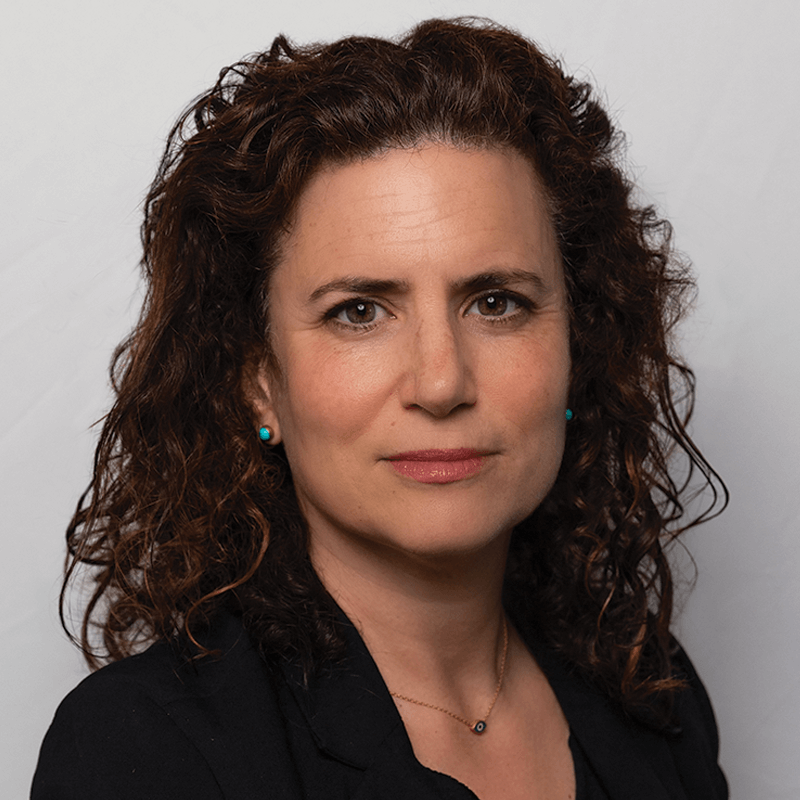
“I don't give a s— if he's a Robin Hood and he's stealing from the rich to help the poor — good, let him keep doing it.”Adina SashOrthodox women's activist, on Jona Rechnitz
Adina Sash, an Orthodox women’s activist, shared on Instagram a screenshot of an April 2025 message from Mayweather, asking her to contact Rechnitz so they could help her cause. Sash advocates for agunahs, women whose husbands refuse to grant a Jewish divorce, often generating headlines for stunt-driven pressure campaigns against the men.
Sash called Rechnitz a “massive” behind-the-scenes supporter of agunahs, estimating he had donated $250,000 to cover the women’s legal fees.
“I don’t give a s— if he’s a Robin Hood and he’s stealing from the rich to help the poor,” Sash said in an interview. “Good, let him keep doing it.”
Rechnitz, who denied Mayweather’s claims through an attorney, said he was unavailable for a phone interview Wednesday. But in a text message, he said he had brought Mayweather to organizations “involved in holy work.”
“Nobody stood by our side and I asked him to do so for me,” Rechnitz added, “and I also arranged for any out of pocket costs incurred for his trips to Israel such as airfare and hotels.”

Lavish gifts
In the first few days after Oct. 7, Mayweather quickly emerged as a rare ally for the Jewish state. He made public statements defending Israel on social media to his more than 25 million Instagram followers. He sent his private jet, loaded with emergency supplies, to the country less than a week after the attack. And he visited the country at least four times over the next two years, each time accompanied by Rechnitz.
Rechnitz, a real estate scion, had begun working his way into Mayweather’s inner circle after moving to his hometown of Los Angeles in 2017. Rechnitz was coming off a stint in New York that concluded with his sentencing to five months in jail for a bribery scheme involving the city’s then-deputy mayor for public safety and the leader of the New York City correction officers’ union. (The sentence was overturned on appeal in 2023.)
Mayweather was a controversial figure in his own right. In addition to his domestic violence record, he has been ordered by a judge to pay child support, and he is currently being sued based on allegations that he failed to pay rent and the bill for his private jet.
Rechnitz said he was forewarned. “Many people told me not to deal with him and criticized Jewish organizations for honoring him,” Rechnitz said in a text message to the Forward. “People make mistakes and I do not think that anyone can pass judgment without being in the same situation. Like many people, Floyd has his faults.”
The relationship between the two seemed to serve them both: Mayweather was flattered by Jewish leaders willing to look past their bad qualities, and bringing the boxer around helped rehabilitate Rechnitz in the Jewish world. Mayweather’s lawsuit described Rechnitz as his “de-facto” investment manager, real estate advisor, and banking liaison; it did not say how much Rechnitz was paid for those services but said it was a “constructive fiduciary relationship.”
They also made money together, according to one filing against them related to the cryptocurrency EthereumMax. Mayweather promoted the token at a boxing match and a Miami bitcoin conference in 2021. A class action lawsuit against the company alleged that Rechnitz had made hundreds of thousands of dollars selling his tokens after a raft of promotions from celebrities like Mayweather inflated their value. The filing claimed Mayweather was paid $2.5 million to be a “marquee promoter” of the coin. A judge later dismissed the case.
Despite the checkered past of both the boxer and his confidant, Jewish groups received them enthusiastically. United Hatzalah festooned its headquarters with Mayweather banners upon his first post-Oct. 7 visit to Jerusalem, with its president, Eli Beer, donning a Mayweather-branded cap during the visit. Magen David Adom’s American fundraising affiliate presented the boxer with a rhinestone-studded emergency vest.
Aish, an international Orthodox outreach group, bestowed Mayweather with a “Champion For Israel” award, with Mayweather and Aish CEO Rabbi Steven Burg posing for a photograph overlooking the Western Wall.
Mayweather also spoke to students and faculty at Rae Kushner Yeshiva High School, an Orthodox institution in New Jersey, last year, accompanied by Beer and Rechnitz and introduced by head of school Rabbi Eliezer Rubin, who said he was “exhilarated” to have Mayweather there.
Jewish groups characterized Mayweather’s support for the Jewish people as authentic and purely motivated. But it was also clear that it was driven by Rechnitz’s ties to the community. At a 2025 gathering of the Republican Jewish Coalition, Jona’s father, Bobby — himself an eminence grise of the pro-Israel lobby — proudly told those gathered at the event that his son was the boxer’s entree into Israel and Jewish affairs. When Mayweather took the mic, he said he saw Bobby as a “father-like figure” and Jona as a brother.

Responding to questions about the lawsuit, United Hatzalah spokesperson Simmy Allen said in a statement Wednesday that the organization would not comment on legal matters between private parties.
“Mr. Mayweather visited United Hatzalah’s headquarters in Jerusalem twice and saw firsthand how United Hatzalah is on the frontlines of emergency medical services in Israel and we are grateful for his support,” Allen wrote. He did not mention Rechnitz.
In an email, Rubin, Kushner’s head of school, said he did not regret welcoming Floyd and that Rechnitz did not facilitate the visit.
“When even influential Jews are remain silent about the malicious and vile attacks against the Jewish people, we need to commend and support people outside of our faith who are standing with us,” Rubin wrote.
He added that the school had no relationship with Rechnitz.
Representatives from Aish and the Republican Jewish Coalition did not respond to questions.
The new allegations
Mayweather’s lawsuit alleges that Rechnitz exploited the boxer’s trust — and his property — to enrich himself.
The bulk of the $175 million claim relates to jewelry belonging to Mayweather that Rechnitz allegedly pawned to a Miami jeweler for $13 million. Mayweather says its real value was closer to $100 million, and that Rechnitz did not have permission to borrow against the assets.
Mayweather also claimed that Rechnitz drew loans totaling tens of millions of dollars on various properties owned by Mayweather entities without his consent, and diverted at least $15 million in funds intended for Mayweather into accounts controlled by co-defendants.
Morris Missry, an attorney for Rechnitz and co-defendants Ayal Frist and Alexander Seligson, said Wednesday in a statement that Mayweather’s claims were “utterly baseless.”
“Mr. Mayweather’s gambling issues, prolific spending habits, monies owed to third party creditors and IRS tax liens and levys, as well as other unseemly behavior will be exposed and we believe that Mr. Mayweather will be the one paying significant damages to our clients,” Missry wrote.
Mayweather’s lawsuit is not the first lodged against Rechnitz since his 2016 plea agreement. In 2023 a judge granted $17.7 million plus interest to a jeweler who said Rechnitz’s checks to him had bounced. Separate lawsuits filed by a former neighbor of Rechnitz’s, Joe Englanoff, alleged that Rechnitz convinced Englanoff to invest $1.4 million in tickets to a Mayweather fight, which Rechnitz promised he could resell at several times the value.
Englanoff, who was renting Rechnitz the house next door, moved to evict him and separately sued Mayweather and Rechnitz for $15 million, citing breach of contract. Rechnitz countersued, saying the property was in worse condition than what Englanoff advertised. Rechnitz said in a text that Englanoff “is a serial litigant whose greed has blinded his ways.” Litigation is ongoing.
Englanoff did not respond to an inquiry.
Some on social media called Mayweather’s Instagram post attacking Rechnitz into question for antisemitism, noting that Mayweather had compared him to vermin and chosen a picture of Rechnitz wearing a yarmulke.
One who appeared to side with Mayweather was Rae Kushner Yeshiva High School teacher Rabbi David Schlusselberg, who said on X that Mayweather had spoken admirably to his students when he visited last year.
“When a Jewish person in his inner circle backstabs him and is being sued for $175 million, it isn’t antisemitic for Floyd Mayweather to post about this,” Schlusselberg wrote on X. “I feel terrible for Floyd Mayweather who has only showed love and support for the Jewish people.”
But Schlusselberg later deleted the post. Though he did not want to say why, he told the Forward he did so after speaking to Rechnitz on the phone.
Sash, the agunah activist, said any sentiment supporting Mayweather for pro-Israel advocacy was naive.
“The only reason he ever stood with Israel is because that’s how Jona puppeteered him,” Sash said. “Floyd is a puppet. Jona was the puppet master.
“He told me explicitly that his goal was to position Floyd as a representation of someone who supports Israel,” she added. “He knew that it would be monetarily beneficial for Mayweather’s portfolio to align himself that way.”
Rechnitz said he told Sash he was behind Mayweather’s charitable giving to Jewish groups and that his goal was to position Floyd as a supporter of Israel, but denied mentioning any underlying financial motive.
And he added that he was surprised Sash disclosed his involvement in her cause, which he said was supposed to remain confidential. He said he helped agunahs independent of Mayweather, with the assistance of family and friends.
Despite Rechnitz’s overt machinations with regard to his friend and client, Sash saw Rechnitz’s support for agunot as genuine. In one instance, she said, he had offered an agunah’s husband $500,000 to grant a Jewish divorce. (The man did not accept, Sash said.)
What financial benefits Rechnitz believed would accrue to Mayweather from his pro-Israel support was unclear, but Sash — who said she never took money from Rechnitz or Mayweather — speculated it had to do with real estate, a shared area of interest for the two men.
As to the possibility that Rechnitz paid for his support with someone else’s money, Sash said it didn’t matter.
“Even if it were to be proven that that exact money was taken from someone else, good, because the system is so rigged against agunahs,” she said. “If there is someone else willing to do illegal activity to help agunahs, amazing — we need every ounce of help we can get.”
Did you know that only 2% of Forward readers donate to support our nonprofit newsroom? That 2% make it possible for millions to read the Forward without a paywall or subscription — removing any barriers to the full and fair Jewish story.
But while the Forward is free to read, it isn’t free to produce. Big stories — like deep dives into the antisemitism data, political scoops or reporting trips to college campuses — take months of research and fact-checking. All while we keep you informed of what you need to know each day.
— Rachel Fishman Feddersen, Forward Publisher & CEO
Support our mission to tell the Jewish story fully and fairly.