Brooklyn grocer’s boycott of Israeli products spurs celebration and talk of lawsuits
Legal watchdog calls Park Slope Food Coop ban “discriminatory” as the international movement to boycott Israel pursues gains
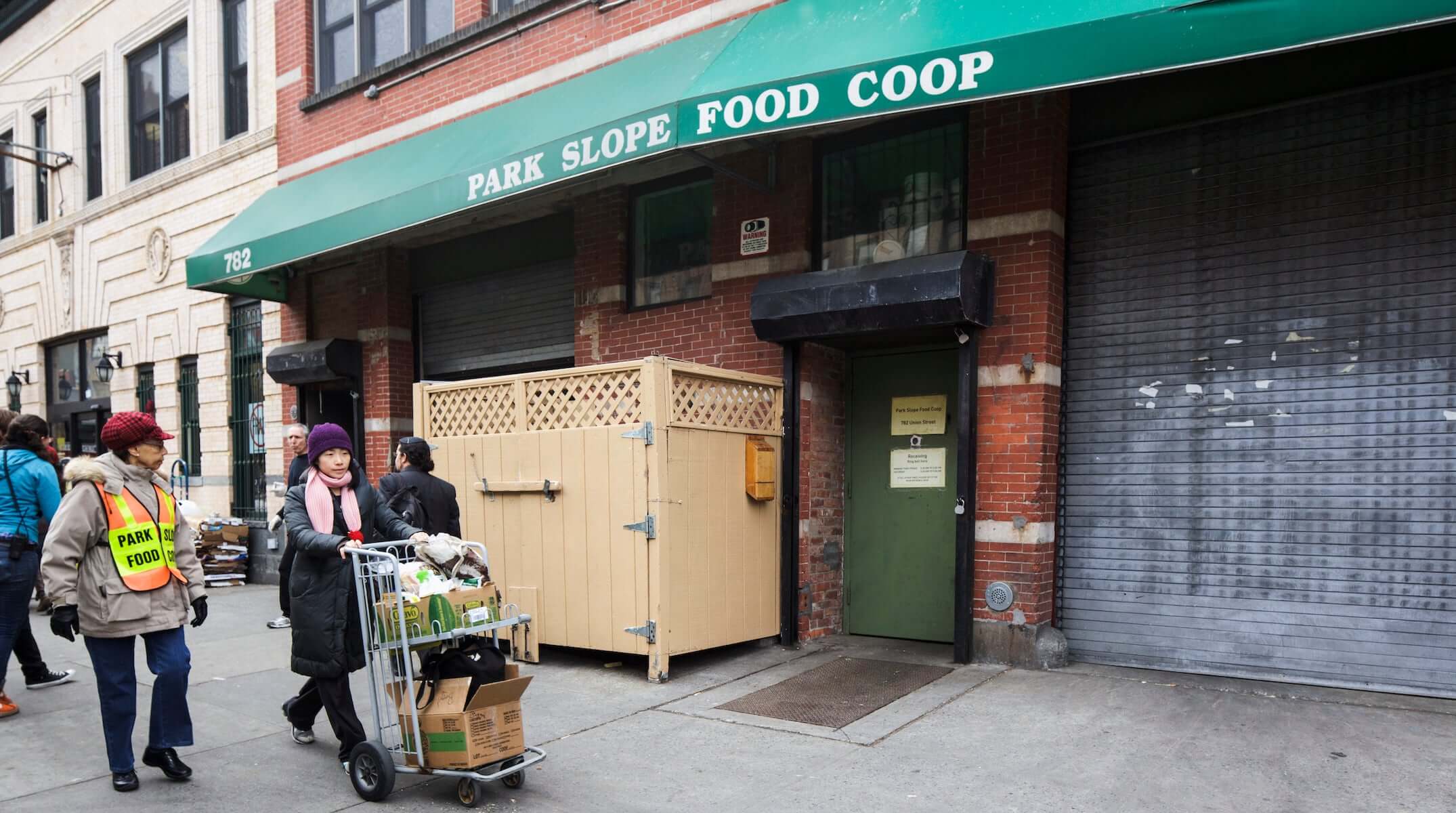
The exterior of the Park Slope Food Coop in Brooklyn. Photo by James Leynse/Corbis via Getty Images


By Hannah Feuer and Mira FoxMay 27, 2026
The move by a members-only New York City grocery to ban products from Israel achieved a long-sought goal for a boycott movement, while leaving open questions about what happens next — including possible lawsuits.
Members of the Park Slope Food Coop voted Tuesday night to boycott Israeli products, with 67% of 6,772 votes cast in favor of the boycott and 31% against, following a related vote to lower the threshold for approving boycotts from 75% to 50% plus one vote. The measure specifies that the ban will continue “until Israel complies with international law, including by ceasing unlawful discriminatory practices, in its treatment of Palestinians.”
The co-op had debated a boycott for more than a decade, aligned with a global boycott, divestment and sanctions movement.
Some longtime members and staff objected, voicing concerns about dividing a usually cohesive community where members must volunteer their labor and work in teams in order to shop. Tensions flared in the run-up to Tuesday’s vote, drawing in condemnations from a local rabbi and congressman.
But the only words on the measure itself Tuesday night came in the presentation from its sponsors, which cited “Israeli occupation and apartheid” and “genocide in Gaza” — followed by a successful motion to preempt discussion before the vote.
“Tonight’s win is proof that cooperative movements are powerful models for exercising solidarity and participatory democracy,” said PSFC Members for Palestine member Taylor Pate, who is running for the coop board. “I am so proud to be a member of the world’s largest member-labor-required food coop that has decisively voted no to supporting a country that has carried out genocide, occupation, and apartheid in Palestine.”
The campaign’s work is not finished. All Park Slope Food Coop boycotts — which historically included South Africa and Chile — must come up for an annual renewal vote.
Alyce Barr, a veteran Jewish coop member who introduced the ban proposal Tuesday night, says future efforts will involve “work with the members of our coop to make sure that our coop is everything we want it to be — welcoming, available to people across economic levels and ethnicities” as well as working “to get more people involved in the democratic effort.”
But some attorneys monitoring the vote and its aftermath suggest talk of democracy does not change an outcome they consider discriminatory.
Kenneth Marcus, CEO of the Louis D. Brandeis Center for Human Rights Under the Law — which helped negotiate a settlement in 2022 that prevented Ben & Jerry’s from refusing to sell its ice cream in the West Bank and East Jerusalem — said in a statement to the Forward the group “is actively evaluating all available legal claims arising from the discriminatory nature of this boycott and the procedural irregularities that allowed it to pass.”
Coop4Unity, a group of members who opposed the boycott, said in an email that they had already retained legal counsel and begun to develop a litigation strategy.
New York City and state Human Rights Law prohibit boycotts that discriminate against someone because of a protected class, such as race or national origin. Groups including the Lawfare Project have argued that provision makes it illegal to engage in boycotts of Israeli goods, which they view as a form of discrimination based on national origin.
Craig Gurian, executive director of the Anti-Discrimination Center — which helped draft parts of New York City’s human rights law — said he believes a suit could be brought that alleges the coop is unwilling to do business with vendors based on their national origin or religion.
“If anybody on the pro-boycott side is thinking, ‘Oh, this is a slam dunk, there’s no risk of liability here,’ they’re being imprudent,” Gurian told the Forward.
But legal advocacy groups including the Center for Constitutional Rights and Palestine Legal have argued boycotts are protected under the First Amendment because they target the policies of the Israeli government, not Jews or Israelis because of their religion or nationality.
A food coop in Olympia, Washington, successfully fought off a lawsuit after it approved an Israeli products ban in 2010.
Meanwhile, U.S. food companies that import products from Israel are waiting to hear what happens next.
One is Seed + Mill, a Manhattan-based sesame and halva brand. Australian co-founder Rachel Simons said she hasn’t heard from the coop, but she assumed after yesterday’s vote that the company’s products would no longer be stocked.
The Park Slope Food Coop has been one of the company’s largest, most high-profile retail outlets, Simons said, accounting for thousands of dollars in sales. She said that the company works with a tahini factory in Israel owned by Arab Israelis, and that her team in New York employs people of many different nationalities and religions.
“I feel a tremendous responsibility to humanize the entire business, the supply chain, the people who are being hurt and harmed by this decision,” Simons told the Forward. “The people who voted against our products, I don’t know how much they really know about who they’re hurting.”
“Our Coop’s boycott policy is a response to genocide and apartheid, consistent with our values and past boycotts including apartheid South Africa,” said PSFC Members for Palestine in a statement. “If companies doing business in Israel feel harmed by a boycott, they should be lobbying their government to end the oppression of Palestine, not asking Coop members to end our commitment to human rights. Don’t call us, call the Knesset.”
Fresh Traction
The Park Slope Food Coop ban comes as the larger BDS movement is finding fresh traction following the Gaza War.
Bestselling Irish author Sally Rooney, who long refused to work with Israeli publishing houses in compliance with the boycott, recently announced plans to publish her latest novel in Hebrew through an Israeli publisher that now complies with specific tenets of BDS by accepting the movement’s central three demands — “an end to Israel’s occupation of territories captured in 1967, full civil equality for Palestinian citizens of Israel, and the implementation of the Palestinian right of return” — and not doing business in West Bank settlements or receiving money from the Israeli state.
In the U.S., opposition to Israel boycotts attracted bipartisan consensus even relatively recently. In 2019, Congress passed a resolution condemning the boycott, divest and sanction movement by an overwhelming margin of 398-17, and nearly two dozen states have their own restrictions.
But that consensus is breaking down as the conflict in Gaza and war with Iran has brought the movement to boycott Israel to the fore, such as when BDS advocates last October claimed victory for the closure of a popular Israeli restaurant chain in Washington, D.C.
BDS activists are also renewing efforts to repeal legislation or executive orders aimed at limiting boycotts against Israel. Illinois was one of the first states to pass legislation banning the state’s public pension funds from investing in foreign companies that boycott Israel in 2010. The law passed unanimously.
Now, State Rep. Abdelnasser Rashid has introduced legislation to repeal the law. He has found support from Daniel Biss, the Jewish mayor of Evanston, Ill., who is now a Democratic nominee running for Congress.
Biss voted for the anti-BDS law when he was a state senator in 2015, but now he says he’s changed his mind.
“We should all be able to agree that our government must not be wielded to stop people from using their economic agency to advocate for their values,” Biss wrote in a Substack post.
Similar efforts to repeal laws or executive orders that bar state transactions with companies that boycott Israel are ongoing in Maryland, Minnesota and Wisconsin.
“People in other states have reached out to us,” Rebekah Levin, a Jewish Voice for Peace member in Illinois, told the anti-Zionist news site Mondoweiss. “They want to know what we did and how we did it. If we overturn this it would be a boost to other states. It’s a powerful message. This is why pro-Israel groups are afraid of this passing. It’s about more than just Illinois.”
Supporters of the Park Slope Food Coop boycott also see their effort as the beginning of a broader fight.
“The Park Slope Food Coop has inspired and facilitated the growth of co-ops in New York City and around the world, and organizers hope that tonight’s victory will resonate in a similar way,” Park Slope Food Coop Members for Palestine said in a statement.
Updated May 28 to include a statement from PSFC Members for Palestine.
Sarah Diaz contributed research.
Did you know that only 2% of Forward readers donate to support our nonprofit newsroom? That 2% make it possible for millions to read the Forward without a paywall or subscription — removing any barriers to the full and fair Jewish story.
But while the Forward is free to read, it isn’t free to produce. Big stories — like deep dives into the antisemitism data, political scoops or reporting trips to college campuses — take months of research and fact-checking. All while we keep you informed of what you need to know each day.
— Rachel Fishman Feddersen, Forward Publisher & CEO
Support our mission to tell the Jewish story fully and fairly.