Ever the restless spirit, Tel Aviv-born architect and designer Ron Arad is still reinventing himself and his art
Arad, 75, was recently appointed a Commander of the Order of the British Empire
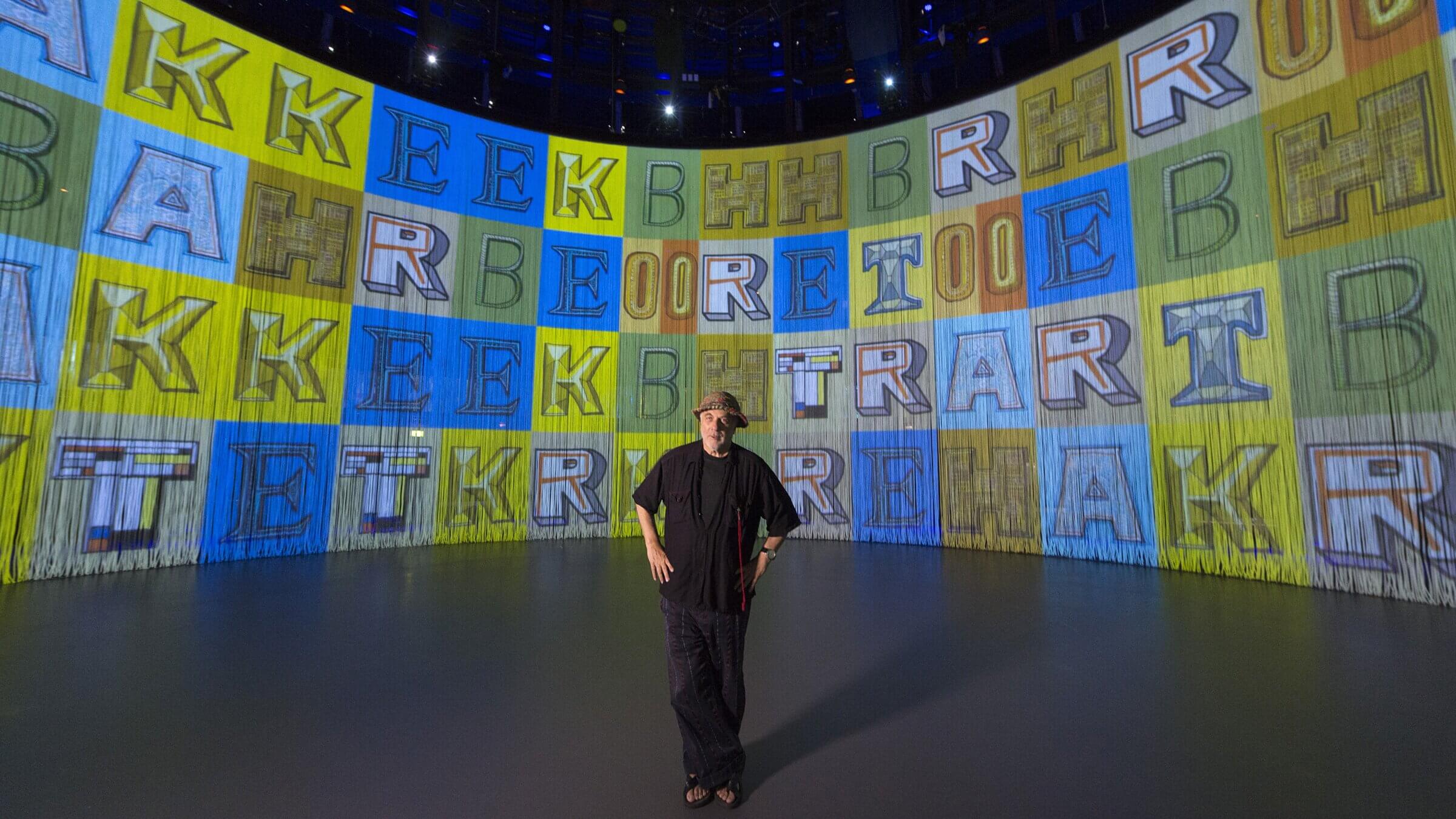
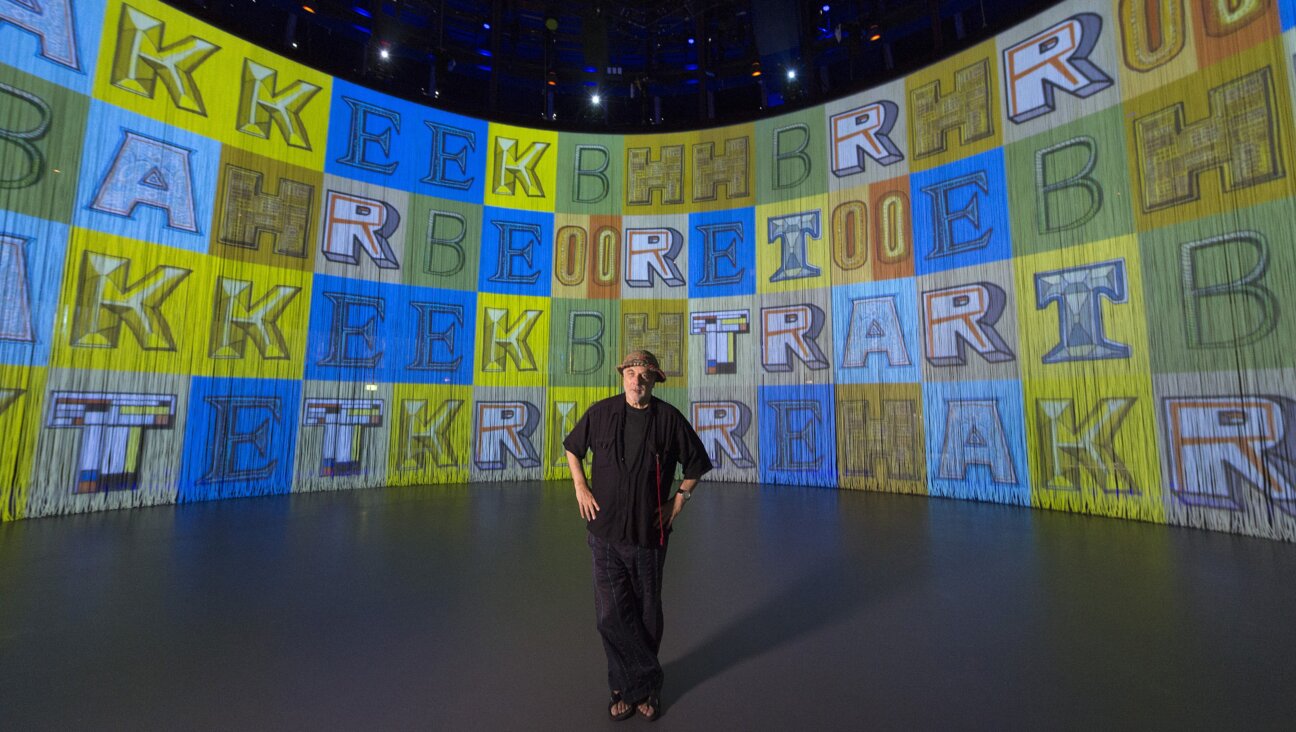
Rod Arad stands near the screen into the art installation ‘Curtain Call.’ London, 2016. Photo by by Ron Arad at the Roundhouse on August 8, 2016 in London, United Kingdom. The epic floor-to-ceiling artwork made of 5,600 silicon rods suspended from an 18 metre diameter ring provides a canvas for films, live performance and audience interaction. Ray Tang/Anadolu Agency/Getty Images
By Benjamin Ivry June 16, 2026
When the announcement was made on June 12 that Ron Arad, 75, has been appointed a Commander of the Order of the British Empire (CBE), it marked another step in the Tel Aviv-born architect, artist and designer’s remarkably varied journey. Arad’s mother was the painter Esther Peretz-Arad and his father Grisha was a sculptor and photographer. After industrial design studies at the Bezalel Academy of Arts and Design in Jerusalem, Arad traveled to London to become an architect, and has remained based there ever since. Yet although he won early fame with his piquant, witty concepts for chairs, Arad has proven anything but sedentary over the past half-century. Indeed, a 2010 retrospective at London’s Barbican Art Gallery was titled “Restless.”
Despite this seemingly permanent shpilkes (restless agitation), humane consideration for the pathways of others has been a constant in Arad’s public projects. His design for Beit Shulamit (2025), a cancer treatment center at the HaEmek Medical Center in Afula, northern Israel, intended to serve Jewish, Christian, Muslim and Druze communities in Israel and Palestine, deliberately freed patients and visitors from “horrible hospital corridors,” Arad told an architectural periodical. Patients walking around the site are given views of nature outdoors at every turn, in a facility that is the first to offer specialist cancer treatment for residents of West Bank conflict zones, including the cities of Jenin and Nablus. Named in honor of Dr. Shulamit Katzman, a pediatrician, the building’s gently curved lines embrace the public.
This awareness of social cohesion is also present in an Arad sculpture on the Tel Aviv University campus. “Kesher” is dedicated to the estimated 4,000 Ethiopian Jews who died from adverse conditions in transition camps on the Sudanese border while trying to emigrate to Israel between 1979 and 1990. Composed of dynamically soaring, interwoven metal tubes, the artwork, wrapped around two live palm trees, a ubiquitous symbol of the Middle East, evokes an expedition. A repeated figure-eight symbolizes the endless continuity of the immigrants’ route and the resolve that it communicates.
In England, Arad assisted the National Health Service (NHS) in responding to the COVID-19 pandemic. A flock of UK Jewish celebrities posed for photos wearing Arad-designed cotton masks, including actor Stephen Fry, comedian David Baddiel, and television host Natasha Kaplinsky. Despite lively colors, the masks, intended to be sold for fundraising, retained a somewhat tragic aura, like the grotesque permanent smile of Victor Hugo’s Gothic novel The Man Who Laughs.
Potential tragedy inherent in triumph likewise radiates from another Arad project, the Totzeret HaAretz (ToHA) tower, an office skyscraper in central Tel Aviv which was inspired by the shape of an iceberg. Its angular glass, built as the polar ice caps are rapidly melting and the fate of the passenger liner Titanic’s collision with an iceberg is particularly relevant, the ensemble when complete will include an 80-floor companion tower, Tel Aviv’s tallest building.
Similarly, Arad is aware of the agony of defeat as well as artistic victories he has experienced over the years. When his codesign for a National Holocaust Monument Ottawa in Canada failed to win a competition, Arad published the concept anyway. The result is a highly literary, theological rumination on the impact of the Shoah on modern Jewish history. Ever conscious of the pedestrian’s progress, Arad’s design featured concrete walls framing 22 narrow passageways, one for each country in which Jewish communities were decimated. These walls, spaced around a meter apart, would have allowed only one visitor to fit through at a time. The solitude would have been lessened by an architectural allusion to the covenant of the pieces (Brit Bein HaBetarim), the first of a series of covenants between God and the Patriarchs. In this narrative, God revealed himself to Abram (later Abraham), promising that his descendants would inherit the Land of Israel.
Less loftily or weighty with destiny, Arad’s chief promise as an artist is to his own creativity. He was so inspired by a melody by the American Jewish songwriter Jonathan Richman about shedding personal inhibition and pretension by accepting new, unfamiliar surroundings and contexts, that in all seriousness he informed an interviewer in 2005 that he wanted Richman’s tune, “I Was Dancing In The Lesbian Bar” to be played at his funeral. Another impeded project where dancing might have been at least delayed was a London Holocaust Memorial and Learning Centre design, initially approved in 2017, but later bogged down by objections about its proposed site, Victoria Tower Gardens, next to the Houses of Parliament. However, in January, a Holocaust Memorial Act 2026 received Royal Assent, officially clearing a legal hurdle blocking the construction of Arad’s UK Holocaust Memorial; the recent conferral of a CBE by Charles III, known to take particular interest in Jews and Holocaust victims, represents further establishment endorsement of Arad and his work.
Despite this authorized approval, Arad looks likely to remain an offbeat spirit, drawing inspiration from a wide range of predecessors, including the Czernowitz-born Austrian Jewish creator Friedrich Jacob Kiesler who innovated with 1965’s “Shrine of the Book” in Jerusalem to house the Dead Sea Scrolls and the Aleppo Codex, among other texts. Kiesler was also responsible for an unbuilt architectural concept, the Endless House, a biomorphic, continuous form with no beginning, end, or even boundaries between floor, wall, and ceiling. Some Arad projects resemble completed versions of things Kiesler and his fellow Jewish surrealists might have only dreamed of.
When it is built, Arad’s Holocaust Memorial will pay tribute to several minority groups targeted by the Nazis, in addition to the Jews. The Learning Centre is intended to explore antisemitism, but also extremism, Islamophobia, racism, homophobia and other forms of prejudice in today’s society. Much of it will be underground, drawing visitors down narrow stairs into the exhibition space and learning center, in yet another example of Arad’s obsession with peregrinations, like a modern-day architectural Benjamin of Tudela, a medieval Jewish traveler. Ever shedding past identities, Arad told the 2005 interviewer that the living person he most admired was Bob Dylan, for “reinventing himself and for reinventing us.” In a comparable way, Ron Arad has also reworked his own optic to express modern Jewish identity in a variety of forms, as an excursion hampered by tragedy and ominous echoes at times, but also with the possibility of quick-witted celebration.
At last year’s Royal Academy Summer Exhibition, Arad presented a bronze sculpture titled “I doubt therefore I think” (Dubito Ergo Cogito). Inviting museumgoers to sit on it, the artwork likely referred to a time-honored Jewish tradition of doubt as the mitzvah of questioning. This mitzvah has accompanied Arad’s career-long odyssey in the arts.
Did you know that only 2% of Forward readers donate to support our nonprofit newsroom? That 2% make it possible for millions to read the Forward without a paywall or subscription — removing any barriers to the full and fair Jewish story.
But while the Forward is free to read, it isn’t free to produce. Big stories — like deep dives into the antisemitism data, political scoops or reporting trips to college campuses — take months of research and fact-checking. All while we keep you informed of what you need to know each day.
— Rachel Fishman Feddersen, Forward Publisher & CEO
Support our mission to tell the Jewish story fully and fairly.