The Jewish friendship that let David Hockney experience ‘dangerous perfection’
Hockney’s long connection with the American artist R.B. Kitaj was key to his art, as well as his life
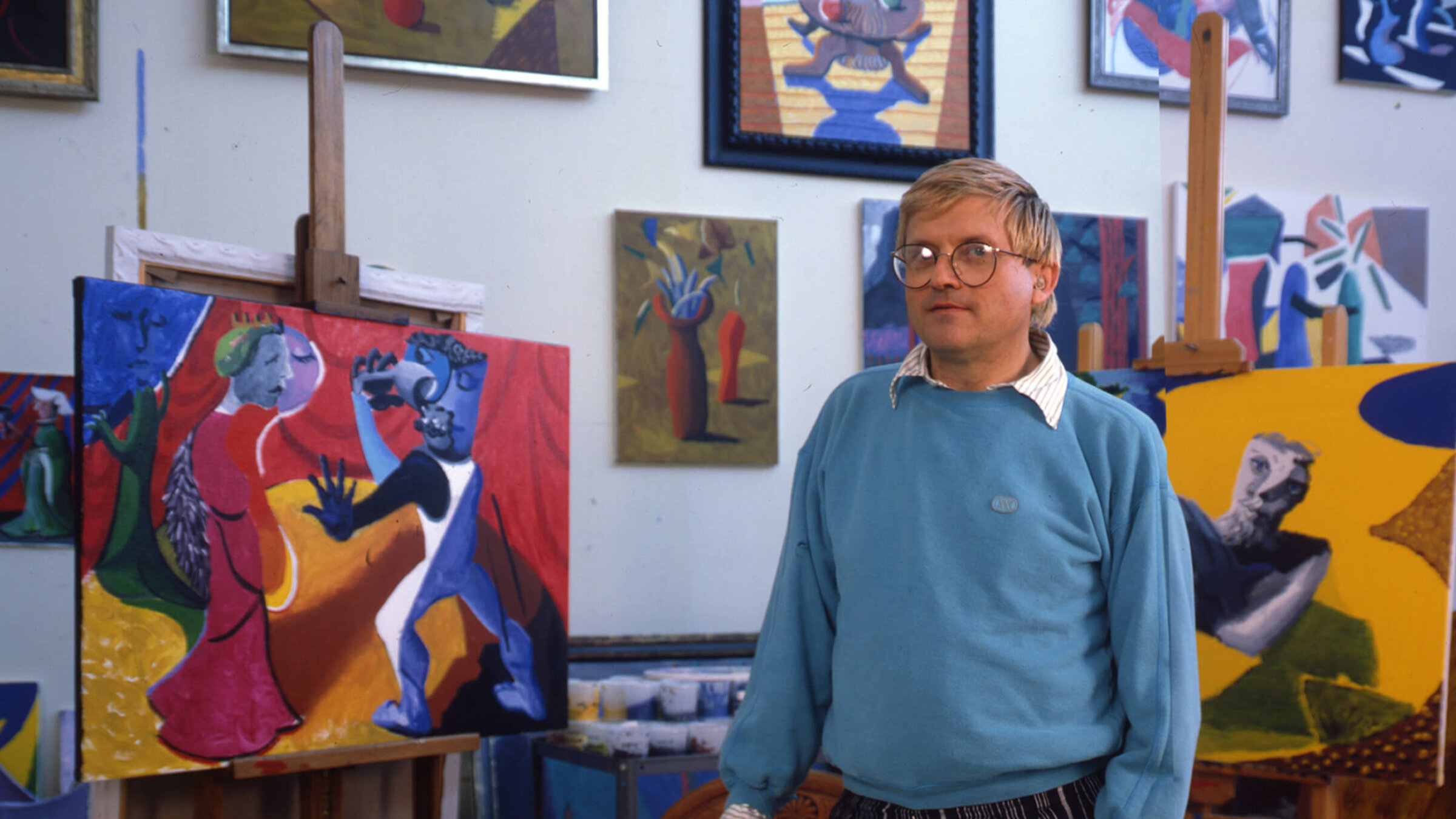
David Hockney in Los Angeles, California, in the 1980s. Photo by Anthony Barboza/Getty Images

By Talya Zax June 12, 2026
Think of the British painter David Hockney, who died Thursday at 88, and you think of color. 1967’s “A Bigger Splash,” almost certainly his most famous work, is a study in blue so profound that it’s nearly synesthetic: The pool is such a saturated cool that you can feel the water lap your feet, and the sky so rich with California sunlight that your shoulders burn. When Hockney turned more toward landscapes in later years, trees came in every color of the rainbow — here a pink trunk, there a purple — and roads were streaked salmon and teal.
Which makes it stranger that one of the works of his that I find most evocative has no color at all. It’s a 1975 pen and ink drawing of the American Jewish artist R.B. Kitaj, one of Hockney’s dearest friends, sitting on a bench outside an art school in Vienna.
Kitaj, head propped in his hand, looks out toward the left side of the page. His face is the lone area of detail in a scene thrown together with brisk, expressive lines. There is a sense of place around him, but that place is in the act of disappearing. As the scene spreads to the right and lower edges of the page — the areas that would fall outside Kitaj’s line of sight — it ceases to exist. Kitaj’s bench is slatted, rounded and real, but the bench abutting it is depicted in a few brief strokes. The buildings and street are sketched with light attention within what seems to be Kitaj’s periphery line, and are nonexistent beyond it.
The picture is a study of a man in deep focus. Hockney draws Kitaj’s head — and by inference, everything within it — as real and lifelike. But beyond the scope of Kitaj’s vision — the material the world presents him, possibly to be made into art — Hockney shows his surroundings as being valuable only as perspective lines, helping to situate the subject in space.
To be caught thinking is a vulnerable experience. To have someone restore your sense of your own physical self is a shock. By sketching Kitaj in his moment of remove, Hockney gave a renowned and somewhat glamorous friendship a sense of life. And he gave a sense of life, too, to the thing that made his own art so attractive: the impression of a rare and gorgeous intensity of vision, one that could draw a viewer’s attention so completely that it seemed what was on the canvas was the only real thing on earth.
In his drawing of Kitaj, the line is blurred between his subject’s concentration and his own. Is it really that Kitaj is so immersed in the act of seeing — or that Hockney is, his gaze so rapt upon his friend as to make him able to capture, briefly, what it was like to see through Kitaj’s eyes?
From the first days of their friendship at the Royal College of Art, Hockney and Kitaj existed on two planes for one another: human and artistic. As each worked to find the right way to reflect their own humanity in their art, their concepts of both themselves and their work influenced one another. “I was painting about my Jews and my books and Hockney was just coming out of the closet, so I said paint that,” Kitaj once said. And another time: “He switched to his gay culture as I began on my Jewish culture in its first forms.”
When Kitaj married the painter Sandra Fisher in 1983 — after Hockney introduced them in the 1970s — Hockney was his best man. “Those orthodox Rabbis had never seen such a gang under the chuppa,” Hockney told 032c magazine in 2025. At that moment, he said, “life for me had reached a dangerous perfection.”
A “dangerous perfection.” What did that mean? I see a glimpse of the answer in Hockney’s drawing of Kitaj — a sense of connection so complete as to threaten the boundaries of selfhood. At Kitaj’s wedding, Hockney experienced that threat as a kind of transcendence: Look, how wonderful being alive among other people can be. The experience captured in his drawing of Kitaj is different, but related. It’s that of a kind of looking, and seeing, that briefly gives total knowledge.
That kind of completeness is one of the aims of friendship, and also of art. There will be much to miss about Hockney, an artist who was easy to love. But the rare experience of absolute immersion that his best work gave its viewers may have made, out of all he accomplished, the biggest splash.

Hello, fellow Forward reader! I’m Joel Brown, a Forward reader and supporter for more than 15 years, and currently the chair of the board of directors.
I’m an avid Forward reader because it ticks so many of my essential boxes: excellent journalism, Jewish focus and diverse viewpoints. In today’s political climate, what I most appreciate is the Forward’s independence — made possible by the generosity of its membership.
The Forward is committed to bringing you unbiased, nuanced Jewish news. From my position as board chair, I see an exciting future as we expand our position as the definitive independent voice of contemporary American Judaism.
That’s why I’m paying it Forward, by matching $36,000 of reader gifts. It’s an investment in the Forward’s newsroom, to continue telling the American Jewish story with truth and independence.
— Joel Brown, Forward board chair
Support our mission to tell the Jewish story fully and fairly.