Inspired by a queer Bundist poet, this Jewish composer set her work to Yiddish music
Avi Fox-Rosen composed the piece by Irena Klepfisz, reflecting on the Warsaw Ghetto as Yiddish art-pop
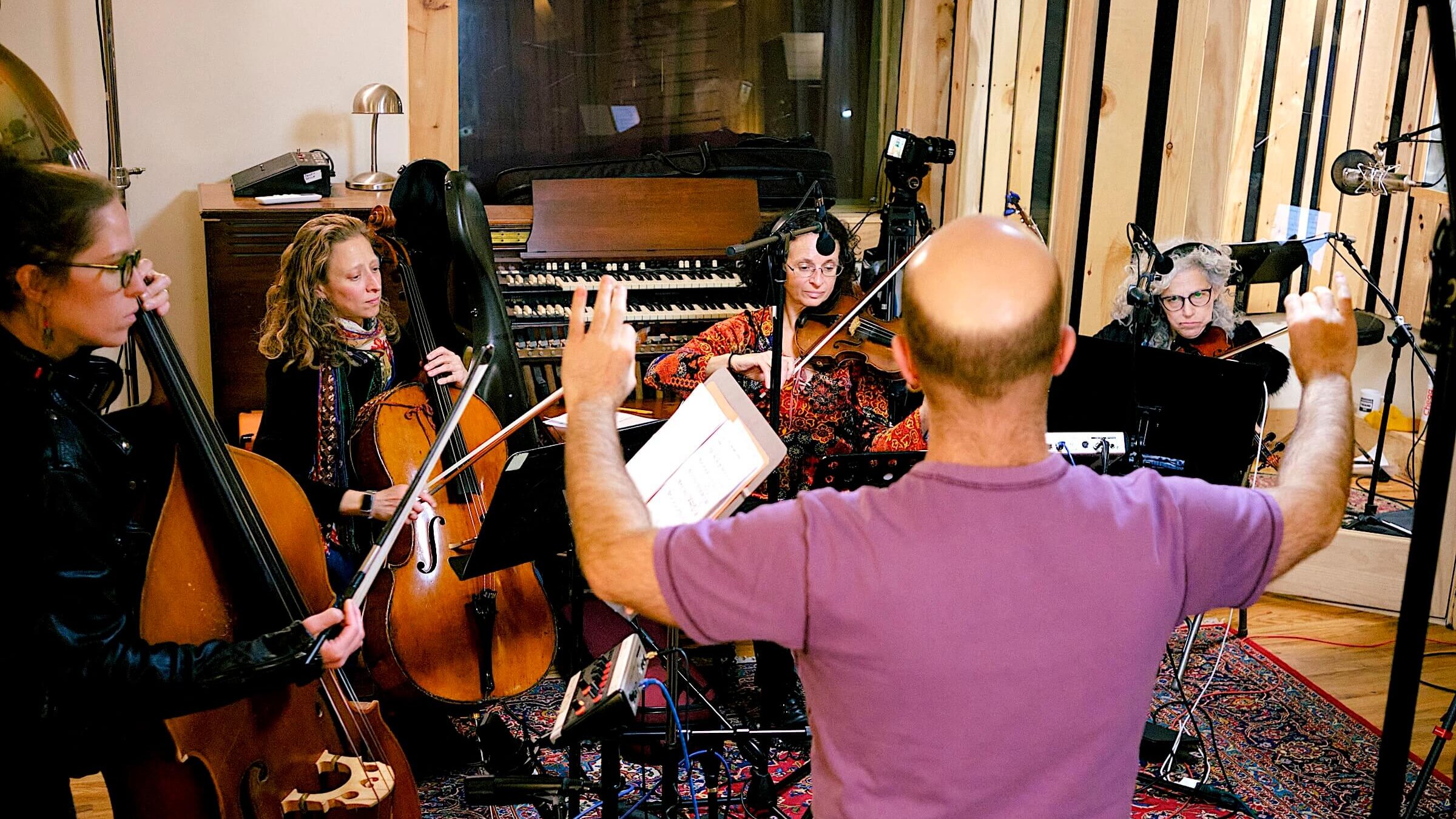
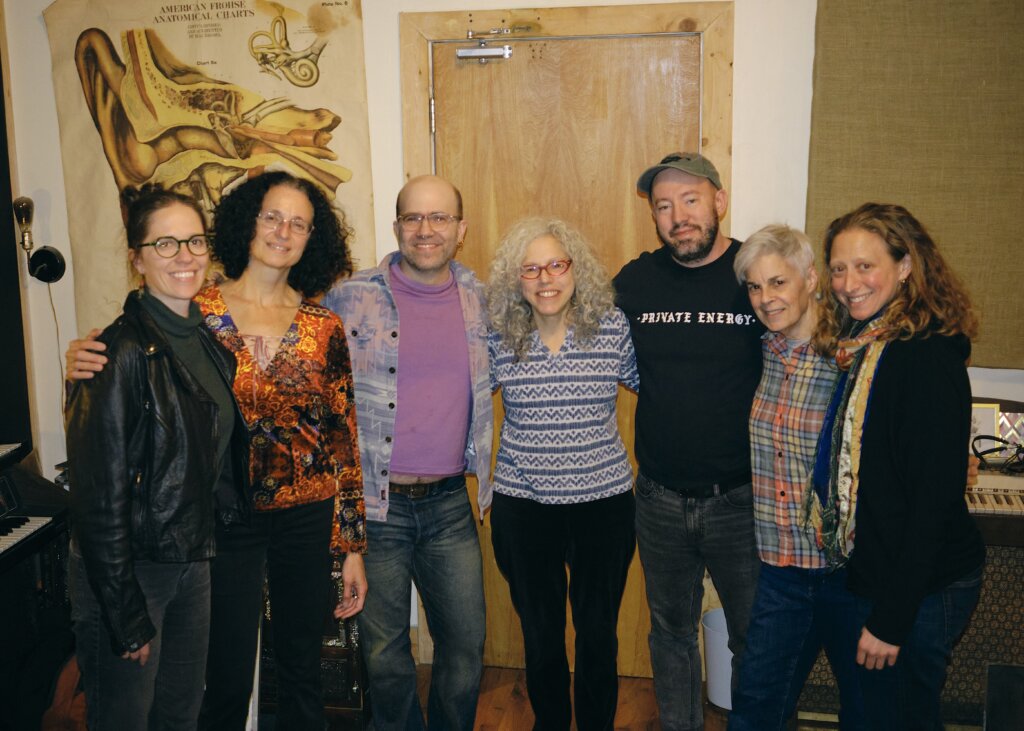
Avi Fox-Rosen directs a recording session for the album Photo by Shmulie Lowenstein
Composer Avi Fox-Rosen, like many Jews looking for meaningful community outside of religion, found a spiritual home in music.
“I think I was looking for, in some ways, a mentor or somebody in a generation ahead of me who can provide another model for how to be Jewish and work towards peace and intersectional justice,” Avi Fox-Rosen said.
He found queer Bundist poet Irena Klepfisz.
Klepfisz is the daughter of Michał Klepfisz, an organizer of the 1943 Warsaw Ghetto Uprising, and Rose Klepfisz. Michał was killed on the second day of the revolt.
Fox-Rosen recently set to music a poem by Klepfisz, “Di rayze aheym/The journey home.” The Yiddish-English bilingual poem is one of her best known works and has been central to many people who have sought queer, secular and leftist framings for their engagement with Jewish identity. Fox-Rosen is releasing a new original album of the same title on May 30.
“Di rayze aheym” is based on a trip Klepfisz took with her mother to Poland in 1983 around the 40th anniversary of the Warsaw Ghetto Uprising. It was the first time either of them had been back since World War II.
In an interview with the author, Klepfisz compared today’s clean, well-kept condition of the Jewish cemetery in Warsaw with its appearance during her visit in the ‘80s, when it was overgrown and weathered by time. “It was practically wild,” she said.
“Where ‘Di rayze aheym’ sprang from was that cemetery — there are allusions in the poem to it,” said Klepfisz. The poem contains a total of nine sections, including “Vider a mol/Once again” and “A beys-oylem/A cemetery,” with many of them containing direct translations between English and Yiddish side by side.
Fox-Rosen remembers being drawn to Klepfisz’s work in the time following Oct. 7, as many Jews were finding themselves renegotiating their relationship to Jewish identity. “She has this incredible body of work that explores identity and displacement and diaspora. Also queerness, of course, and this exists alongside her work in prose and activism,” Fox-Rosen said.
Fox-Rosen, the son of Reform Rabbi Karen Fox, comes from Los Angeles. He was not raised with a particularly strong relationship to Yiddish culture. Describing his Jewish schooling, he said that “there was no significant Yiddish content, but a lot of Hebrew content.” He immersed himself in music, Jewish and otherwise, and eventually came to Yiddish music and culture in a roundabout way.
“My first big plan was to be a jazz guitar player, move to New York City and get famous that way. So I moved to New York City and as I worked in the jazz scene, I got to know a lot of Jewish musicians doing meaningful work with Yiddish content,” said Fox-Rosen. Frank London of the Klezmatics, as well as Greg Wall who is often referred to as the “Jazz Rabbi,” are among the musicians Fox-Rosen cites as influential in getting more involved in Yiddish culture.
He was initially drawn more to the secular Yiddish community than the actual Yiddish language or music traditions, he said. “I loved that there was this committed group of secular Jews making really interesting music, that’s what drew me in.”
He went on to become a member of the Yiddish-language rock band Yiddish Princess, alongside Sarah Gordon, Michael Winograd and Yoshie Fruchter.
“I’d been looking for a non-religious way to express Jewishness and find my people, and Irena has largely been one of the people to shape this community,” said Fox-Rosen.
Klepfisz has often referred to herself as a “practicing secular Jew.” She notes the intensely secular values of the Bund in interwar Poland. “The Bundists in interwar Poland didn’t deny their Jewishness; in fact, they emphasized it. But they were also militant secularists. For example, they would insist on meetings on Shabes.”
Not wanting to show up empty-handed when offering Klepfisz to set her poem to music, Fox-Rosen produced a demo of some verses of “Di rayze aheym” set to music.
“I was very flattered,” Klepfisz said. “I thought it was actually a very good choice, because it’s a very minimalist poem, so you don’t have a lot of words to fit. There are a lot of big blank spaces for the music.”
What resulted is an album of art-pop meets klezmer and Yiddish. Fox-Rosen noted influences for him from art-pop musicians Rufus Wainwright as well as Anohni and the Johnsons. Essential for Fox-Rosen in evoking a Yiddish sound are the instrumental contributions of two familiar faces in Yiddish music: klezmer fiddler Alicia Svigals and improvisational pianist Marilyn Lerner. “At times I wanted it to feel like a real fiddle kapelye, which it often does because of Alicia,” said Fox-Rosen. Kapelye is Yiddish for a klezmer band.
“You know, we used to say that Yiddish was ‘on life support,’ but I don’t think that’s true anymore,” Klepfisz said. “There was the revival that popped up in the ‘80s with klezmer music and now I think there’s a much greater appreciation for Yiddish culture.”
“Di rayze aheym/The journey home” is now available for pre-order through Borscht Beat on Bandcamp and will be released on May 30 alongside a concert at Jalopy Theatre in Brooklyn.

Did you know that only 2% of Forward readers donate to support our nonprofit newsroom? That 2% make it possible for millions to read the Forward without a paywall or subscription — removing any barriers to the full and fair Jewish story.
But while the Forward is free to read, it isn’t free to produce. Big stories — like deep dives into the antisemitism data, political scoops or reporting trips to college campuses — take months of research and fact-checking. All while we keep you informed of what you need to know each day.
— Rachel Fishman Feddersen, Forward Publisher & CEO
Support our mission to tell the Jewish story fully and fairly.