Israel names a street after renowned Yiddish poet Abraham Sutzkever
Sutzkever was a leader of the “Paper Brigade” that rescued Jewish cultural treasures from the Nazis
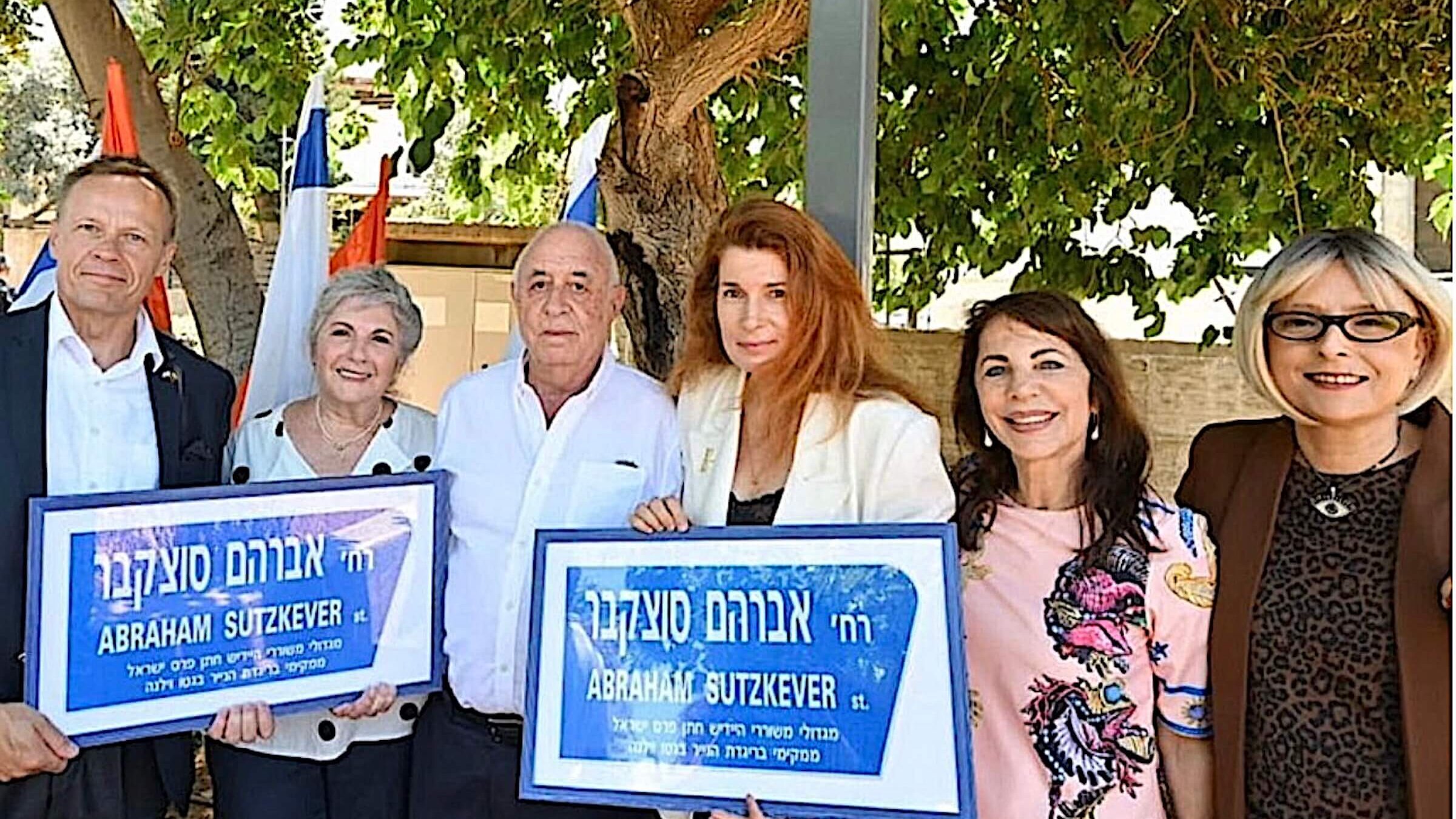
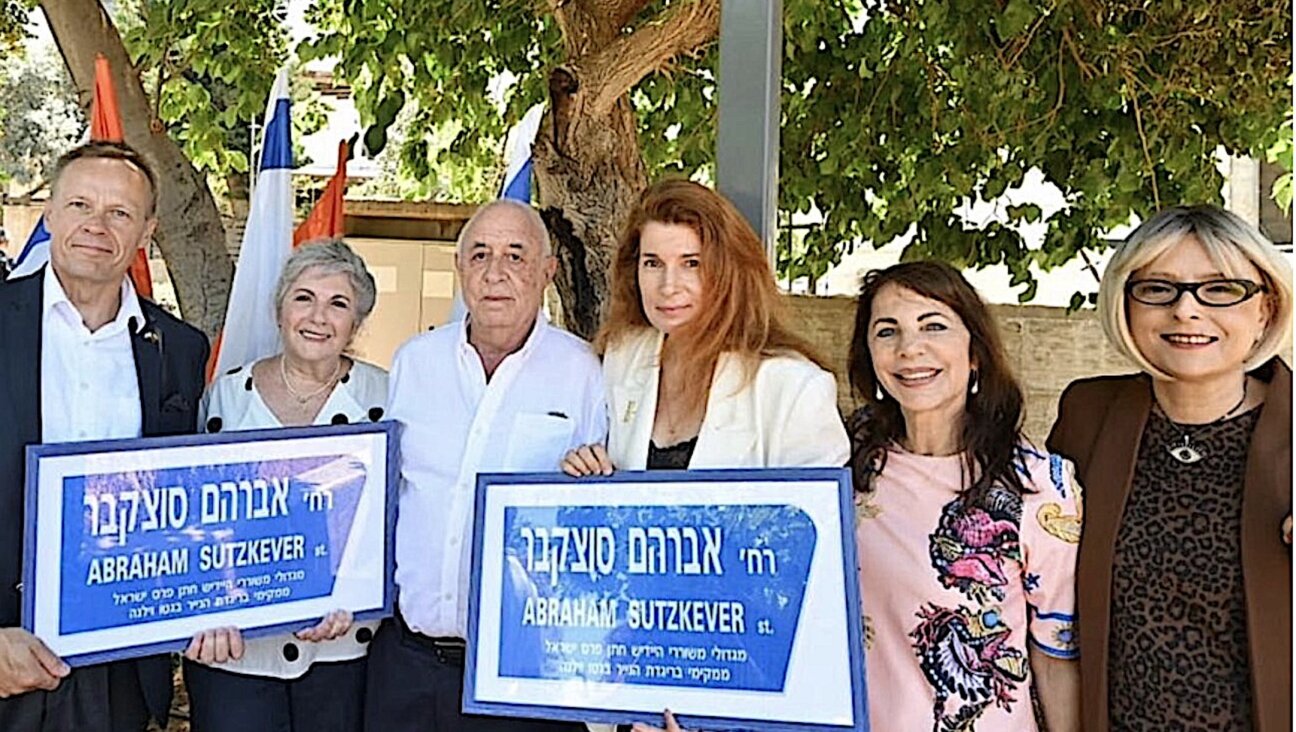
Dignitaries at the June 9th ceremony naming a street after Abraham Sutzkever in Netanya. Third from right: Sutzkever’s granddaughter, Hadas Kalderon Courtesy of Hadas Kalderon

By Rukhl Schaechter June 10, 2026
The Israeli city of Netanya has renamed one of its streets Rechov Avrom Sutzkever (Abraham Sutzkever Street), after the renowned Yiddish poet and Vilna partisan.
The event on June 10 marked an important cultural moment, recognizing the legacy of a poet who devoted his life to Yiddish language and Jewish culture. During his lifetime, Sutzkever was celebrated not only for his poetry, but also for editing the storied Yiddish literary magazine Di goldene keyt (The Golden Chain) for 46 years. His work remains a fixture in the field of Yiddish literature today.
Sutzkever was born in 1913 in the shtetl of Smorgon, in what is now Belarus. During World War I, his family moved to Siberia, where his father, Hertz Sutzkever, died. In 1921, his mother Rayne moved the family to Vilnius, where Sutzkever attended cheder.
Sutzkever survived the Vilna Ghetto. He was a leader of the “Paper Brigade” that rescued Jewish cultural treasures from the Nazis and later became the only Jewish witness called by the Soviets to testify at the Nuremberg Trials.
His poetry chronicled his childhood in Siberia, his life in the Vilna ghetto and his escape to join the Jewish partisans. In 1947 he settled in Palestine, later Israel.
In Israel, he continued to create, publish and preserve Yiddish culture for decades. Yet, despite his immense influence around the world, he remained less known in Israel because he chose to write and fight for the Yiddish language rather than switch to Hebrew.
This is the first time a street in Israel has been named after him. Even Tel Aviv never did so, despite the fact that Sutzkever lived there for many years and the city was once a hotbed of Yiddish cultural activity, due to the influx of Yiddish-speaking immigrants who settled there after the Holocaust.
The street-naming ceremony was attended by the Mayor of Netanya, Avi Slama; representatives of the Lithuanian Embassy; public figures, artists, and members of the family, including Sutzkever’s granddaughter, Hadas Kalderon.
In the past decade, Kalderon has been instrumental in keeping Abraham Sutzkever’s memory alive, most notably through two documentary films: Ver Vet Blaybn? (Who Will Remain?) in 2021, and Black Honey: The Life and Poetry of Avraham Sutzkever in 2018.
Kalderon told me that she was very moved by Netanya’s decision to name the street after her grandfather, in a garden overlooking the Mediterranean Sea. “It was not only a tribute to Sutzkever himself, but also a powerful moment of recognition for Yiddish language and culture within the State of Israel,” she said.
I’m personally matching all gifts to the Forward, up to $36,000. Can I match your gift now?

Hello, fellow Forward reader! I’m Joel Brown, a Forward reader and supporter for more than 15 years, and currently the chair of the board of directors.
I’m an avid Forward reader because it ticks so many of my essential boxes: excellent journalism, Jewish focus and diverse viewpoints. In today’s political climate, what I most appreciate is the Forward’s independence — made possible by the generosity of its membership.
The Forward is committed to bringing you unbiased, nuanced Jewish news. From my position as board chair, I see an exciting future as we expand our position as the definitive independent voice of contemporary American Judaism.
— Joel Brown, Forward board chair
Support our mission to tell the Jewish story fully and fairly.