Why children in Rio de Janeiro are singing in Yiddish
A cultural rediscovery is underway, led through music, university courses and children’s education.
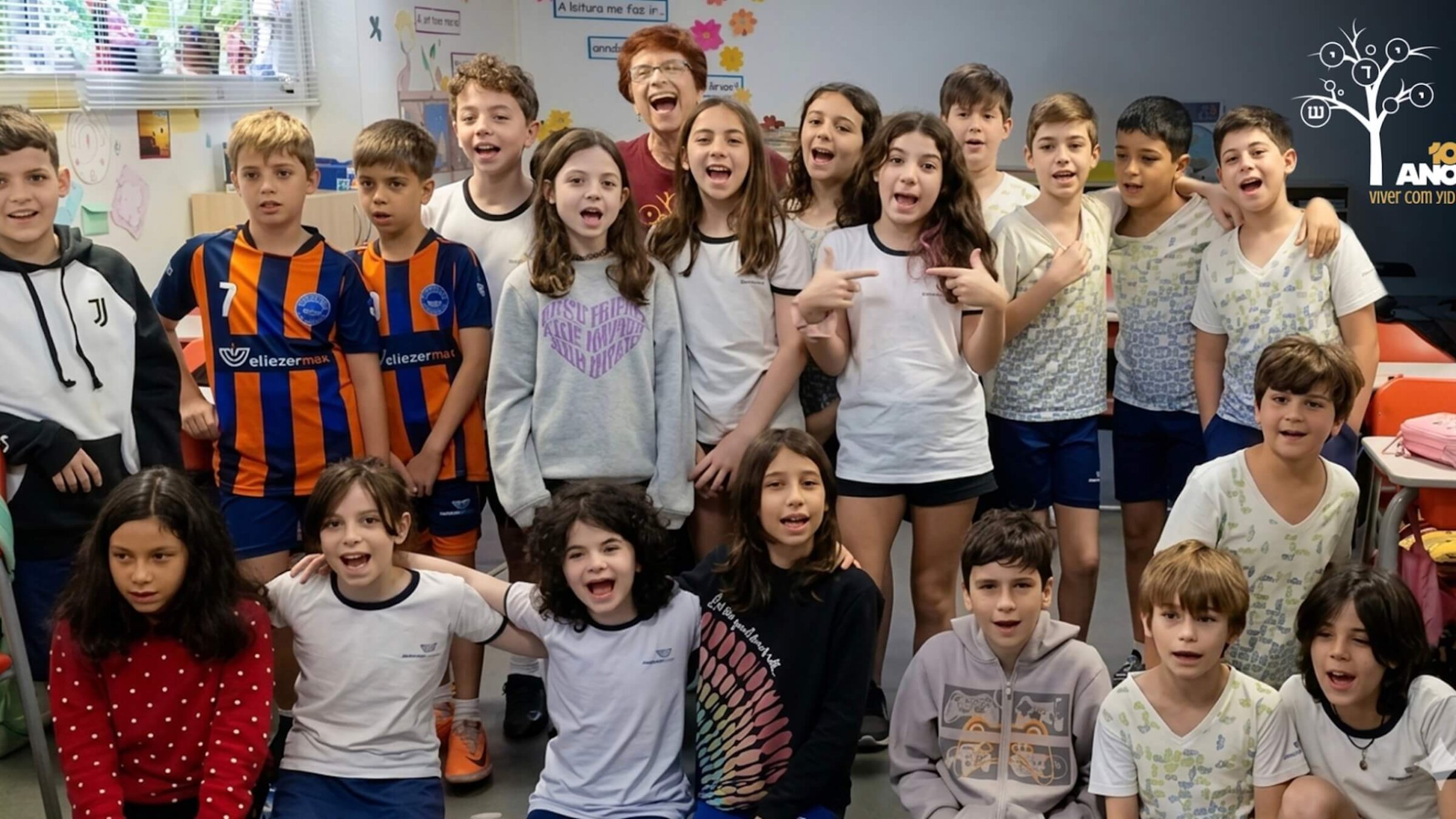
Students in the Yiddish workshop at the Eliezer Max Jewish day school in Rio De Janeiro Courtesy of Viver con yidish
By the time the children began singing in Yiddish on their own at a playground in Rio de Janeiro, Sonia Kramer realized something important had changed.
The songs were not part of a formal lesson. No teacher had prompted them. The children — classmates from a Jewish day school — simply started singing melodies they had learned in workshops organized by Viver com Yiddish (“Living for Yiddish”), the educational and cultural initiative Kramer founded a decade ago.
“For me, that was the moment the language felt truly alive,” she said. “Maybe later they will forget some of it. Maybe not. But at that moment, the songs became part of their memory.”
In Brazil, where Yiddish disappeared from Jewish day schools by the early 2000s (they used to teach the language once or twice a week), such moments are rare enough to feel historic.
Kramer, an emeritus professor at the Pontifical Catholic University of Rio de Janeiro (PUC-Rio) and a daughter of an Auschwitz survivor from Ostrowiec, Poland, doesn’t describe what’s happening as a “revival.” The word feels too grand for Rio’s context. There are no Yiddish-speaking neighborhoods anymore, no immersion schools, no daily life conducted in the language.
Something else, though, is emerging: a cultural rediscovery led through music, literature and children’s education. Yiddish is circulating again — at shows, at parties, in university classrooms. It’s not yet a revival, but Yiddish is undeniably alive.
“We skipped a generation,” Kramer said. “The immigrants wanted their children to learn Portuguese. Yiddish reminded many people of sorrow and survival. But now we are beginning to value what was created in that language — the literature, the songs, the poetry, the theater, the cinema.”
A spark that grew into a program
The roots of Viver com Yiddish reach back to 2016, when Kramer attended the annual Yiddish immersion retreat, Yiddish Vokh.
“For the first time in my life, I was in a place where 150 people were speaking and singing in Yiddish — every day, all week,” she recalled. “Not as nostalgia. As a language that is alive.” One day at the event, an educator familiar with Kramer’s work in childhood education encouraged her to create Yiddish workshops for children in Brazil.
Back in Rio, Kramer approached several progressive Jewish schools with a proposal: Not traditional language instruction, but cultural workshops built around shmuesn (daily conversation), Yiddish songs, stories, games and children’s literature. One school, Escola Eliezer Max, agreed to join the project.
Today, the initiative encompasses university classes, research projects, a musical ensemble and workshops that reach 400 to 500 children annually.
Some of the educators came through those university courses. Alice Fucs began studying Yiddish through Kramer’s courses at PUC-Rio and has taught in the children’s workshops ever since.
“I started studying Yiddish in 2020 and soon realized I would never stop,” she said. “It connected me with my family’s past and opened up a new and amazing world. The workshops with the children are both a chance to pass on what I’ve already learned and a chance to learn more every month.”
Teaching has its own challenges. “Some of the children find it hard to grasp a language that isn’t tied to a country,” Fucs said. “We bring in contemporary Yiddish work to try to build that bridge.”
The workshops run once a month, preschool through fifth grade — far from enough to create fluency. But fluency isn’t the immediate goal.
“Our first objective was to create an emotional memory,” she said. “Positive feelings connected to Yiddish.”
Teaching a language that “disappeared”
A couple of years ago, one encounter crystallized the challenge: During a workshop, a 10-year-old boy told the teachers that learning Yiddish was pointless.
“My parents told me not to pay attention to this,” he said. “The language disappeared from the world.”
The comment deeply affected the workshop educators who decided to respond not with argument, but with evidence.
A month later, they returned carrying a large bag of Yiddish children’s books; many bilingual.
The children protested immediately.
“But we can’t read Yiddish,” they told her.
“You can read some of it,” Kramer replied.
Kramer showed them Yiddish interviews produced by the Yiddish Book Center and Yiddish music clips performed abroad, explaining that the language is alive in many countries. The children seemed impressed.
For Kramer, moments like this counter a familiar misconception: that Yiddish belongs only to the past, or that it was merely a “dialect.”
“People still say that it’s not really a language, then you have to explain: No, it has literature, poetry, theater, philosophy. It developed across centuries.”
Growing seeds through music and stories
The workshops at Eliezer Max begin with four-year-olds. Meeting only once a month, teaching grammar isn’t the goal. Instead, the project meets children where they already are: in songs and stories. Before launching the workshops, Kramer noticed that Yiddish songs had virtually vanished from Rio’s Jewish schools. “In my childhood, Yiddish music was everywhere,” she said. “And suddenly there was nothing.”
So the workshops focus on repertoire: songs, stories, emotional connection. Teachers explain who wrote the lyrics, introducing children to Yiddish poets and writers. “What is extraordinary in Yiddish culture,” Kramer said, “is how deeply literature lives inside the music.”
The approach resonates. The school coordinator now includes Yiddish songs at school events, alongside the Portuguese, Hebrew, and English repertoire. Music teachers prepare children to perform them; families hear the music at holiday celebrations; classroom teachers incorporate elements into broader cultural programming.
Sometimes the songs travel home. “Is there a greater fargenign (joy) than receiving a video of my 12-year-old granddaughter and 9-year-old grandson spontaneously singing Tumbalalaika before bed?” said Sonia Tucherman, grandmother of two children in the workshops. “It was a seed planted by my grandparents, and I see it bearing fruit in my grandchildren.”
Still, the program’s reach has clear limits. Yiddish isn’t part of the school’s curriculum — the workshops sit alongside it, not within it. They end at fifth grade, which means older children often drift from the songs they once knew. And one meeting a month, said Kramer, isn’t enough to anchor a language.
Building something to last
For all that it has built, Viver com Yiddish still rests on a fragile structure.
Most of the educators and musicians involved work multiple jobs. Much of the organizational labor — translating materials, adapting books, preparing lessons — falls to volunteers. Kramer herself works largely as a volunteer, but that arrangement isn’t sustainable for the younger teachers and musicians who built the project into what it is.
Viver com Yiddish’s current fundraising campaign aims to train a new generation of Yiddish educators and create paid positions to coordinate educational materials and programming.
“You cannot sustain this on passion alone,” Kramer said. “We have to train the next generation, and give the people already doing this work the conditions to continue.”
“We’re trying to bring back a language and a culture considered lost by our generation, and pass it to another generation,” she said. “That feels deeply Jewish to me: taking something from the past and carrying it into the future.”
Did you know that only 2% of Forward readers donate to support our nonprofit newsroom? That 2% make it possible for millions to read the Forward without a paywall or subscription — removing any barriers to the full and fair Jewish story.
But while the Forward is free to read, it isn’t free to produce. Big stories — like deep dives into the antisemitism data, political scoops or reporting trips to college campuses — take months of research and fact-checking. All while we keep you informed of what you need to know each day.
— Rachel Fishman Feddersen, Forward Publisher & CEO
Support our mission to tell the Jewish story fully and fairly.