At the dawn of the World Cup, the story of the Jews who helped bring soccer to America
We’ve all heard of Lionel Messi, but what about Eddy Hamel, Jeff Agoos and Alan Rothenberg?

The World Cup officially begins June 11 with a match between Mexico and South Africa. Photo by Getty Images

By Dan Friedman June 10, 2026
When the North American FIFA World Cup starts in Mexico City on June 11, the story will largely be told through the familiar lenses of Lionel Messi, the geography of the 48 participants and three hosts, and — because 75% of the games will be played there — the continuing rise of soccer in the United States. But there is another, less familiar story woven through the tournament: the long, strange and often overlooked history of Jews in North American soccer.
Mostly that’s been in the United States where players and owners have included a larger proportion of Jews than in Canada and Mexico. By my count, no Jewish players have represented Mexico, and only two Jewish men have represented Canada at senior international level and one of them, Tomer Chencinski, only did so once, in a friendly game where Canada lost 2-0 to Belarus in Doha. (Daniel Haber played 5 international games in his career).
For whatever reason, whether more closely linked to Europe, denied entry to other sports, or just arbiters of excellent taste, Jewish Americans have been at the forefront of soccer in the United States for over a century. The first American to play for a major European team was Eddy Hamel for Ajax Amsterdam in 1922. Hamel was a New York-born winger who became a star for Ajax in Amsterdam during the 1920s. An injury forced his retirement in the 1930s and, after the Nazi occupation of the Netherlands, he was deported and murdered at Auschwitz in 1943. His story remains one of the most tragic intersections of Jewish history and world football.
Jews also comprised the largest soccer crowd in America when 46,000 New Yorkers watched Hakoach Vienna play New York All Stars in 1926. That record stood for over 50 years but it also encouraged a number of members of the Hakoach team to emigrate to the US and start a New York team that was a crucial part of the American Soccer League of the era.
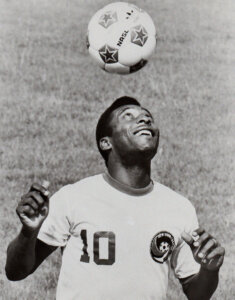
Later, in the 1970s, the National American Soccer League — the glitzy NASL — became a success thanks to the glamorous New York Cosmos. As head of Warner Communications, their CEO Steve Ross, born Rechnitz, was the person who brought Pele over and made the league the star-studded affair it became. After Herman Sarkowsky co-founded the Seattle Sounders, the continent was almost ready for football.
When the NASL faded and folded, soccer dwindled as a major sport in the United States. Alan Rothenberg saw an opportunity to revive the sport by hosting the 1994 World Cup and founding the MLS as a reset. As president of the U.S. Soccer Federation and the chief executive of the World Cup USA 1994 organizing committee, he made both of those happen and laid the foundations for the current shape of U.S. soccer.
The success of the MLS was not a foregone conclusion, though; indeed, it barely survived to the millennium. It was founded in 1993 but only started playing in 1996 — losing an estimated $350 million between its founding and 2004. The league initially turned to Don Garber, a former NFL executive, in August 1999 but even he couldn’t turn it around. By late 2001, it looked like the league would fold like its predecessors but it was able to secure new financing from owners Lamar Hunt, Philip Anschutz, and the Kraft family to take on more teams. Over the past 20 years, it has become robust, enjoying the general boom of all things soccer, riding the coattails of the English Premier League.
Without Robert Kraft and Anschutz, Major League Soccer might not exist today. During the league’s precarious early years, the two billionaire owners absorbed enormous losses to keep the fledgling competition alive. Kraft, the owner of the NFL’s New England Patriots, was also a central figure in bringing the 2026 World Cup to North America. As chairman of the United Bid Committee, he played a crucial role in securing the tournament for the United States, Canada and Mexico.
If Kraft represents one side of the Jewish soccer story, Chuck Blazer represents another.
The larger-than-life American soccer executive helped expose corruption inside FIFA, serving as a key witness in the investigations that ultimately toppled some of the most powerful figures in world football. Yet Blazer was a product of the very system he later helped unravel. His spectacular rise and fall remains one of the strangest chapters in soccer history, a tale of luxury apartments, exotic pets and global corruption.
Unlike baseball, basketball or boxing, soccer never became known as a major arena of Jewish achievement in the United States. Perhaps that has been due to the historic lack of status for soccer in the country. Despite the excellence of Yael Averbuch West for the USWNT and a number of Jewish players for the USMNT including Jonathan Bornstein, Benny Feilhaber, Dan Calichman, DeAndre Yedlin, Kyle Beckerman and the maverick Yari Alnutt there have been no soccer equivalents of Sandy Koufax or Hank Greenberg.
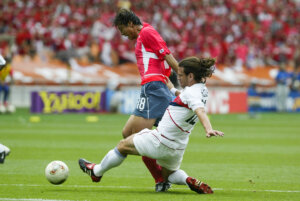
The stalwart defender Jeff “Goose” Agoos came closest with 134 international appearances and six more for the U.S. soccer Olympic team. But playing with a mediocre USMNT, he enjoyed few legendary moments. In fact, arguably no professional moments outshone the bizarre story of his 1989 NCAA championship ring in his junior year, the season that he played in the Maccabiah. On Dec. 3 of that year, his Virginia Cavalier team (playing for future USMNT coach Bruce Arena) met the top ranked, undefeated Santa Clara team in a freezing cold stadium in Piscataway, N.J. The teams were still tied 1-1 after FOUR overtimes and, with no penalties on the books, they shared the spoils. It was the third time that two teams shared the championship and has never happened again.
This year’s USMNT squad does include the only Jewish player at this summer’s tournament — reserve goalkeeper Matt Turner. If, as coach Mauricio Pochettino plans, Turner exclusively warms the bench, he will take his place alongside many of America’s notable Jewish soccer figures who have furthered the game, even if not on the field.
I’m personally matching all gifts to the Forward, up to $36,000. Can I match your gift now?

Hello, fellow Forward reader! I’m Joel Brown, a Forward reader and supporter for more than 15 years, and currently the chair of the board of directors.
I’m an avid Forward reader because it ticks so many of my essential boxes: excellent journalism, Jewish focus and diverse viewpoints. In today’s political climate, what I most appreciate is the Forward’s independence — made possible by the generosity of its membership.
The Forward is committed to bringing you unbiased, nuanced Jewish news. From my position as board chair, I see an exciting future as we expand our position as the definitive independent voice of contemporary American Judaism.
— Joel Brown, Forward board chair
Support our mission to tell the Jewish story fully and fairly.