This year’s biggest World Cup upset came from its most Jew-ish team
Cape Verde, the island country that shut out Spain, has a rich Sephardic heritage — and a player with likely Jewish ancestry
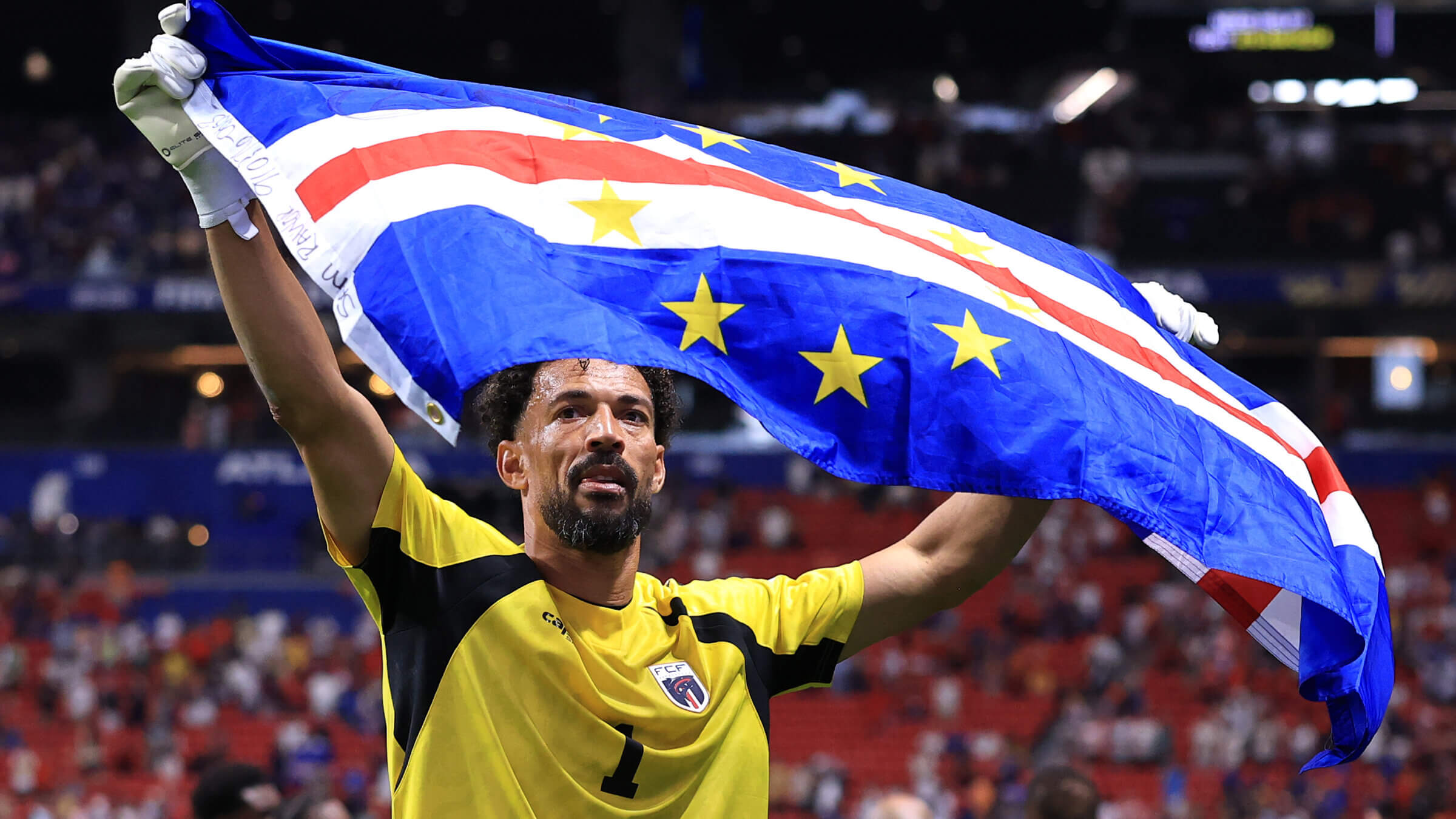
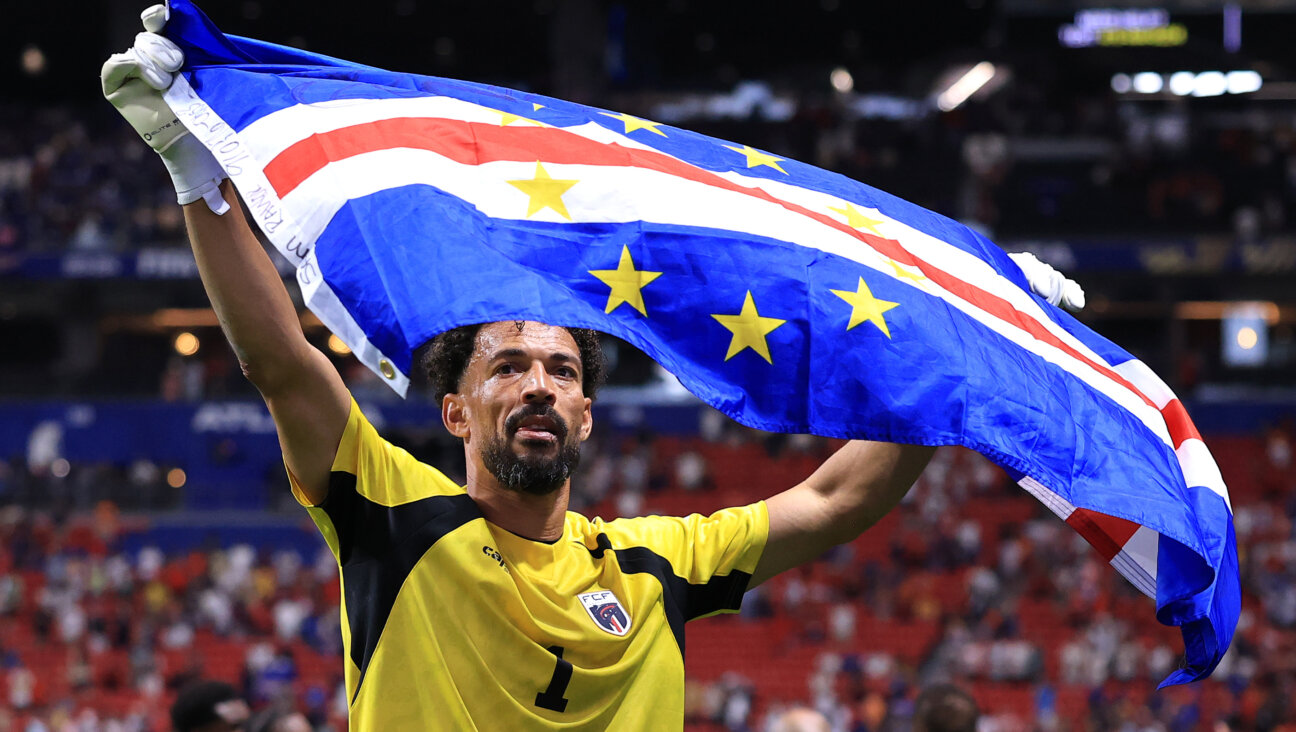
Vozinha, the Cape Verde goalkeeper, waves the national flag after the 0-0 draw with Spain. Photo by Buda Mendes/Getty Images
By Louis Keene June 18, 2026
Cape Verde, an island nation of about 530,000 people off the coast of Africa, shocked soccer fans around the globe by holding Spain without a goal in their debut World Cup match this week. But Carol Castiel saw it coming.
For the better part of four decades, Castiel has been working to document and preserve the island nation’s rich but little-known Sephardic heritage. And while there are no known practicing Jews in Cape Verde today, Castiel said connection to Jewish identity remains in the country and in its soccer team.
The proof, she said, was in the team’s first result.
Cape Verde’s stout defense — led by 40-year-old goalkeeper Vozinha’s seven saves — shut out the team FIFA ranked second-best in the world, and a country whose GDP is 600 times greater than its own. Cape Verde, ranked 67th, didn’t buckle as Spain fired shot after shot on the goal. The game ended in a 0-0 stalemate.
“In the face of hardship, they just keep going, and they find ways,” Castiel said. “They’re the underdog.”
But there was also a Jewish genealogical connection on the Cape Verde team sheet: Reserve forward Gilson Benchimol’s surname dates back some 150 years to Sephardic Jews on the island.
The 2026 World Cup’s biggest upset to date has put the spotlight on the 10-island archipelago about 350 miles west of Senegal. Castiel, an American Jew and ex-journalist who is obtaining citizenship in Cape Verde, is also hoping it brings attention to her effort to preserve Jewish memory there.

An island nation’s Jewish roots
Jewish life on Cape Verde dates back to the 16th century, when the Portuguese Inquisition caused Jewish converts to Christianity — known then as “New Christians” — to emigrate en masse from the Iberian peninsula. (The Portuguese Inquisition started a couple decades after the Spanish Inquisition.)
The islands were far from the center of the Inquisition, perhaps allowing some of the exiled to resume practicing Judaism in secret. They also offered New Christians the chance to pursue commercial opportunities in international trade. These New Christians lived under surveillance even in Cape Verde, though, and one of the islands had a Jewish ghetto in the 16th century.
That first wave of migrants eventually assimilated through marriage or out-migrated, and the archipelago’s Jewish footprint largely disappeared. Some historians suggest that last names on the island related to trees and animals, like Carvalho (oak) or Pinto (chick), hint at possible Jewish ancestry. (Some Sephardic Jews and conversos adopted or were assigned last names during the Inquisition.)
Cape Verde became a popular Jewish destination again in the second half of the 19th century, after the Inquisition ended. The territory was still a Portuguese colony with a powerful grip on transatlantic trade, and Jewish emigres — many from the northern Morocco city of Tetouan — found success in agriculture and international shipping.
“They were key to the economy in those days,” Castiel said.
Some of the primary exports from that era, like coffee and rum, continue today. (The islands were also a hub of slave trade, and historians believe New Christians were among the slave traders.)
Few in number and mostly male, the latter wave of Jewish immigrants also married out of the religion, Castiel said, and their descendants today are Catholic. But their Jewish surnames remain prevalent on the islands. Castiel said names like Cohen and Levy, as well as variations on common Sephardic names like Ohayon and Benchimol, show that “the blood of Jews is running through the veins of a lot of people there.”
Castiel said she did not believe the national team’s Benchimol — who plays professionally for the Russian club Akron Tolyatti — identifies as Jewish. (The Forward has reached out to the player for comment.)
Though the Cape Verdeans with common Jewish surnames don’t tend to identify as Jewish, many embrace their Jewish ancestry.
One of them is Jose Levy. His great-grandfather, Fortunato Levy, emigrated from Morocco in the late 19th century and started a business doing sea-transportation around the islands. His father worked for the Portuguese government until Cape Verde won independence in 1975.
Levy, who worked for the United Nations before retiring recently, said many Jewish Cape Verde families returned to Portugal after independence. But to this day, many of his friends in Praia — the Cape Verde capital, where he lives — have Jewish names.
“Neither me nor my father were directly exposed to Jewish religion,” Levy, 68, said in an interview. “But our grandparents and great-grandparents were proud Jews, and they made a great contribution to what Cape Verde is now.”
Historic preservation
There are no known synagogues on the islands — even historic ones — and Cape Verde is one of the rare places in the world without a Chabad. But there are at least four small Jewish cemeteries spread across three islands, Castiel said. Modeled after Moroccan cemeteries, each has white horizontal stones with inscriptions in Hebrew and Portuguese — but they were overgrown, eroding or otherwise disarrayed when Castiel first visited.
“In Judaism, the most important thing is to create burial grounds to rest the souls,” Castiel said. “In that regard, these Jews did that. It’s just that they couldn’t sustain it.”
The nonprofit she founded in 2007, the Cape Verde Jewish Heritage Project, aims to restore the sites and expand the documentation and of Jewish life on the island through research, oral history and tourism. In 2018, the nonprofit installed a series of plaques to commemorate the 19th-century Jewish settlers interred at the cemeteries.
According to Castiel, the nonprofit’s primary funder is Morocco’s King Mohammed VI, whose Jewish historic preservation efforts in Morocco — the ancestral homeland of many Cape Verde migrants — are well-documented. Levy sits on the board.
“We carry the last name, but the religion aspect was not transferred, so we are Catholic,” Levy said. “But we are very proud of our Jewish ancestors.”
Did you know that only 2% of Forward readers donate to support our nonprofit newsroom? That 2% make it possible for millions to read the Forward without a paywall or subscription — removing any barriers to the full and fair Jewish story.
But while the Forward is free to read, it isn’t free to produce. Big stories — like deep dives into the antisemitism data, political scoops or reporting trips to college campuses — take months of research and fact-checking. All while we keep you informed of what you need to know each day.
— Rachel Fishman Feddersen, Forward Publisher & CEO
Support our mission to tell the Jewish story fully and fairly.