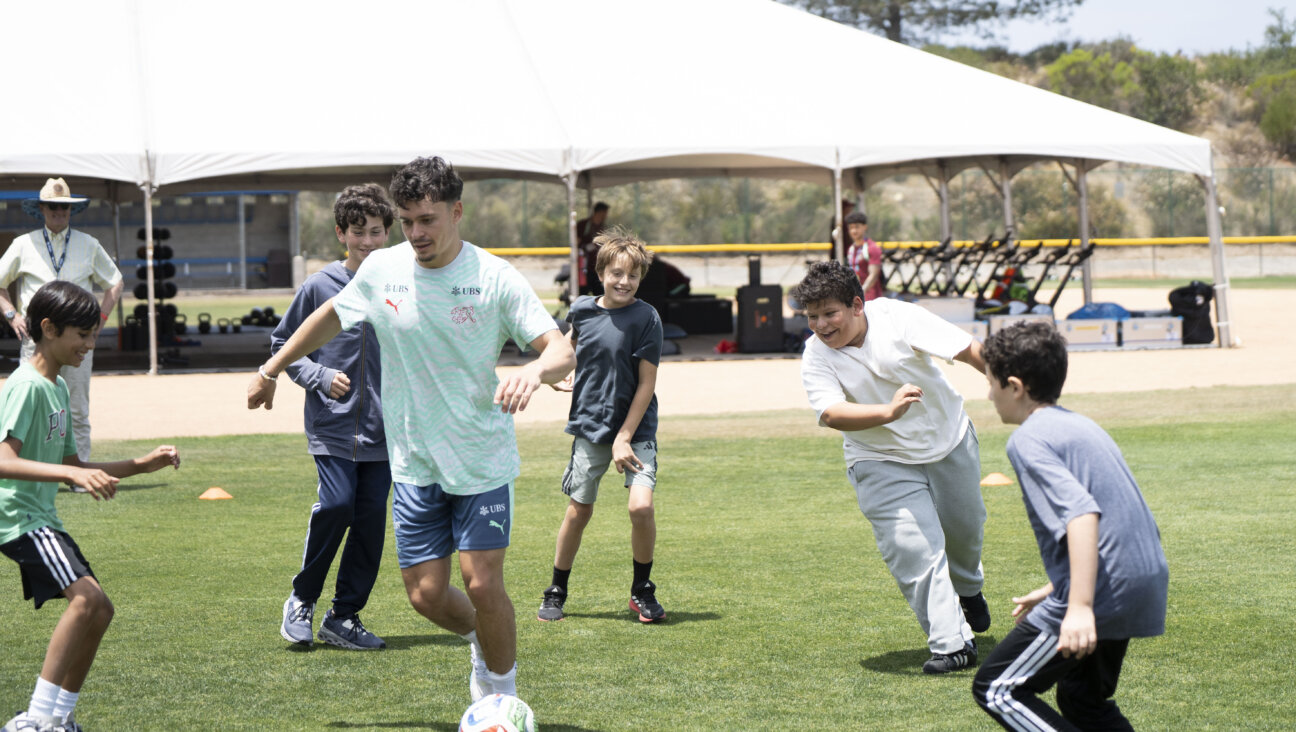
Swiss World Cup team sets up shop at California Jewish day school’s soccer field
San Diego Jewish Academy has been hosting Switzerland’s national squad. Cue the snake jokes
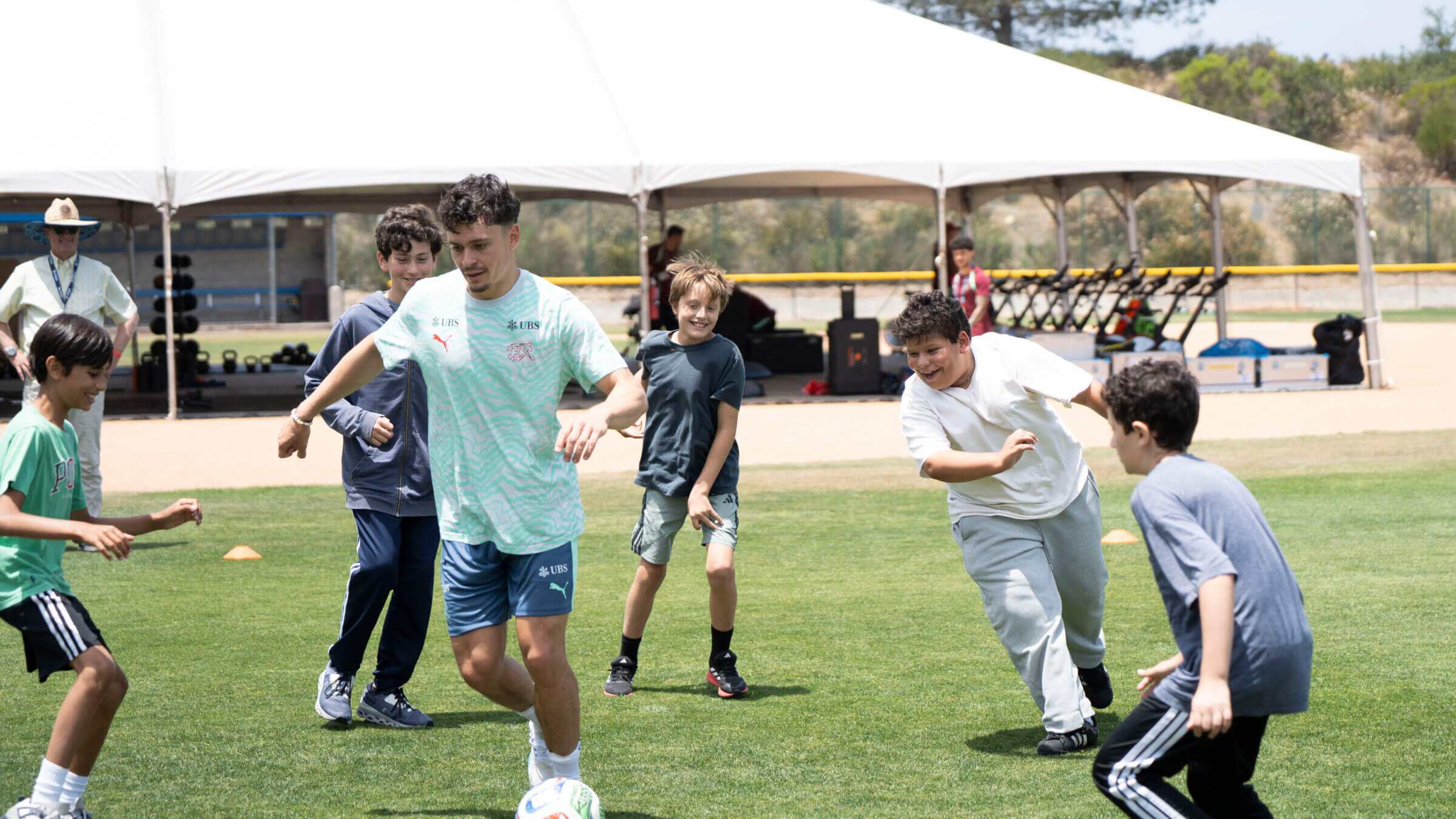
Swiss winger Fabian Rieder plays with San Diego Jewish Academy students. Courtesy of San Diego Jewish Academy
By Louis Keene June 11, 2026
For years, San Diego Jewish Academy had been preparing for the World Cup. The school, serving students from pre-K through 12th grade, has one of the best soccer fields in California, and tournament organizer FIFA had approved the site to serve as a national team’s base camp — if any visiting countries were interested.
When the school looked at the World Cup’s qualifying nations, they wondered if their plans might be for naught.
“You have Qatar, Egypt, Jordan, Iran — teams that wouldn’t necessarily choose the Jewish Academy,” said Adam Benmoise, SDJA’s director of auxiliary programs. “We were nervous.”
To their relief, the World Cup schedule delivered a stroke of luck. The four teams playing group-stage games on the West Coast did include Qatar. But one the others was a country famous for its neutrality. Switzerland began practicing at the Jewish day school June 2.
Both sides have found the arrangement a winning one. For Switzerland, San Diego Jewish Academy is more than just a practice field. It’s also a gym, a media center and an office space. (Or a synagogue, if they needed one.) And for SDJA, a pluralist school with about 500 students, the rental arrangement doesn’t just pay the bills: it also connects the local Jewish community to the world’s biggest sporting event.
The partnership is the culmination of four years of planning for Benmoise, a lifelong soccer fan whose job is to drum up outside revenue for the school. Recognizing the unusual quality of the SDJA field — real grass, not turf — he pitched the school’s CFO and athletic director on the idea of renting it out to pro teams with an eye on the 2026 World Cup.
His first move was to bring San Diego tourism officials for a site visit. They were shocked — and word got around about the 56-acre hillside campus.
“It’s a true gem,” Benmoise said. “It’s built properly, it’s manicured properly, it’s mowed properly, we have the proper irrigation. It has all of the footprints of a professional-grade soccer field, but was built for a school.”

The field was used for practices during the Gold Cup, a biennial international soccer tournament, then by Major League Soccer and touring European clubs, and finally by the U.S. men’s and women’s national teams — whose rave reviews of the campus put San Diego Jewish Academy on FIFA’s radar.
To be added to FIFA’s official site catalogue for the World Cup, though, the vetting was more rigorous. The international soccer governing body has strict pitch standards, and it employs a phalanx of inspectors and groundskeeping experts to ensure fields are up to par and consistent with one another. Benmoise also had to prove that SDJA’s facilities could accommodate the wide-ranging needs of a national team program.
In response, the school expanded the playing area by covering an unused softball diamond with 16,000 square feet of sod — a project funded by school donors. (SDJA hasn’t fielded a softball team for over a decade, Benmoise said.) The school also rented and installed a 4,500 square foot tent with tile flooring to set up a gym alongside the pitch — a temporary construction that will be paid for by the Swiss. Benmoise is hopeful the school will get to keep the workout equipment.
Sergio Affuso, a press officer for the team, said in an email that Switzerland was “very happy” with the base camp. “It is great to see how enthusiastic everyone is about hosting us here, included the kids of the school, and the facilities are very well prepared,” Affuso said.
Per FIFA rules, each of the 48 countries playing in the World Cup has to host a public community day at their base camp to locals during one of its first five days of practice. But because school was still in session those days, FIFA allowed SDJA to invite only the internal school community to the event.
That day — June 3 — the SDJA student body, faculty and a few dozen parents filled the bleachers to watch the “Red Crosses” practice. Then the team set up some mini games to play with the kids — shooting on the goalies, passing and dribbling drills, and the crowd-pleaser known as “three Swiss players against 45 fourth graders.”
A pair of journalism-interested SDJA students are getting another special perk: the Swiss federation hired them as media interns for the duration of their stay in San Diego.
Benmoise didn’t want to share how much FIFA is paying to use the field, but said the compensation is “very generous.”
“Let’s just say we’re not charging FIFA the same that I would charge, like, a youth team,” he said.
SDJA isn’t the only Jewish school whose facilities rate professional use. A pair of Orthodox high schools in Los Angeles rent their basketball gyms to NBA players for off-season workouts. The all-star roster that uses those courts appreciate not only their quality, but also the schools’ privacy and security.
Benmoise said the Swiss team — which kicks off against Qatar on Saturday in San Francisco — was thus far too focused on game prep to explore the rest of the campus. But a social media post from the team’s Instagram account about their practice field did cause a stir back home.
The post was an overhead map of the practice facility, showing the dressing area, the play area, the goalkeeper area and — on the next slide of the carousel — the hills beyond the field, labeled “snake area.”
“Watch out for the snakes 🐍 👀,” the caption read.
An alarmed Swiss media published a number of stories about the threat of serpentine pitch invasions, forcing Affuso clarify that the post was an attempt at humor.
“People in Switzerland understood the joke,” he told The Athletic. “But maybe, abroad, they didn’t.” (Benmoise said snakes had “never been an issue” on the campus.)

Hello, fellow Forward reader! I’m Joel Brown, a Forward reader and supporter for more than 15 years, and currently the chair of the board of directors.
I’m an avid Forward reader because it ticks so many of my essential boxes: excellent journalism, Jewish focus and diverse viewpoints. In today’s political climate, what I most appreciate is the Forward’s independence — made possible by the generosity of its membership.
The Forward is committed to bringing you unbiased, nuanced Jewish news. From my position as board chair, I see an exciting future as we expand our position as the definitive independent voice of contemporary American Judaism.
That’s why I’m paying it Forward, by matching $36,000 of reader gifts. It’s an investment in the Forward’s newsroom, to continue telling the American Jewish story with truth and independence.
— Joel Brown, Forward board chair
Support our mission to tell the Jewish story fully and fairly.