A Jewish nonprofit was training men to prevent sexual abuse. Then the funding disappeared
Jewish Women International has had to lay off staff after the Department of Justice bottlenecked grants to prevent violence against women

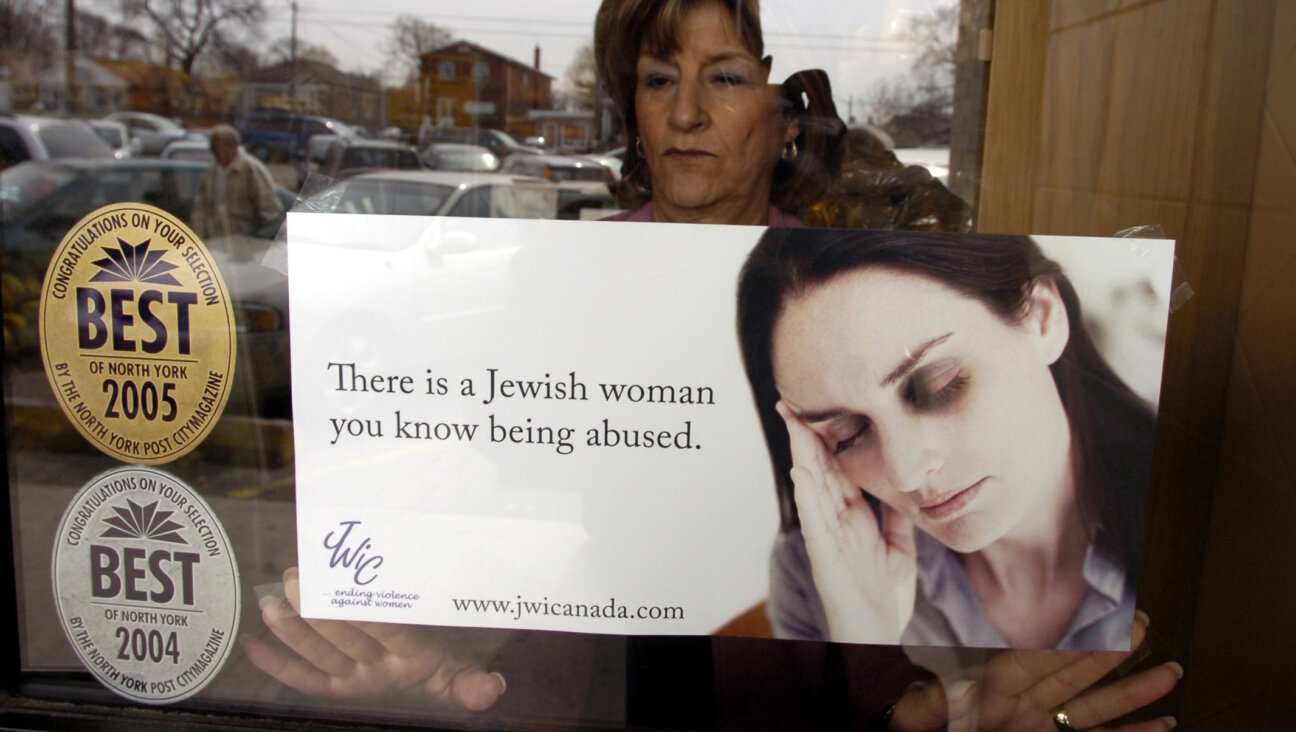
A poster promoting a 2005 domestic violence awareness campaign by the Canadian branch of Jewish Women International is displayed in a Toronto window. Photo by Rick Eglinton/Toronto Star via Getty Images

By Arno Rosenfeld June 11, 2026
When Jewish Women International began speaking out on behalf of Israeli women who experienced sexual violence during the Oct. 7 Hamas attack, or during captivity in Gaza, the organization quickly received new funding and partners for its “I Believe Israeli Women” campaign.
Another project, focused on supporting young Jewish women who have felt isolated “in a post-October 7th world,” has also been popular with philanthropic foundations.
But its work to support female victims of violence in the U.S. — historically a core part of its mission — relies on federal government grants that have evaporated in the second Trump administration, sending the whole organization reeling.
The Department of Justice has refused to release more than $200 million in funds allocated by Congress to help prevent violence against women, including the “culturally specific” grants that funded work educating Jewish men — including helping Orthodox leaders in Philadelphia reduce the stigma around reporting domestic violence and training members of ZBT, a Jewish fraternity, on sexual consent.
“I have been struggling to keep my staff employed,” said Meredith Jacobs, the group’s CEO, in an interview with the Forward. “I’ve taken money from a line of credit — I’ve gone into investment funds — with the hope that, ‘Maybe next month we’ll hear,’ ‘Maybe next month we’ll hear,’ ‘Maybe next month we’ll hear.’”
Jacobs eliminated two senior executive roles at the small organization, which currently has 12 employees and a budget of around $2.5 million, laying off its vice president of government relations in April and declining to replace the chief of programming who retired in December.
Grants awaiting approval
Congress appropriated $713 million to the Department of Justice to spend last year on grants required by the Violence Against Women Act, but the department has only distributed $472 million so far with no announcement as to when the rest of the money will be delivered to organizations.
The Trump administration has gummed up the grant distribution process across the federal government with new requirements that a senior political appointee approve each individual grant. Elon Musk’s team of consultants also removed information about how to receive funding from the Justice Department’s Office on Violence Against Women last spring before adding it back with new restrictions.
One grant program, which provides funding for religious minorities, LGBTQ individuals and people with disabilities, has still not been restored.
Jacobs said her organization had been receiving around $200,000 per year in federal grants but was expecting closer to $1 million last year as it expanded its work training other faith-based nonprofits on how to run domestic violence prevention programs.
The Department of Justice did not respond to questions Thursday about when Jewish Women International and other grant applicants would receive responses to their 2025 funding requests.
JWI was founded in 1897 as the women’s auxiliary of B’nai B’rith and, like many legacy organizations that previously relied on mass membership, it has grappled with how to modernize its operations in recent decades. (The National Council of Jewish Women, a larger peer of JWI, is in the process of a restructuring that has entailed severing ties with several local chapters around the country.)

After years of shrinking spending, Jacobs grew JWI’s budget from around $1.5 million when she started the job in 2020 to nearly $3 million last year with new programs that include a gun violence prevention coalition and financial literacy classes for survivors of domestic violence.
Jacobs said that even in the absence of federal funding JWI remains committed to women’s security and is bringing what she called a “trauma-informed” lens, honed through work with victims of violence, to its women’s leadership network.
Sexual violence in the Oct. 7 attacks and their aftermath spurred a wave of private funding focused on Israel, and on the climate for Jews in the diaspora.
“After Oct. 7, the interest shifted to Israel and antisemitism,” said Jacobs. But domestic violence within U.S. Jewish communities, an especially sensitive subject, has drawn little funder interest. “It’s really hard getting donor attention on our work around domestic and sexual violence,” Jacobs admitted.
Some of the group’s core work may be paused indefinitely until either the Justice Department grants are released or private donors step up to cover the gaps.
“It’s hard to talk about the idea that people within the Jewish community would be abusers,” Jacobs said. “It’s something people don’t like hearing about or talking about.”

Hello, fellow Forward reader! I’m Joel Brown, a Forward reader and supporter for more than 15 years, and currently the chair of the board of directors.
I’m an avid Forward reader because it ticks so many of my essential boxes: excellent journalism, Jewish focus and diverse viewpoints. In today’s political climate, what I most appreciate is the Forward’s independence — made possible by the generosity of its membership.
The Forward is committed to bringing you unbiased, nuanced Jewish news. From my position as board chair, I see an exciting future as we expand our position as the definitive independent voice of contemporary American Judaism.
That’s why I’m paying it Forward, by matching $36,000 of reader gifts. It’s an investment in the Forward’s newsroom, to continue telling the American Jewish story with truth and independence.
— Joel Brown, Forward board chair
Support our mission to tell the Jewish story fully and fairly.