In Congress, a measure to tighten U.S.-Israel military ties sparks backlash on both sides of the aisle
A controversial provision in the annual defense bill fuels a fight over what comes after the current aid agreement with Israel expires in 2028.
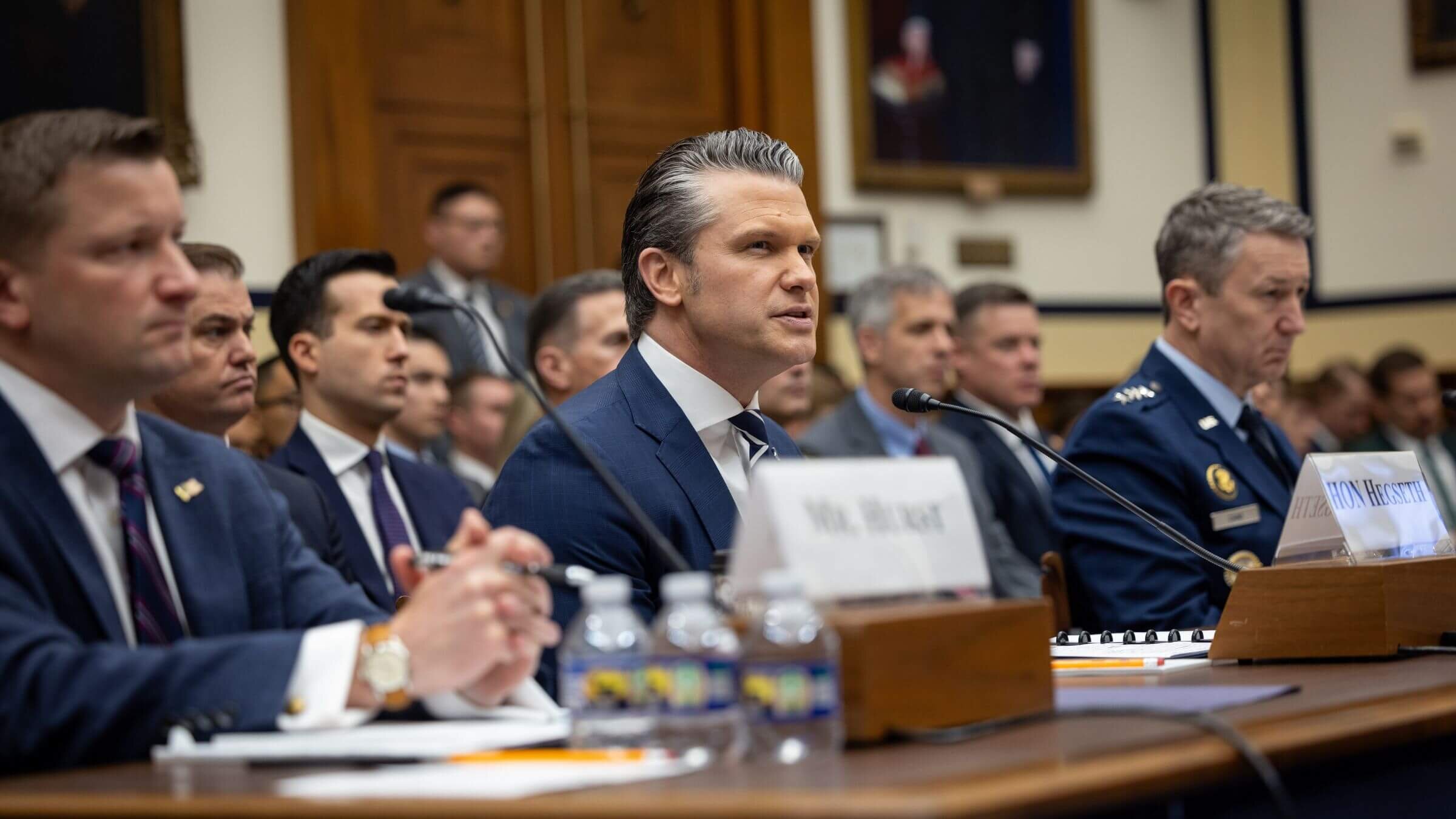
WASHINGTON, DC – APRIL 29: Secretary of Defense Pete Hegseth testifies during a House Armed Services Committee hearing on the Department of Defense FY27 budget request Photo by Nathan Posner/Anadolu via Getty Images

By Simone Saidmehr June 10, 2026
Next year’s National Defense Authorization Act has made its way to the House floor, and has some Democrats and conservatives alike rallying against a provision that critics in Congress say would embroil the U.S. in unprecedented levels of military integration with Israel.
The measure, Section 224 of the House Armed Services Committee’s version of the National Defense Authorization Act, was advanced by Chairman Mike Rogers, R-Ala., and ranking member Adam Smith, D-Wash., as part of the committee’s annual defense bill. If enacted, it would establish a framework for expanded U.S.-Israel defense cooperation. An official designated by the Pentagon would be responsible for coordinating collaboration with Israel on technologies ranging from missile defense and drones to artificial intelligence, cybersecurity and biotechnology. The provision also encourages joint research projects, shared manufacturing arrangements, military training exercises, and closer cooperation between American and Israeli defense companies.
While the proposal has generated controversy in its own right, it is also fueling a broader conversation about what the U.S.-Israel defense relationship should look like after 2028, when the current 10-year memorandum of understanding governing American military assistance to Israel expires.
The United States has provided military assistance to Israel since 1960, but since 1998, the bulk of that aid has been directed by a series of such memoranda negotiated between the two countries. Congress must still approve the funds annually, but lawmakers have historically funded the agreements as negotiated.
But in recent months, Israeli Prime Minister Benjamin Netanyahu has made clear that he does not wish to renew the 2016 MOU to its full extent, stating that he hopes to “taper off” U.S. aid over the next decade and wishes to focus instead on a more collaborative defense relationship.
His comments come as public support for Israel has declined in the United States and military aid has come under increasing political scrutiny, with many Democrats and some Republicans calling to reduce or cut off assistance. An April Pew Research Center survey found that 60% of Americans hold an unfavorable view of Israel, up from 53% a year earlier. Negative views have risen among both Democrats and Republicans, particularly among younger generations. Today, 57% of Republicans and 84% of Democrats ages 18 to 49 have an unfavorable view according to the Pew survey.
Rachel Brandenburg, managing director and senior policy analyst at the Israel Policy Forum, said Israeli leaders are likely aware that future aid packages could face greater scrutiny from both Democrats and an increasingly isolationist wing of the Republican Party, a factor that helps explain the Israeli interest in reducing its reliance on U.S. aid. At the same time, she said, Israel’s increasingly sophisticated defense industry and strong economy have made it less reliant on American financing than in the past.
Against that backdrop, supporters of Section 224 argue that deeper cooperation could help lay the groundwork for a future relationship based on mutual benefits.
“The United States has more to gain by harnessing Israel’s defense tech ecosystem, their innovative capabilities,” Brandenburg said. “Their economy is strong, so there’s quite a bit that they could be buying with their own dollars.”
Michael O’Hanlon, the Chair in Defense and Strategy and director of research in the Foreign Policy program at the Brookings Institution, told the Forward he believes the concerns that Section 224 would integrate the U.S.-Israel defense relationship to unprecedented levels are overblown. “My overall sense is that this would move the US-Israel relationship in the direction of AUKUS,” he said, referring to an existing trilateral security partnership between Australia, the United Kingdom and the United States.
“In theory, it shouldn’t really be needed because collaboration is already close,” he explained. “In practice, this kind of provision might help cut through bureaucratic red tape and speed up collaborations. But on balance, I don’t expect huge change because the partnership is already very tight.”
Critics, however, see the proposal very differently.
Its opponents worry that if the U.S. and Israel move away from a military-aid relationship and toward a more collaborative partnership, large parts of the U.S.-Israel defense relationship will be harder to scrutinize or limit. Instead of debating aid packages, lawmakers could find themselves dealing with defense projects that are already built into Pentagon programs and contracts.
“It’s taking one program that’s become unpopular and turning it into another program that those who would disapprove of an intensified U.S.-Israeli defense relationship won’t really know about,” said Steven Simon, a senior research fellow at the Quincy Institute.
If combined with Israel’s stated desire to reduce its reliance on aid and other efforts to deepen defense cooperation, Simon says Section 224 could produce a relationship that is “much more integrated, immutable, and immune to political pressures than has ever existed.”
Similar concerns have been raised by lawmakers on the left.
Sen. Bernie Sanders announced Monday that he intends to “strongly oppose” the provision, arguing that “Netanyahu is lobbying for Section 224 in the national defense bill, a provision that quietly expands U.S.-Israel military cooperation and weapons development with almost zero oversight.”
Rep. Ro Khanna, a California Democrat, also opposes the provision and introduced an amendment to strike Section 224 during committee markup, stating, “The American people are tired of the arrogance and insolence of Prime Minister Netanyahu telling America what we should do.”
On the right, political figures and commentators have framed the measure as a threat to American sovereignty.
Former representative Marjorie Taylor Greene tied the provision to the recent reports of Israeli espionage against the U.S., stating on X, “The Pentagon raised threat of Israeli spying on the U.S. to the highest level and AIPAC is openly cheering Republicans for section 224 in the NDAA that merges our military with Israel’s military.” Kentucky Representative Thomas Massie — who this week held a hearing premised on the conspiracy theory that Israel intentionally killed U.S. soldiers on the USS Liberty during the Six Day War — pledged to offer a floor amendment to strike the section.
The debate has also been picked up by far-right commentators, including podcaster Alex Jones, who stated: “This is beyond treason. This is absolutely a foreign government merging with us. Israel is now the main threat to the existence of this country.”
Brandenburg pushed back on concerns that the proposal would weaken oversight. Rather than moving cooperation further from public view, the legislation calls for additional reporting to Congress and public disclosure of some forms of existing coordination between the two countries, Brandenburg noted.
“That’s new,” she said, “in the sense of adding the accountability and transparency to these elements of the relationship in ways that didn’t exist previously.”
She also asserts many critics have overstated the significance of Section 224, noting that many of the forms of cooperation described in the legislation — including collaboration on missile defense, cyber security and counter-drone technology — are already taking place.
“Those who want to counter the idea that Israel and the United States should be working together have exaggerated what this legislation is actually saying,” she said. “They are accusing it of things like integrating the U.S. and Israeli militaries, or subjugating the U.S. military to the Israeli military. None of that is actually called for in here.”
I’m personally matching all gifts to the Forward, up to $36,000. Can I match your gift now?

Hello, fellow Forward reader! I’m Joel Brown, a Forward reader and supporter for more than 15 years, and currently the chair of the board of directors.
I’m an avid Forward reader because it ticks so many of my essential boxes: excellent journalism, Jewish focus and diverse viewpoints. In today’s political climate, what I most appreciate is the Forward’s independence — made possible by the generosity of its membership.
The Forward is committed to bringing you unbiased, nuanced Jewish news. From my position as board chair, I see an exciting future as we expand our position as the definitive independent voice of contemporary American Judaism.
— Joel Brown, Forward board chair
Support our mission to tell the Jewish story fully and fairly.