Slovenia’s last Jewish institution endures through desecration and decay
The founder of the Jewish Cultural Center Ljubljana scrounges for funds to keep the doors open. The return of an Israel-friendly prime minister could help
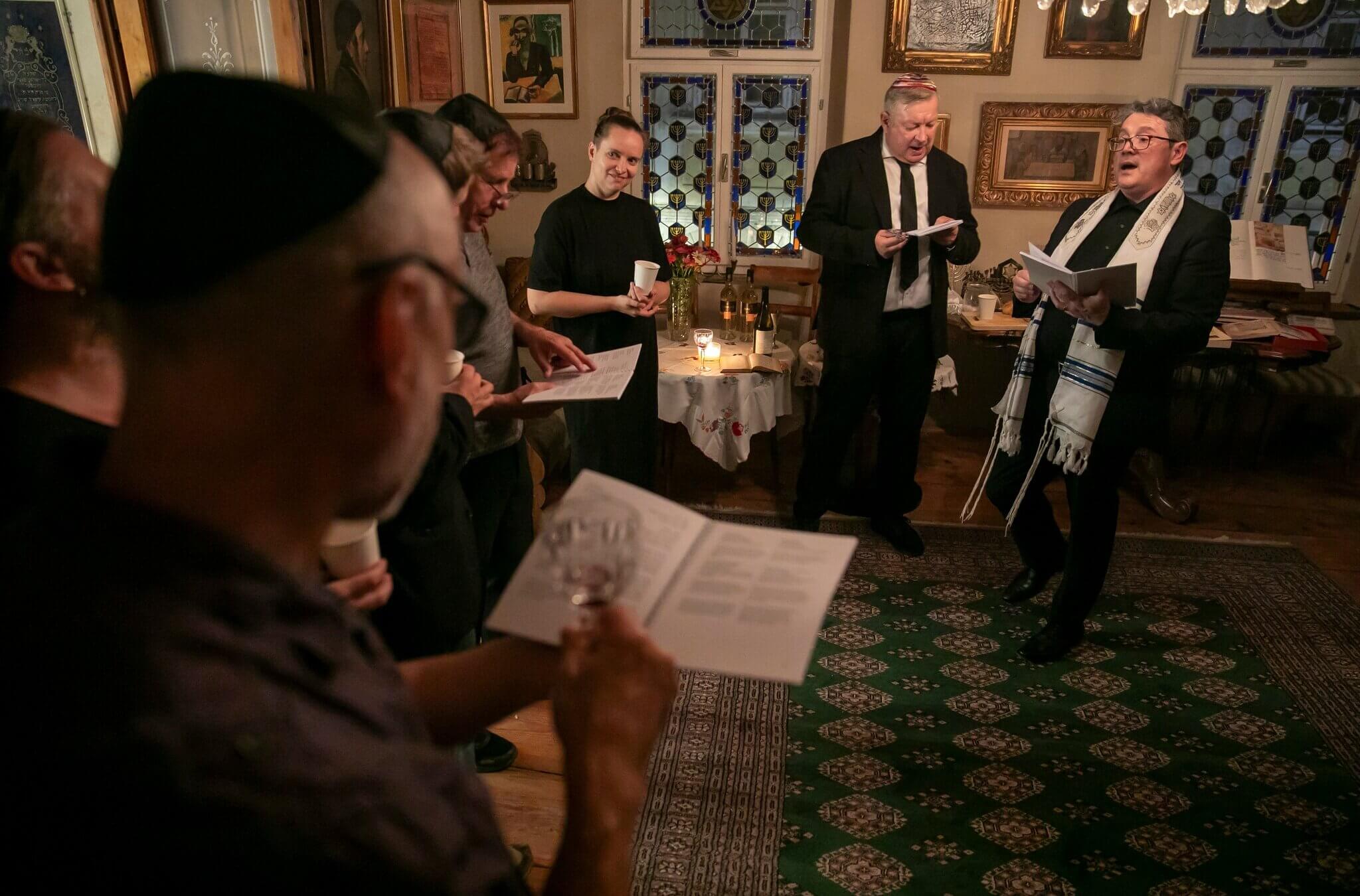
Jewish Cultural Center Ljubljana director Robert Waltl, right, at the opening of an exhibition on the Holocaust. Courtesy of Jewish Cultural Center Ljubljana

By Alan Grabinsky June 17, 2026
On a Saturday morning last July, Robert Baruh Waltl watched two processions converge on central Ljubljana. From one direction, near the river, came a column of neo-Nazis chanting nationalist slogans chanting “Long live Slovenia.” From the other came pro-Palestinian marchers singing “from the river to the sea”.
The city, he notes drily, is very small. “You could see both demonstrations at the same time,” he told me over a video call from his office. “Far right from one side, far left from the other.”
In Slovenia, this is what the view looks like from the only Jewish institution in the country.
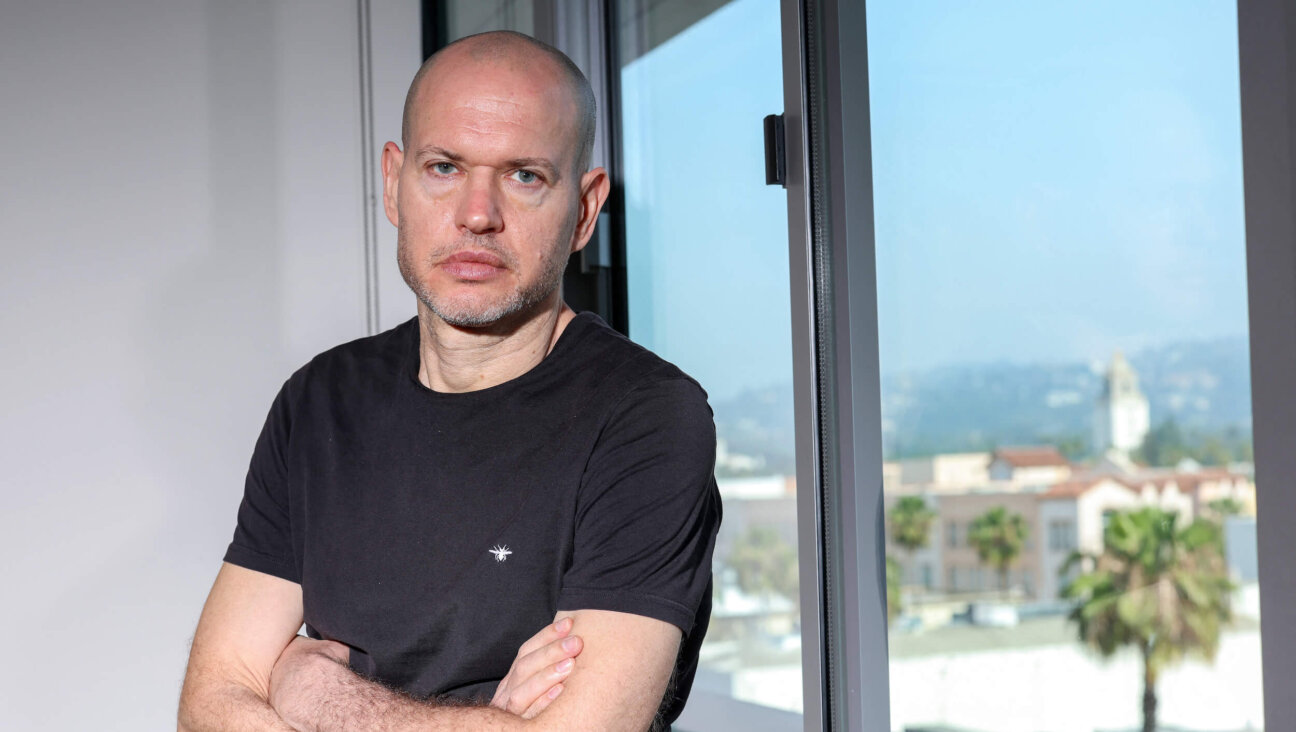
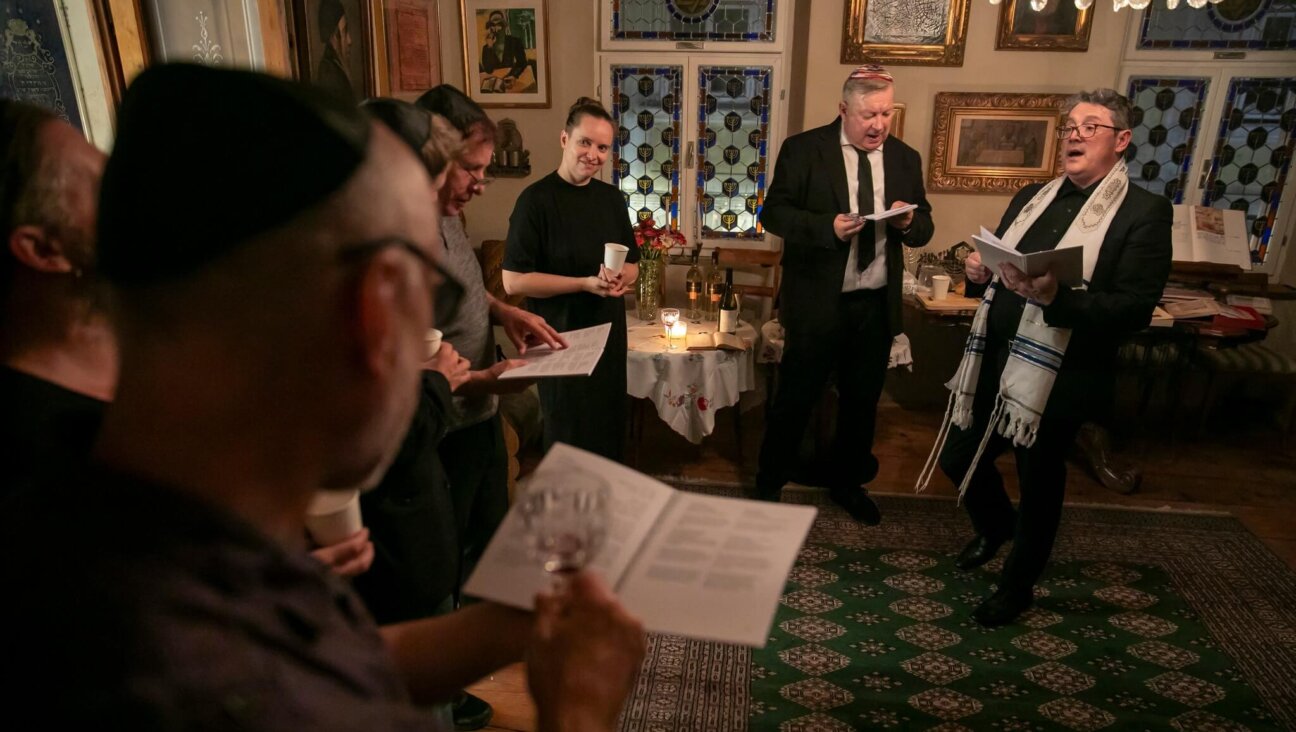
The Jewish Cultural Center Ljubljana, which Waltl has directed since its founding in 2013, is overextended by design and necessity. In the absence of a synagogue elsewhere, it functions as one. It is also a cultural center, a museum, and, increasingly, a one-man operation.
“If I’m not in Ljubljana,” Waltl says, “there is no one to even open the door.” For more than a decade, the center has run almost entirely on donations, German embassy micro-grants, and cross-subsidies from Waltl’s adjacent performance space, the Mini Theater. The Slovenian government has never provided stable funding. Applications to the Ministry of Culture go unanswered. “They tell us the Festival of Tolerance is the most important anti-racism event in Slovenia,” Waltl says, speaking of an open event organized by him and the community, “and we don’t receive a single euro for it.”
Waltl did not grow up Jewish. He was born near the Austrian border and moved to Ljubljana as a young man to study theater. Then came a letter from the local Jewish community: did he know that his grandmother had been Jewish? He didn’t. He began attending events, cautiously at first. A trip to Israel changed things. He started reading, learning Hebrew and collecting Judaica. Eventually, he underwent a formal conversion — a giyur — at a liberal congregation in Frankfurt. “I said, OK, now I’m so deep,” he recalls. “I will never feel truly Jewish if I don’t take this last step.”
The community he joined had only barely survived the 20th century. Before the Second World War, Slovenia’s largest Jewish population lived in the Prekmurje region in the northeast. Most were deported to Auschwitz after 1941; roughly 90% were killed. In Ljubljana itself, Jews had been expelled in 1515, and the postwar communist Yugoslav government did nothing to restore their memory: cemeteries and schools were destroyed or simply left to ruin. By the time Waltl arrived, the standard answer when Ljubljana tour guides were asked about Jewish history was blunt: no Jews after 1515. “They didn’t know anything about the Holocaust,” he says. “Nothing about anything.”
His response was methodical. He installed the first memorial plaque on the site of Ljubljana’s medieval synagogue. In 2014, at a gathering of young Jewish leaders in Berlin, he met Gunter Demnig, the German artist behind the Stolpersteine project, and brought the initiative home. Today, Ljubljana and surrounding cities have 68 stumbling stones and one large stone commemorating 150 Jewish refugees expelled from Croatia who sheltered in Ljubljana. He co-founded the Festival of Tolerance with Branko Lustig, the Auschwitz survivor and double Oscar-winning producer of Schindler’s List and Gladiator, born in Osijek, Croatia, who brought early credibility and international reach to the project before his death.
For years, the center also served as a functioning synagogue, anchored by a wave of Israeli tourism. After the Jewish congregation of Slovenia lost its premises in 2014 and moved into Waltl’s building, the arrangement found its footing through sheer numbers. According to Walt 50,000 to 60,000 Israeli tourists visited Slovenia each summer and many of these came to services organized by a Chabad rabbi from Trieste, Ariel Hadad. Then COVID hit. The tourists vanished. So did the rabbi. The pandemic forced a theological rethinking: Waltl discovered liberal Judaism through the Central Synagogue of New York’s online programming and began working with a rabbi from Luxembourg, who now visits several times a year alongside a rabbi from Vienna. When there is money to bring them, they come.
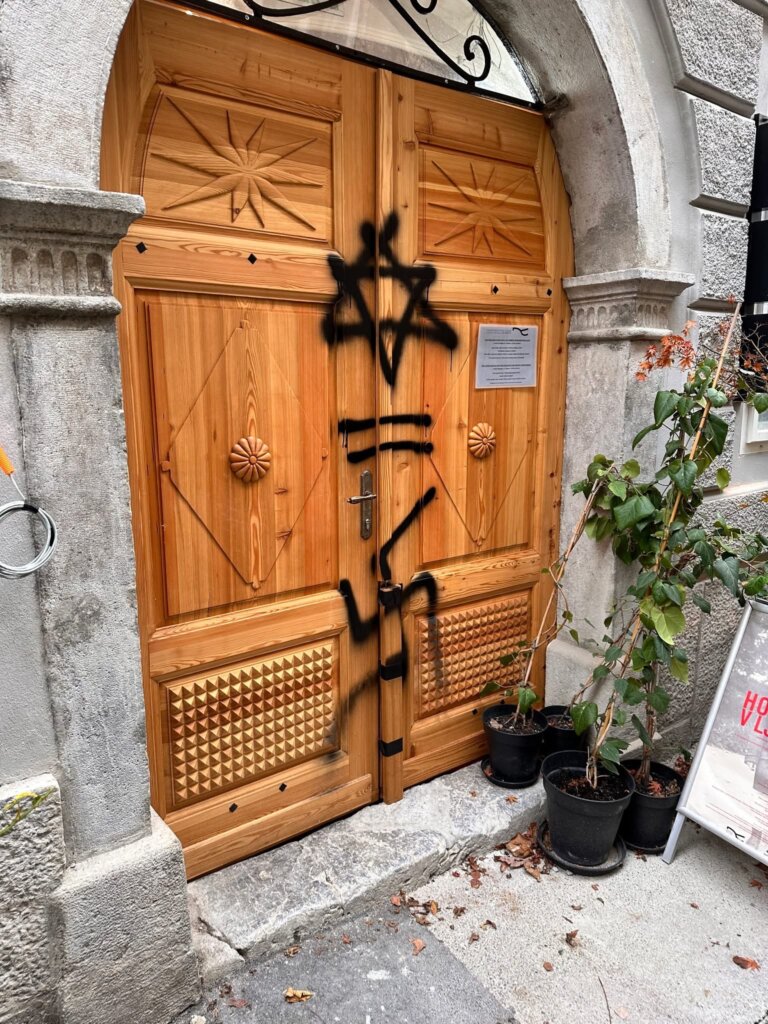
Oct. 7 transformed the center’s situation entirely. On November 6, 2023, someone painted a large swastika equated with a Star of David on the center’s front door. The Jewish graveyard was desecrated during the Festival of Tolerance. When Waltl attempted to screen footage from the Hamas attack for the city’s diplomatic corps, hundreds of pro-Palestinian demonstrators gathered outside and tried to set the doors on fire. The screening was cancelled. There is no Israeli embassy in Slovenia, and no other address for the anger. “In their eyes, we represent Israel,” Waltl says. “We represent everything bad happening in the Middle East.”
Today the center carries a 60,000-euro mortgage taken out for emergency renovations after earthquakes damaged the 500-year-old building, leaving water leaking and unsustainable structural issues. Robert thought that he would receive some sort of financial help from the government to keep this, the only Jewish center in the country, running, but he was unpleasantly surprised to have received none. Since Oct. 7 the relationship with the government soured even more: the prime minister and the president used to show up for Holocaust Remembrance Day and Chanukah festivities, but stopped, says Waltl.
This month, Slovenia changed leadership again, with Israel ally Janez Janša returning as prime minister.
Some other signs of hope: The Rothschild Foundation recently awarded a grant for the country’s first permanent exhibition on Jewish history in Slovenia, set to open this September. The German Embassy contributed 3,000 euros. American tourists — a growing presence — help cover operating costs through summer donations. But the structural problem remains unchanged: roughly 150 Jews, one institution, and a government that adopted the expansive International Holocaust Remembrance Alliance definition of antisemitism, which encompasses anti-Israel actions, while declining to fund the sole organization actually sustaining the community.
“If I say I will stop doing this,” Waltl says, “there will be no Jewish life in Slovenia anymore.”

Did you know that only 2% of Forward readers donate to support our nonprofit newsroom? That 2% make it possible for millions to read the Forward without a paywall or subscription — removing any barriers to the full and fair Jewish story.
But while the Forward is free to read, it isn’t free to produce. Big stories — like deep dives into the antisemitism data, political scoops or reporting trips to college campuses — take months of research and fact-checking. All while we keep you informed of what you need to know each day.
— Rachel Fishman Feddersen, Forward Publisher & CEO
Support our mission to tell the Jewish story fully and fairly.