Clashes over Israel again define Eurovision — this time under the shadow of the Holocaust
The popular song contest has host city Vienna’s Jewish community on high alert
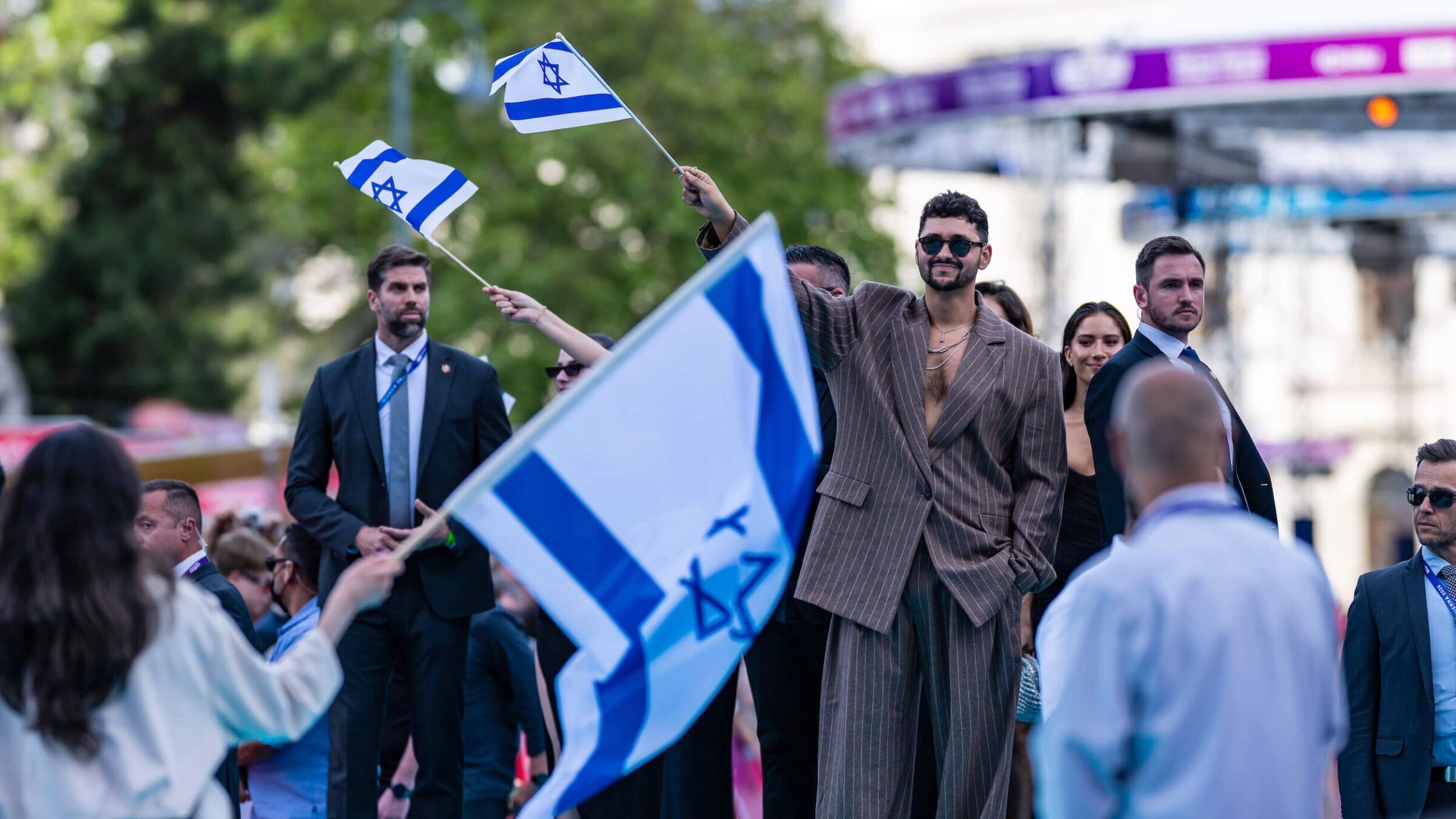
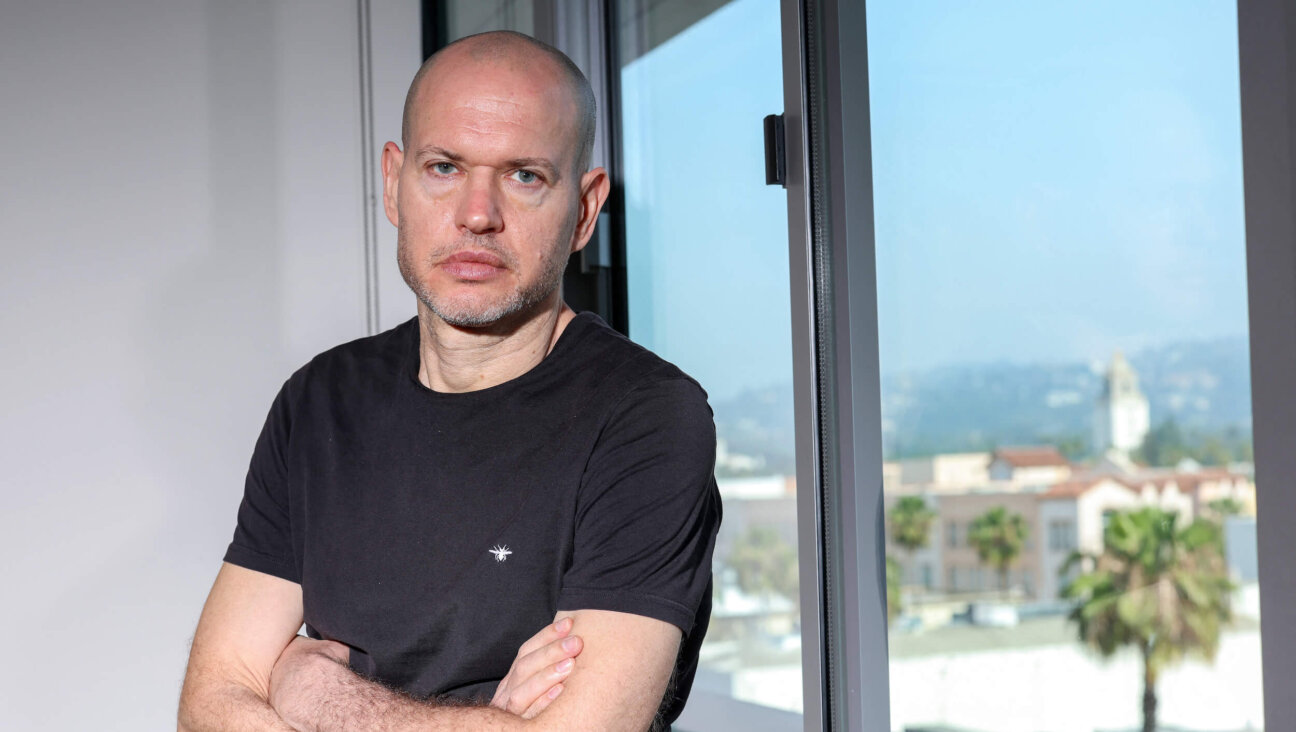
Noam Bettan, representing Israel, attends the Turquoise Carpet of the 70th Eurovision Song Contest Opening Ceremony in Vienna, Austria on May 10. Photo by Christian Bruna/Getty Images

By Anna Goldenberg May 11, 2026
VIENNA — Lisa Wegenstein is putting shakshuka on the menu. She hopes it won’t get her any hate.
Wegenstein, 59, runs Kantine, a laid-back café and bar in Vienna’s Museumsquartier, a hip museum area next to the historic inner city. Kantine has been a local staple for the past 23 years, with a generous cocktail happy hour, a stylish indoor bar and cozy tables in the backyard. And since May 4, it has sported a purple-and-blue sticker for the Eurovision Song Contest on the glass door, with an Israeli flag on each side.
Kantine is one of the 21 temporary “Eurofan Cafés” across Vienna. From May 12 to 16, the ESC will take place in the city, after Austrian sopranist Johannes “JJ” Pietsch won last year’s competition in Basel, Switzerland. Eurovision is Europe’s glitzy song contest: think American Idol meets the Olympics. It’s popular: 80,000 guests are expected to come to Vienna for the event — which features two semi-finals and a grand finale — planning to watch the shows and celebrate at public viewings, parties and cafés.
Vienna’s coffeehouse culture was enshrined as an intangible cultural heritage by UNESCO in 2011. This is why the ORF, Austria’s public broadcaster — which this year organized the ESC — has come up with a plan, together with the association of Viennese coffeehouse owners: Different cafés “adopt” participating countries and their fans, hosting cultural programs and adapting the menu. Originally, no cafés were assigned to adopt Israel — the only competing country left behind.
Behind the seemingly small incident brews a massive debate. The anxieties that Israel’s participation has caused have implications far beyond the ESC’s fan base. Vienna’s authorities are on high alert, fearing protests and terror attacks. With the contest taking place in a city that once had a sizable Jewish community, it once again raises uncomfortable questions about the thin line between political protest and antisemitism.
“That’s a scandal,” Lisa Wegenstein, who is the founder of an annual human rights film festival, remembers thinking when she heard that Israel had no café. Her maternal grandfather is Jewish, and while she only found out about her Jewish heritage as a teenager, she sports a massive gold “chai” on her chain.
“I wanted to stand up against antisemitism,” she says. So she volunteered to host Israel at Kantine.
Controversy amid celebration
Israel’s participation in the song contest has long caused controversy, especially since the Hamas massacre of Oct. 7, 2023, and the subsequent war in Gaza. Last year, the participation of Israeli contestant Yuval Raphael, herself a survivor of the Nova music festival massacre, sparked anti-Israel demonstrations on the streets of Basel. In 2024, Israeli singer Eden Golan was only able to leave her Malmö hotel in disguise for the same reason. 2024’s winner, Swiss singer Nemo returned their trophy in December 2025 in protest against Israel’s continued participation in the contest.
After JJ won last year, he said in an interview that he’d rather not have Israel join the contest in Vienna. Spain, Ireland, Slovenia, Iceland and the Netherlands are not participating this year in protest against Israel’s involvement.
Vienna has enhanced security measures for the main event venue, Stadthalle, which has space for up to 10,000 people. A massive demonstration against Israel is scheduled for May 16, the day of the finals, in central Vienna. On May 15, a “song protest” will take place in the Prater, a park close to the inner city. The event will also commemorate Nakba Day, the organizers have said.
Wegenstein has had talks with the security team of the Museumsquartier and the police. She‘d rather not share any details. “Maybe we’ll be overrun, maybe we‘ll be boycotted,” she said, “I have no clue.”
Rising antisemitism
Austria is walking a thin line. The country‘s history weighs heavily on its handling of Israel-related issues: Long deemed Hitler’s first victim — it became part of Nazi Germany in 1938 — it was only in the 1990s that the country admitted to its complicity in the Holocaust.
That catastrophe decimated Austria’s Jewish community. Up until 1938, more than 200,000 Jews lived in Austria. Jews made up 10% of Vienna’s population. Today, there are around between just 10,000 and 15,000 Jews in Austria. Almost all of them live in the capital. Jewish institutions were heavily guarded even before the Oct. 7 attack; antisemitism has spiked even further since that day.
Roughly three-quarters of all incidents are Israel-related antisemitism, according to the Israelitische Kultusgemeinde, Austria’s Jewish community.
“I wasn’t surprised by the protests against Israel’s participation in the ESC,” said Isolde Vogel, who researches antisemitism at the Documentation Center of Austrian Resistance, a scientific organization researching fascism and its consequences in Austria. “The protests are not about criticising politics or the military, but about demonization fantasies. Israel isn’t a regime that can be equated to Russia.”
She added that KAN, Israel’s public broadcaster — which organizes Israel’s participation in Eurovision — is not close to the government, but independent.
“Excluding Israel would be the end of the independence of KAN,” says Alkis Vlassakakis. He has just given an almost two-hour tour through a temporary exhibition about Eurovision, which he co-curated at QWien, a small museum focused on queer topics.
Vlassakakis, 61, who was born in Greece, is an artist, actor, and die-hard Eurovision fan. He wears a black t-shirt that says “Merci chéri”, the title of a song by Austrian singer Udo Jürgens, which led to Austria’s first Eurovision victory in 1966. “Merci chéri” is also the name of Vlassakakis’ podcast, which he has been hosting together with the former Green party politician Marco Schreuder since 2019.
A mirror to society
It’s no coincidence that the song contest has become a queer fan favorite.
Maybe it’s because of the flamboyance and the cheesy tunes, maybe because of the message of love, tolerance and fun. In 1961, French singer Jean-Claude Pascal won the contest with the song “Nous les amoureux” about a secret love. “Was it a Romeo-and-Juliet-type story? A love story across classes? Or a queer story? You can read into it what you want,” explains Vlassakakis, who is openly gay. “The contest has always mirrored what is possible in society.”
In a somewhat ironic twist of history, the first transgender singer to win the ESC was the Israeli singer Dana International, who brought the ESC to Tel Aviv in 1999, accelerating a cultural shift within Israel that made Tel Aviv a destination for LBGTQ+ tourists.
If this year’s Israeli entry, 28-year-old French-Israeli Noam Bettan, were to win, would young queer Eurovision fans come and celebrate in Tel Aviv of 2027?
Probably not — at least not all of them. The queer community is experiencing a generational shift, Vlassakakis observed. There are younger people who have joined the protest movement, boycotting ESC events because of Israel’s participation. One popular queer ESC event is not taking place this year, officially due to security concerns.
“I hope that afterwards we’ll say that we didn’t need all the security measures,” Lisa Wegenstein of Kantine said. Right now, she’s focusing on fine-tuning her cafe’s cultural program — which will include readings, as well as musical performances by mostly Jewish local artists — and organizing people to hang around and engage in calm, meaningful debates about Israel, if necessary. Think a low-key, voluntary “awareness team.”
The Viennese Jewish community has been very supportive, she says. “Some have asked if they should come and help in the kitchen.”
Wegenstein rejected the offer, because her kitchen is too small. She also still needs to find a suitable shakshuka recipe. What if the guests don’t like the Israeli eggs-in-tomato-sauce brunch staple? That, at least, is the kind of hate she can deal with.
Did you know that only 2% of Forward readers donate to support our nonprofit newsroom? That 2% make it possible for millions to read the Forward without a paywall or subscription — removing any barriers to the full and fair Jewish story.
But while the Forward is free to read, it isn’t free to produce. Big stories — like deep dives into the antisemitism data, political scoops or reporting trips to college campuses — take months of research and fact-checking. All while we keep you informed of what you need to know each day.
— Rachel Fishman Feddersen, Forward Publisher & CEO
Support our mission to tell the Jewish story fully and fairly.