Nearly half of young U.S. Jews want to replace Israel with binational state, poll finds
The new data reflects generational shift and growing gulf between American and Israeli Jews
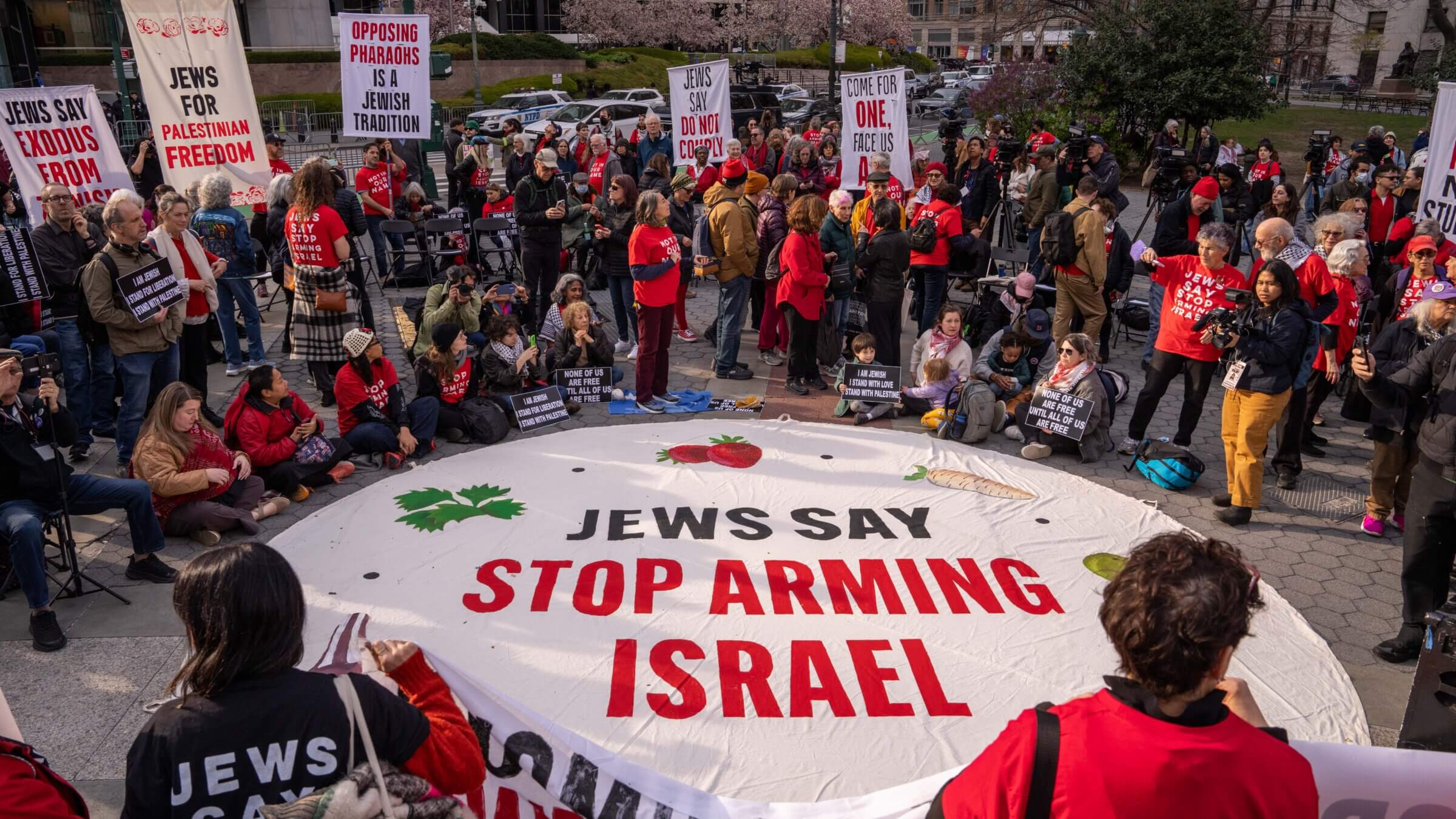
Demonstrators from the group Jewish Voice for Peace hold an emergency Passover Seder outside of ICE headquarters on April 14, 2025 in New York City. Photo by Adam Gray/Getty Images

By Arno Rosenfeld May 27, 2026
Almost half of American Jews under 35 say the Israeli-Palestinian conflict should be solved by creating a single country in Israel, the West Bank and Gaza with a government elected by both Israelis and Palestinians, according to a poll conducted by the Jewish Voter Resource Center.
The findings signal a generational shift in U.S. support for a binational state in Israel, reflecting a core demand of anti-Zionist protests on college campuses and beyond — even as most major Jewish organizations classify calls for a single state as an expression of antisemitism.
“The growing disaffection of younger Jewish Americans from Israel is a direct consequence of the policies of Bibi Netanyahu and the way the American Jewish establishment has demanded an ‘Israel right or wrong’ loyalty,” said Jeremy Ben-Ami, president of J Street, the liberal advocacy group. “They’re reaping the harvest of seeds they planted — this is what you get.”
Ben-Ami pointed to the destruction of Israel’s war in Gaza, in which it killed an estimated 70,000 Palestinians and destroyed more than 80% of the enclave’s infrastructure, and growing violence by Jewish settlers in the West Bank, among other actions.
The data also adds to a growing debate over what share of Jews in the United States are Zionist, The Jewish Federations of North America began circulating data earlier this year that shows that around 90% of American Jews continue to support Israel’s existence as a Jewish and democratic state, even as only 37% label themselves “Zionist.”
The Jewish Voter Resource Center poll, released on Thursday, challenges these findings. Twenty-four percent of Jewish adults polled support a one-state solution to the conflict, according to the survey, nearly double the 13% who said they preferred a binational state just two years ago. While age breakdowns were not available for the 2024 poll, an American Jewish Committee survey in 2022 found that 23% of American Jews ages 25 to 40 supported a binational state.
Half of non-Orthodox Jews under 35 — 51% — support a binational state, according to the new poll.
The Jewish Federations of North America declined to comment.
This abrupt turn comes amid a transformation in how Americans view Israel — favorability toward Israel has plummeted among almost every demographic group since 2022 — that has extended to Jews. A Washington Post poll found that 61% of Jewish adults said Israel had committed war crimes against Palestinians in Gaza, while 39% said it was guilty of genocide.
The shift in public opinion also drives a deeper wedge between Israeli and American Jews. While many Jews in the U.S. have been alarmed by Israel’s conduct in Gaza following the Oct. 7 Hamas terrorist attack, Israeli Jews have expressed a sense of increased vulnerability, and some viewed the massacre as shutting down the possibility of Israel giving up control over the Palestinian territories or granting Palestinians equal rights.
A poll from Tel Aviv University last year found that only 15% of Israeli Jews supported a two-state solution, while 29% wanted to annex the West Bank and Gaza without offering citizenship to Palestinians living there. Only 1% of Israeli Jews supported “one binational state with civil rights.”
When asked in more detail about the possibility of a one-state solution, 3% of Israeli Jews said they would support it only if Palestinians were granted equal rights while 37% said they would support it if Palestinians were not given full rights.
Jeremy Pressman, who studies the Israeli-Palestinian conflict at the University of Connecticut, said that young American Jews have little experience of Israel as a vulnerable underdog, unlike older generations that witnessed the establishment of the state or its victory in the 1967 and 1973 Arab-Israeli wars.
Instead, they’ve largely come of age while Israel has been controlled by right-wing governments and have watched Israeli violence toward Palestinians on social media. “This creates a gap between the dominant Israeli Jewish understanding of the conflict and the center-left — or sometimes radical left — understanding of Jewish Americans,” Pressman said in an interview.
The Jewish Voter Resource Center, which is affiliated with the Jewish Democratic Council of America, polled 800 registered Jewish voters and the margin of error was +/- 3.5 percentage points and +/- 6.9 percentage points for Jews under 35.
Asher Kaplan Leba, a leader of the Massachusetts Synagogue Network on Israel/Palestine in Boston, said that many Jews had become disillusioned with a two-state solution as the Israeli government took steps that seemed to make it more difficult to implement, such as expanding West Bank settlements.
“It was my position for many years,” said Leba, 32. “But I don’t want to spend the rest of my adult life waiting for the authoritarian, ethno-nationalists in control of Israel — who I share no values with — to change.”

Hello, fellow Forward reader! I’m Joel Brown, a Forward reader and supporter for more than 15 years, and currently the chair of the board of directors.
I’m an avid Forward reader because it ticks so many of my essential boxes: excellent journalism, Jewish focus and diverse viewpoints. In today’s political climate, what I most appreciate is the Forward’s independence — made possible by the generosity of its membership.
The Forward is committed to bringing you unbiased, nuanced Jewish news. From my position as board chair, I see an exciting future as we expand our position as the definitive independent voice of contemporary American Judaism.
That’s why I’m paying it Forward, by matching $36,000 of reader gifts. It’s an investment in the Forward’s newsroom, to continue telling the American Jewish story with truth and independence.
— Joel Brown, Forward board chair
Support our mission to tell the Jewish story fully and fairly.