‘Spatial restructuring’ razes hundreds of residences in West Bank refugee camps
Israel is thinning refugee camps by demolishing Palestinian homes, as the IDF deploys new security measures and a combat doctrine imported from the Gaza Strip
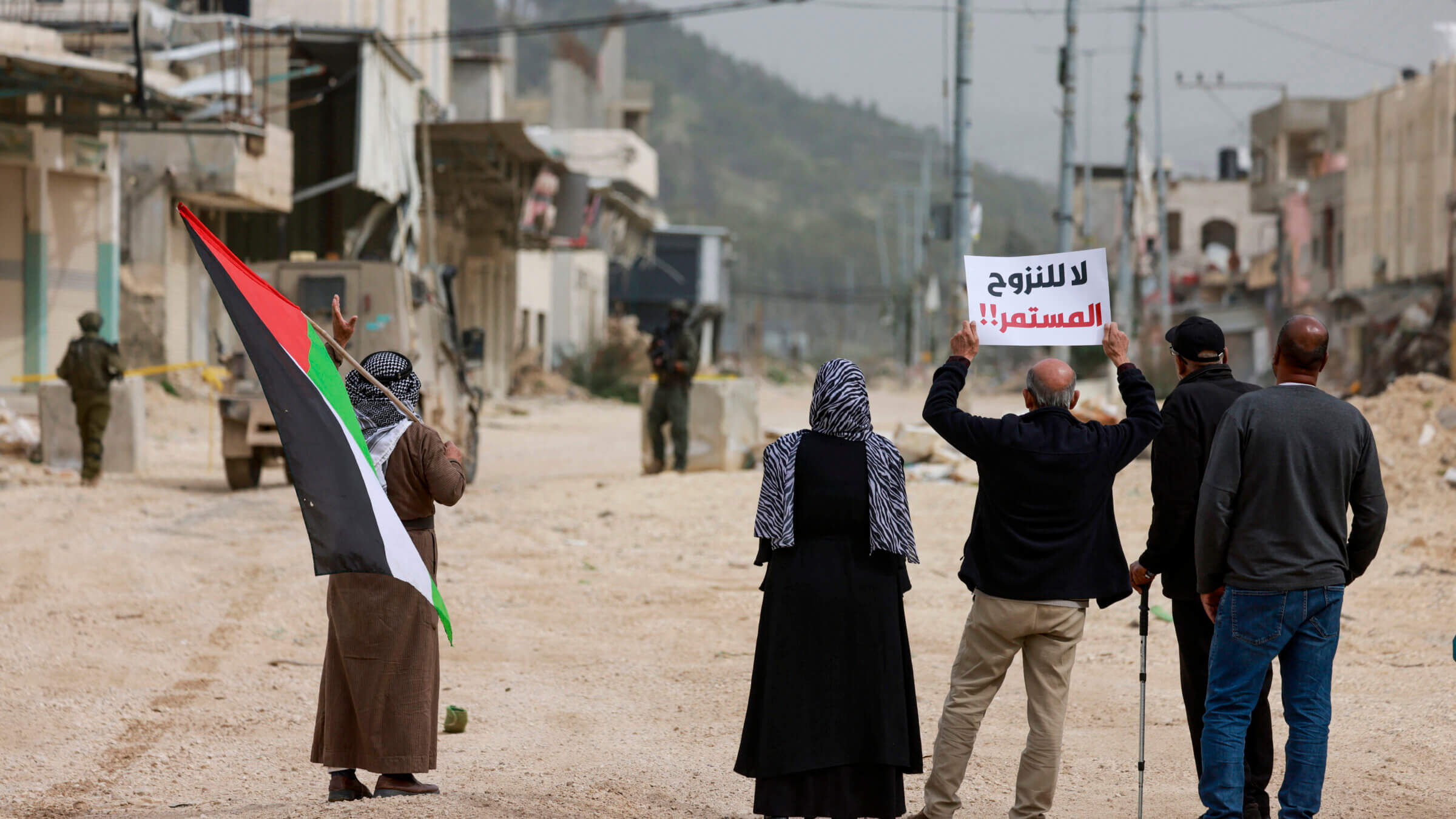
Palestinians protest after Israeli soldiers blocked the entrance of the Nur Shams Palestinian refugee camp in the occupied West Bank on February 9, 2026, demanding to be allowed to return to their homes from which they were expelled during an Israeli army operation. Photo by Jaafar Ashtiyeh/AFP via Getty Images
This article was produced through a collaboration with Shomrim, an investigative outlet based in Israel.
The Israel Defense Forces refers to the systematic demolition of hundreds of homes in the Jenin, Tulkarm and Nur Shams refugee camps as “spatial restructuring,” a bureaucratic euphemism for operations designed to create maneuvering space. For years, Israel has used house demolitions in the West Bank as a punitive measure against terrorists, but over the past 18 months, the purpose behind the policy has changed: Israel is now razing homes in order to widen roads inside the camps, which will allow for the easier passage of military vehicles.
The destruction is part of a trend whereby Israel is importing combat tactics it has used in the wars in Gaza and Lebanon to the occupied West Bank. The main difference is the Israeli settlers — who engaged in persistent efforts to expel Palestinian populations first from Israeli-administered areas of the West Bank, and now from zones under the control of the Palestinian Authority.
In the aftermath of Oct. 7, the IDF distributed thousands of firearms to the settlers, some of whom were recruited as “regional defense soldiers.” As a result, IDF weapons have been used in many of the violent clashes between settlers and Palestinians in the West Bank. Last month, N12 News reported that the IDF will scale back the number of regional defense soldiers — and that Shin Bet will vet the recruits.
But even without the settlers — looking solely from the perspective of the IDF’s military activity — a significant change is underway. From the IDF’s perspective, the West Bank is turning from a place that is home to millions of Palestinians who are not involved in any hostile activity, into a combat zone. And combat zones can be “restructured” according to the military’s needs, even if that includes the demolition of entire neighborhoods or population transfer.
According to the IDF, the change was actually sparked by the Palestinian side. Even before Oct. 7 2023, the army claims, Palestinian terrorist organizations were setting up battalions — larger fighting units that held training exercises and activities based on an organized military doctrine. In July 2023, the IDF responded by launching Operation Home and Garden in the Jenin refugee camp — the largest Israeli military operation since Defensive Shield in 2002. It was a short, targeted maneuver that lasted just two days.
In the aftermath of the Oct. 7 massacre, the IDF described an uptick in the activity of these battalions, which led, in August 2024, to Operation Summer Camps, during which the army entered the refugee camps in Tulkarm and killed the commander of a local battalion. The same month, as Israel Hayom reporter Amir Ettinger revealed, Israel Katz — then minister of foreign affairs and now minister of defense — made the IDF’s intentions quite clear: “The refugee camps are the root of the evil,” he said during a closed-door meeting with leaders of the Yesha Council. “They are not controlled by the Palestinian Authority, but by Iran. The Jenin refugee camp must be cleared of its residents and dealt with the same way we dealt with the Gaza Strip.”
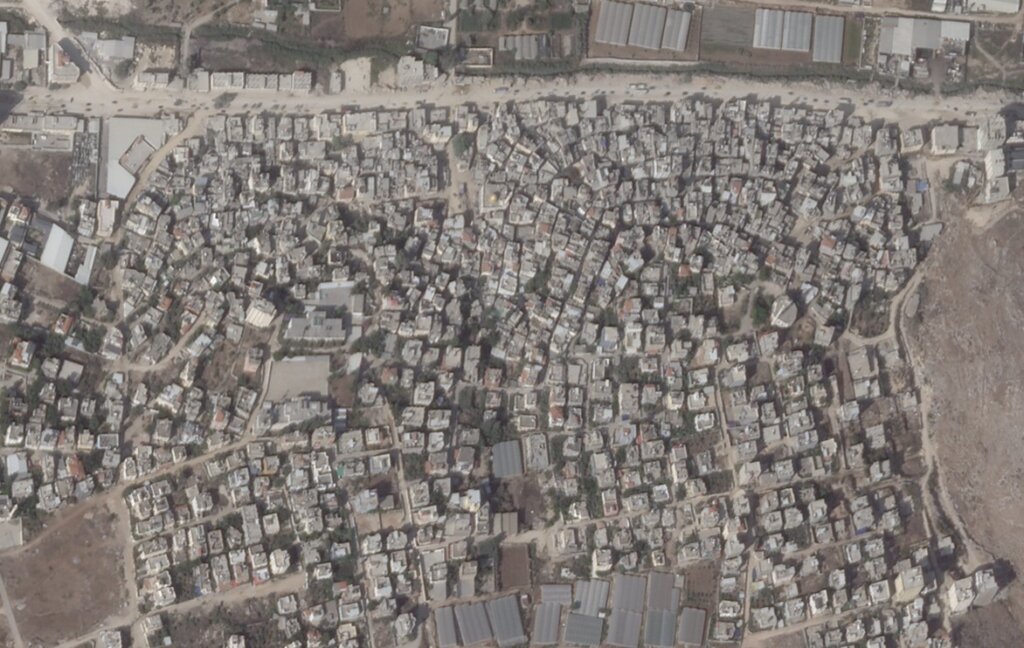
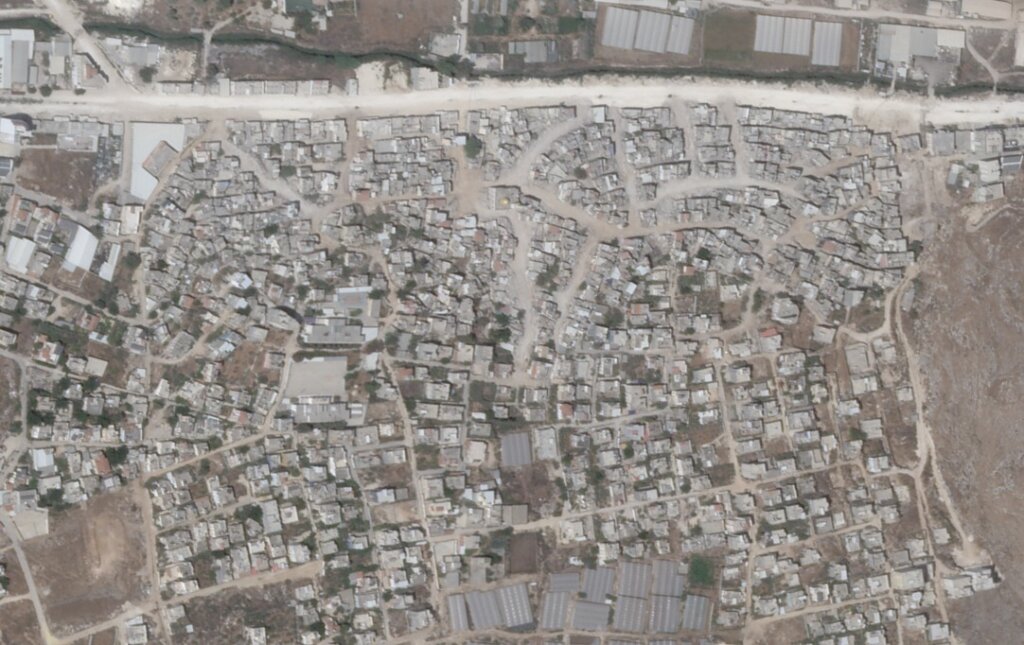
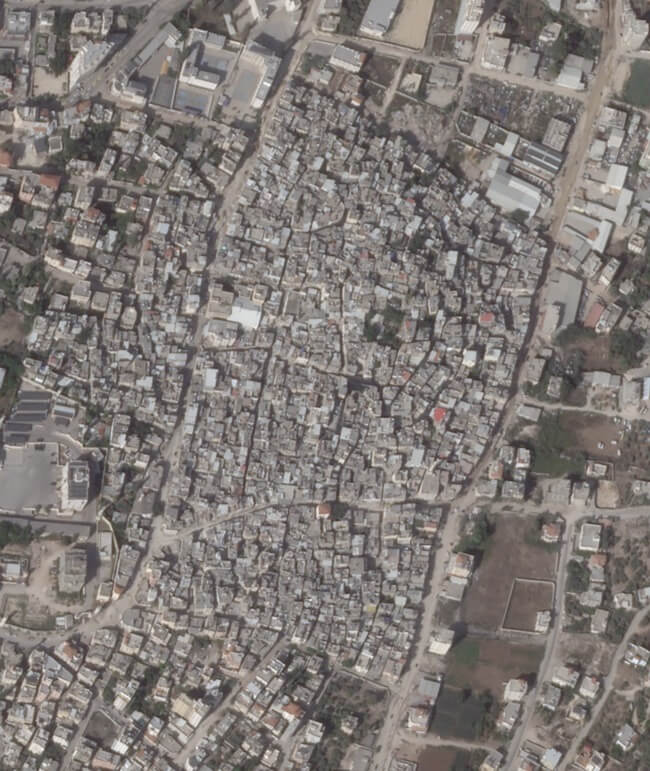
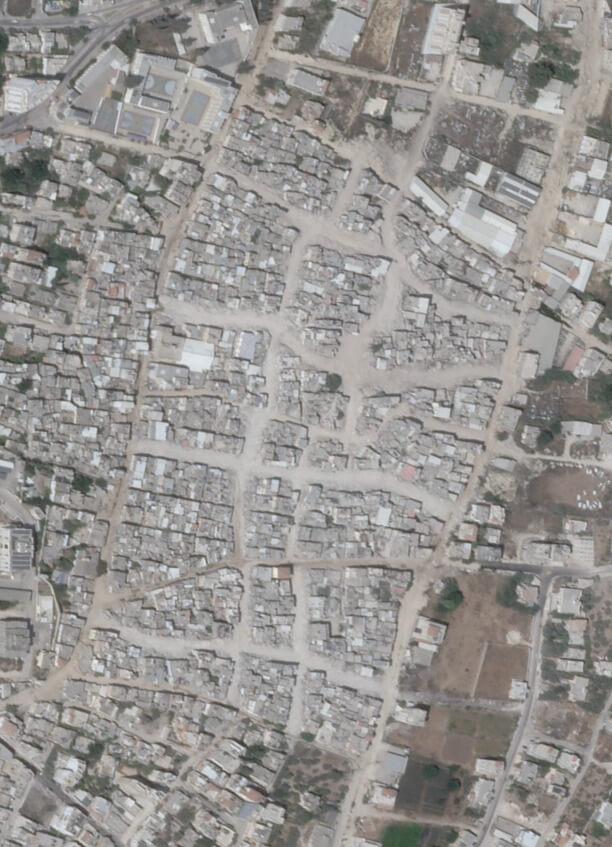
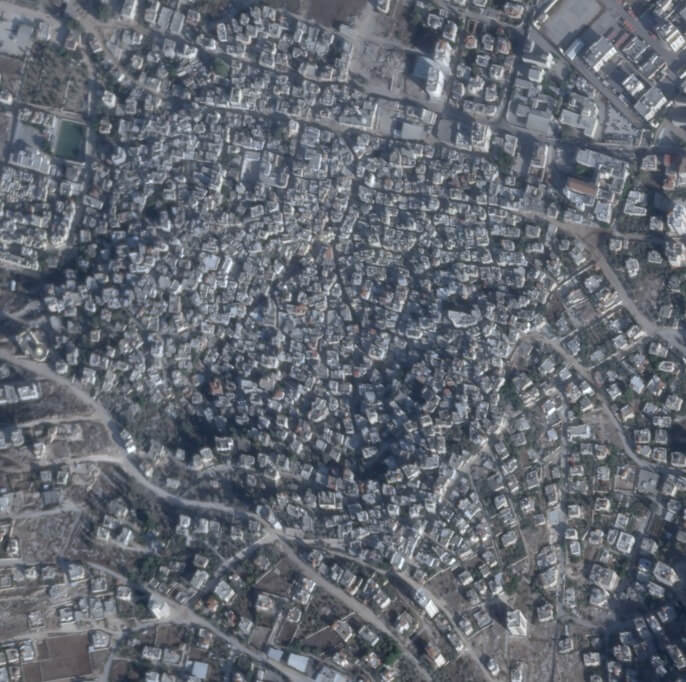
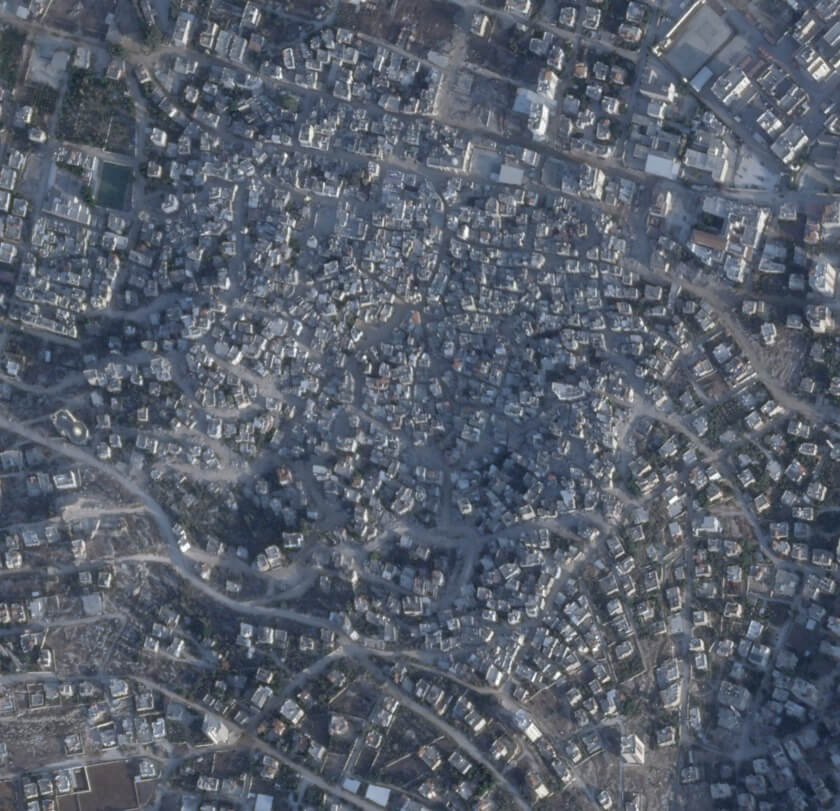
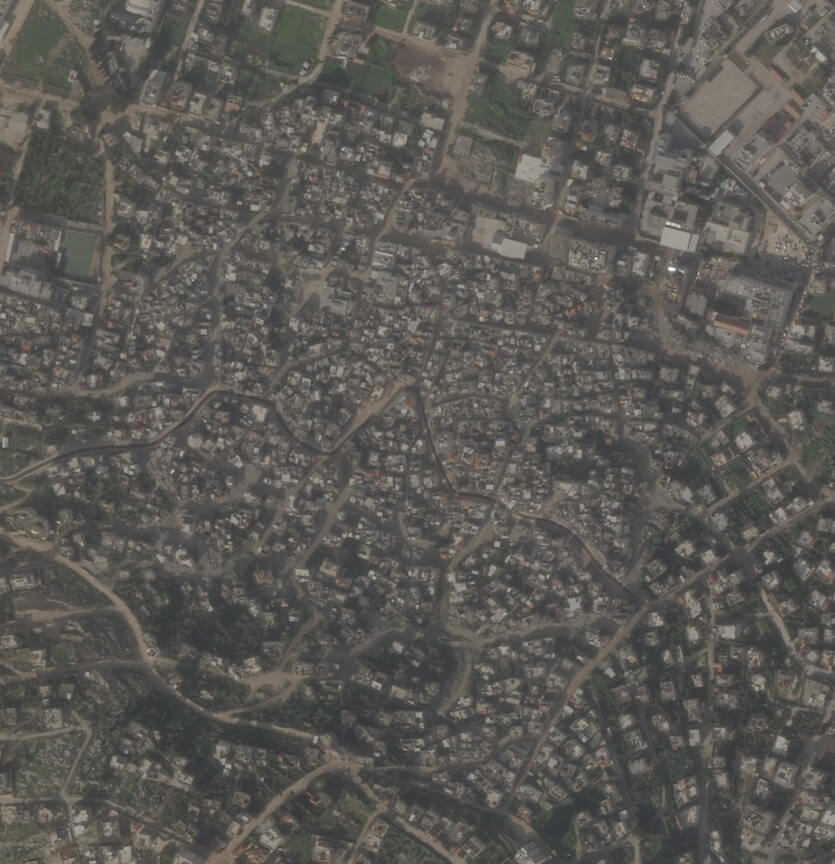
In January 2025, Katz’s words became reality when the IDF launched Operation Iron Wall. According to figures issued by the military, 208 homes were destroyed in the Jenin refugee camp and 234 in the Tulkarm and Nur Shams camps. The goal was to allow armored Israeli vehicles to move within the camp. Satellite images leave no room for doubt as to the extent of the devastation.
-
-
Nur Shams Refugee Camp, October 2024.
Photo by Planet Labs PBC
-
-
Nur Shams Refugee Camp, July 2025.
Photo by Planet Labs PBC
The IDF currently has troops stationed permanently inside the refugee camps and is not allowing the tens of thousands of residents who left to return to their homes. Some Palestinians who were expelled have petitioned to Israel’s High Court of Justice, via the Association of Civil Rights in Israel and attorneys Hila Sharon and Reut Shaer. In February, the IDF told the court that it “does not intend to maintain a permanent presence in the refugee camps and, once the goals of the operation have been fully achieved, the current operation in the camps will be ended.” At the same time, the IDF added that “the necessary operational conditions have not yet been fully met.”
“We are a household of six people, including four children,” says Bassem — not his real name — who lived on the outskirts of the Tulkarm refugee camp and who was expelled around a year ago. “They gave us 10 minutes to leave. And that was that. Since then, we haven’t been home.”
According to Bassem, despite the IDF’s claim that it issues individual permits for residents to visit their homes, his request has been denied. He did manage to get access to the home one time — without permission — in the early hours of the morning. “All of the furniture was broken. The doors were open, there were cats and dogs inside, the trees in the yard had no fruit. Everything was dead. And I regret going to see it. I don’t have any security charges against me and I have committed no crime. Why would they do that to my home? And even if they do give me a permit — there’s no furniture left.”
Bassem and his family now live in rented accommodation. The financial assistance they got earlier is dwindling and he cannot see any kind of future. “UNRWA gave us some money at the start and a few cartons of oil, rice and things like that. Now, 80% of the aid has ended. In my opinion, there’s not even a 1% chance we’ll ever get back to our home.”
-
-
City of Tulkarm, October 2024.
Photo by Planet Labs PBC
-
-
City of Tulkarm, July 2025.
Photo by Planet Labs PBC
Delivering a message
“Spatial restructuring” is not a new concept, but, in the West Bank, its meaning has changed. In the past, it mainly referred to roadblocks designed to control the movement of Palestinian and Israeli vehicles and to allow the Israeli authorities to impose a military closure at will. In the past year it has taken on a new significance: the destruction of Palestinian homes and infrastructure.
For example, in August last year, Maj.-Gen. Avi Bluth, the head of the Central Command, ordered the uprooting of thousands of Palestinian olive trees from an area of about 300 dunams (74 acres) belonging to the village of Al-Mughayyir, following a shooting attack in which a Jewish Israeli was lightly wounded. “Every village and every enemy must know that if they carry out an attack against the [Israeli] residents, they will pay a heavy price. They will experience a curfew, they will experience a siege, and they will experience restructuring operations,” Bluth said. “We are now bearing down on this village, which has been responsible for quite a few attacks lately. We will also deliver this message to the village.”
Similar measures were also taken after the terror attack in May 2025 in which 30-year-old Tzeela Gez was shot dead while on her way to the maternity hospital to give birth. The IDF demolished homes in the adjacent village of Burkin overlooking Route 446 — including a four-story apartment block.
Another indication of the change in the IDF’s approach is the increase in the number of Palestinian fatalities in the West Bank since Oct. 7. According to data released by the Israeli human rights group B’Tselem, 478 and 474 Palestinians were killed by IDF fire in 2023 and 2024 respectively. In 2025, that figure dropped to 221. These have been by far the most deadly years for Palestinians in the West Bank since the early 2000s, at the height of the second intifada. Figures issued by the IDF’s Central Command show a similar trend.
One of the reasons for this increase is the order issued by Bluth — which was revealed last year by Haaretz — that expanded open-fire orders in the West Bank. Here, too, the IDF is importing its operating tactics from the Gaza Strip. The instructions appear to reflect a broader change in the IDF’s combat doctrine, possibly influenced by the fact that many of its soldiers also fought in Gaza.
“A lot of things have changed,” says Meir — not his real name — an officer in the reserves who served for many months in the West Bank before and after Oct. 7. “I’m not sure whether this is something imported from another region, or rather that the security reality has simply changed. Once October 7 happened, it was understood that we can no longer just take it. So, we’re beefing up security: adding posts, bringing back patrols — every patrol that was ever cut has been brought back and every patrol that never existed before has been added.”
Meir claims that the rules of engagement have not been changed and insists that “no one is firing indiscriminately.” At the same time, he adds: “It’s true that there was an understanding that we have to respond more forcefully. Before October 7, people were less eager to use firearms; afterwards, the IDF suddenly remembered that you can’t fight terrorism with the foul odor of tear gas. We are given weapons so that we can use them. When there was a need — we used them. There was a long period of time when we were afraid to shoot, when even shooting in the air would mean that all hell broke loose. You shoot your gun — that’s what it’s for. We don’t walk around with our weapons slung over our shoulders just because it looks good.”
Meir also believes that the change is primarily a response to Palestinian terror. “The Palestinians responded very strongly to October 7. There were Hamas flags, rallies — even violence. It was something out of the ordinary. So, we used the means at our disposal to quiet it down. The Palestinians did things we hadn’t seen before — three armed men tried to infiltrate Adora [a settlement northwest of Hebron], for example, and there were bomb-making factories. We found crazy amounts of terrorist infrastructure.”
-
-
Jenin Refugee Camp, November 2024.
Photo by Planet Labs PBC
-
-
Jenin Refugee Camp, November 2025.
Photo by Planet Labs PBC
-
-
Jenin Refugee Camp, January 2026.
Photo by Planet Labs PBC
‘There’s a problem here. We’ll pay the price’
Maj.-Gen. (Res.) Gadi Shamni, a former Central Command chief, sees things differently. “It’s all a question of proportionality,” he tells Shomrim. “There has been a significant increase in the threat level — a lot of underbelly IEDs and all of that organization [of Palestinian battalions]. That said, October 7 and everything that’s happened since, along with the footage coming out of Gaza, ultimately mean that in a lot of places [the IDF] is sometimes using a ton of force — more than is always necessary. There are some sensitivities which, in the past, [the IDF] treated very seriously. Today, those sensitivities have disappeared — and that’s not a good thing.”
“I have spoken to soldiers and officers, young and old, who used to see things very differently,” Shamni adds. “Today, what they say is: ‘Take no chances — shoot at everything.’ This is a problematic approach and the IDF, at some stage, will have to take control of the situation — because we will end up paying a price. Once, officers dealt with these sensitivities, they briefed their soldiers on how to treat civilians, how to behave in sensitive areas. Today, the lower-ranking soldiers are unaware of any of this, because nobody talks to them. Everything is black or white. There’s no middle ground. And that’s a problem when you’re operating in a civilian environment.”
“[The principle of] proportionality has vanished,” he adds. “When you talk about proportionality, you are told, ‘Now’s the time to kick ass.’ There is also intense pressure from the settlements, the government, from [ministers] Itamar Ben-Gvir and Bezalel Smotrich. Ultimately, the IDF carries out the government’s policies. You can see what Smotrich is doing on the ground and it is incumbent on the IDF to execute those policies. We have a problem here.”
IDF: Freedom of action remains a necessary condition for regional security
The IDF submitted the following response: “The intensive efforts of the IDF to thwart terrorism in Judea and Samaria began before the outbreak of the war. Terrorist infrastructure developed in the refugee camps of the northern Samaria region, from which attacks were launched. In light of this, the IDF launched Operation Iron Wall in January 2025, during which operational and engineering activities were carried out to enable freedom of action for security forces, dismantle terrorist infrastructure and prevent terrorist organizations from establishing a presence.
“In addition to these operational activities, there has been a decrease of about 80% in the volume of terror attacks in northern Samaria recently. Most of the measures implemented during the operation, including the clearing of access routes and other engineering work, were also reviewed by the Supreme Court in response to petitions that were subsequently dismissed following the submission of a formal response and a hearing attended by all parties.
“Vegetation clearing is carried out according to established protocols, with the approval of relevant authorities in Central Command and based on operational requirements. These measures are designed to ensure the safety of road users, protect travel routes and prevent infiltrations and terrorist attacks. Every operation is preceded by a professional assessment. The IDF operates in accordance with the law and its decisions are subject to judicial review. Security forces act against structures built without authorization, prioritizing enforcement against illegal construction near roads that poses a security risk. Such enforcement actions are carried out under the planning and building laws applicable in the region.
“IDF forces continue to operate throughout Judea and Samaria, focusing on targeted counterterrorism efforts to ensure the safety of citizens. The freedom of action maintained by the IDF in terrorist hubs across northern Samaria remains a necessary condition for regional security.”

Hello, fellow Forward reader! I’m Joel Brown, a Forward reader and supporter for more than 15 years, and currently the chair of the board of directors.
I’m an avid Forward reader because it ticks so many of my essential boxes: excellent journalism, Jewish focus and diverse viewpoints. In today’s political climate, what I most appreciate is the Forward’s independence — made possible by the generosity of its membership.
The Forward is committed to bringing you unbiased, nuanced Jewish news. From my position as board chair, I see an exciting future as we expand our position as the definitive independent voice of contemporary American Judaism.
That’s why I’m paying it Forward, by matching $36,000 of reader gifts. It’s an investment in the Forward’s newsroom, to continue telling the American Jewish story with truth and independence.
— Joel Brown, Forward board chair
Support our mission to tell the Jewish story fully and fairly.