Trump says he plans to talk to Hezbollah amid Iran peace efforts
Israel insists it will maintain its freedom of action against the Lebanese terrorist group as low-level fighting continued into Monday
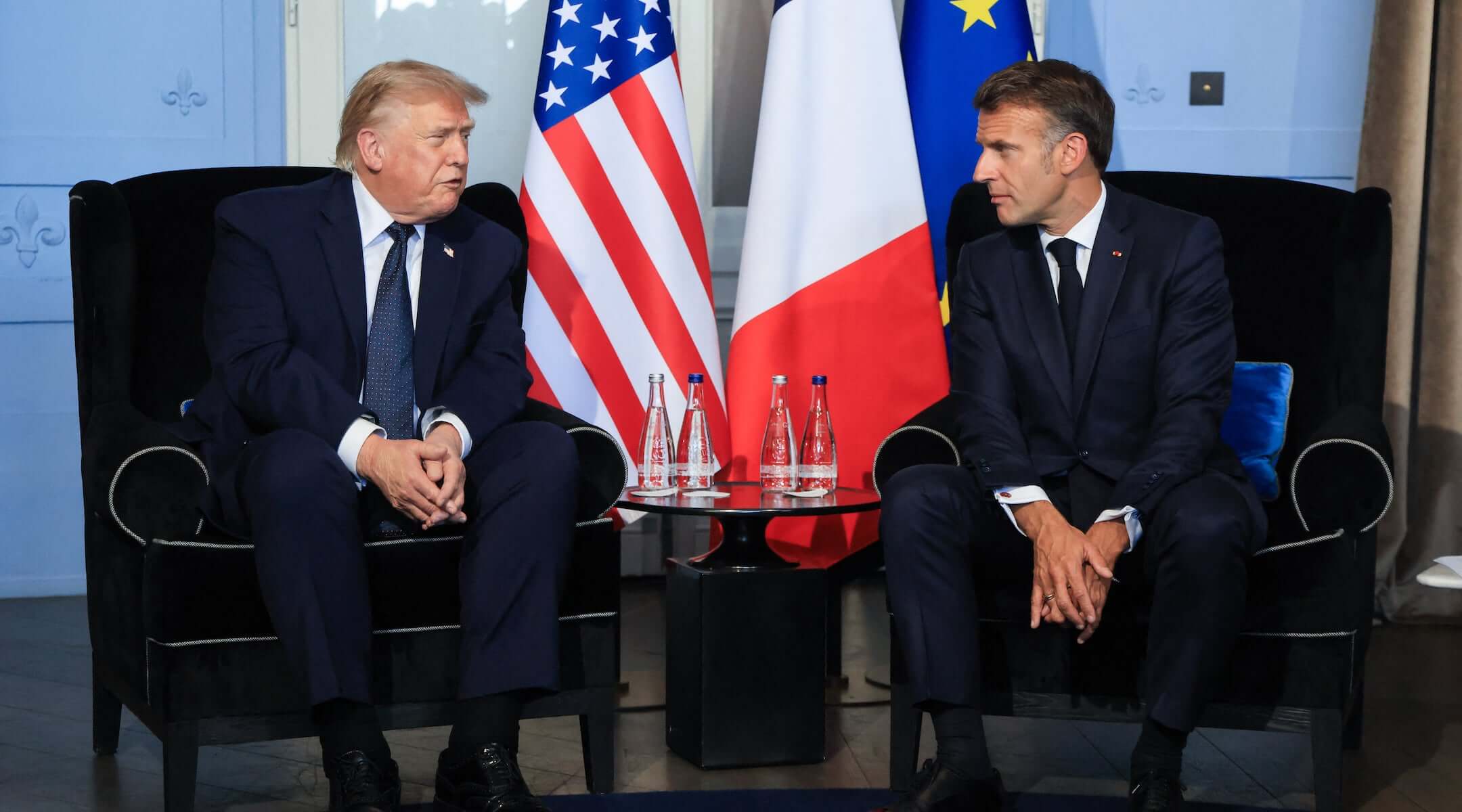
President Donald Trump meets with France’s President Emmanuel Macron in Evian, France, on June 15, 2026. (Ludovic MARIN / POOL / AFP)
(JTA) — President Donald Trump said Monday that he planned to speak with U.S.-designated terrorist organization Hezbollah, during his remarks on an agreement the U.S. and Iran signed virtually the night before to end months of hostilities.
Israeli politicians are railing against the deal and insisting that the country will maintain its freedom of operation against Lebanon-based Hezbollah, which is funded by Iran and attacked Israel days after the U.S. and Israel launched the recent war in Iran at the end of February.
“The deal’s all signed,” Trump said in reference to the Memorandum of Understanding between the U.S. and Iran announced on Sunday night. He made the comments in Evian, France, beside French President Emmanuel Macron in advance of a meeting with the G7. The Straits of Hormuz are partially opened and will be fully open by Friday, Trump added.
The “main thing is that Iran is not expected to have a nuclear weapon and they have fully agreed to that with strong policing powers,” Trump said.
Earlier in the day, U.S. Vice President J.D. Vance told ABC’s “Good Morning America” that the deal included significant sanctions relief in exchange for Iran’s agreement that it would give up its nuclear weapons program, asserting that Tehran would not have enough money to build atomic bombs.
He also noted that the memorandum had been “digitally” signed Sunday in advance of a formal signing ceremony in Geneva on Friday. In France, Trump said that Vance would represent the United States at that ceremony.
The details of the memorandum have not yet been made public, but it’s already clear from public statements including those made by Pakistani Prime Minister Shehbaz Sharif on X that Sunday’s deal is also expected to end the war between Israel and the Iranian proxy Hezbollah.
Iranian Foreign Ministry spokesperson Esmaeil Baqaei told reporters that Lebanon was an essential part of the deal, according to the state-affiliated Tasnim news agency.
Though Trump has strongly pressured Israel to comply with the agreement to end hostilities, Israel has objected to the inclusion of Lebanon in the deal between the United States and Iran.
Trump told reporters in France that “we do need to straighten out the Lebanon thing,” adding that he intended to speak with Hezbollah as part of that effort.
Israeli Defense Minister Israel Katz, speaking before Trump’s remarks, insisted that his country would continue to defend its northern border from Hezbollah attacks and would retain a presence in Lebanon.
“If Iran attacks Israel due to events in Lebanon — we will strike it with full force and make the power gap between us abundantly clear,” Katz said.
Israel was not a party to Sunday’s agreement, which it fears will strengthen Iran and Hezbollah and provide funds for Tehran to rebuild its nuclear and ballistic missile program. Several European leaders, however, welcomed the move. “This is a hugely significant moment. We have long called for de-escalation,” British Prime Minister Keir Starmer said, stressing that “it is vital that all parties seize this opportunity … To secure stability in the region.”
Macron told Trump that the deal was an “important step” toward peace.
Katz, for his part, noted that Israel has conveyed its position to the U.S. administration that it will keep troops in Lebanon, where low-level fighting continued on Monday.
“Prime Minister Benjamin Netanyahu clarified this to U.S. President Trump and other senior American officials, and I also made this clear yesterday to U.S. Secretary of Defense Pete Hegseth,” Katz said.
Israel’s policy is to keep the IDF indefinitely in the security zones it’s established in Lebanon, Syria and Gaza in order to protect communities along the Israeli border, Katz added.
Sunday’s memorandum is expected to extend the shaky ceasefire of April 8 between Iran and the U.S. for 60 days, during which time the countries will negotiate a broader agreement addressing Iran’s nuclear program.
Trump told The New York Times on Sunday that he would renew military strikes on Iran if a nuclear agreement is not finalized.

Hello, fellow Forward reader! I’m Joel Brown, a Forward reader and supporter for more than 15 years, and currently the chair of the board of directors.
I’m an avid Forward reader because it ticks so many of my essential boxes: excellent journalism, Jewish focus and diverse viewpoints. In today’s political climate, what I most appreciate is the Forward’s independence — made possible by the generosity of its membership.
The Forward is committed to bringing you unbiased, nuanced Jewish news. From my position as board chair, I see an exciting future as we expand our position as the definitive independent voice of contemporary American Judaism.
That’s why I’m paying it Forward, by matching $36,000 of reader gifts. It’s an investment in the Forward’s newsroom, to continue telling the American Jewish story with truth and independence.
— Joel Brown, Forward board chair
Support our mission to tell the Jewish story fully and fairly.