For the Jews of Venice, an uneasy history of scapegoating and grudging tolerance
In ‘The First Ghetto,” historian Alexander Lee tries to move beyond the Shylock stereotype, but perhaps not far enough beyond
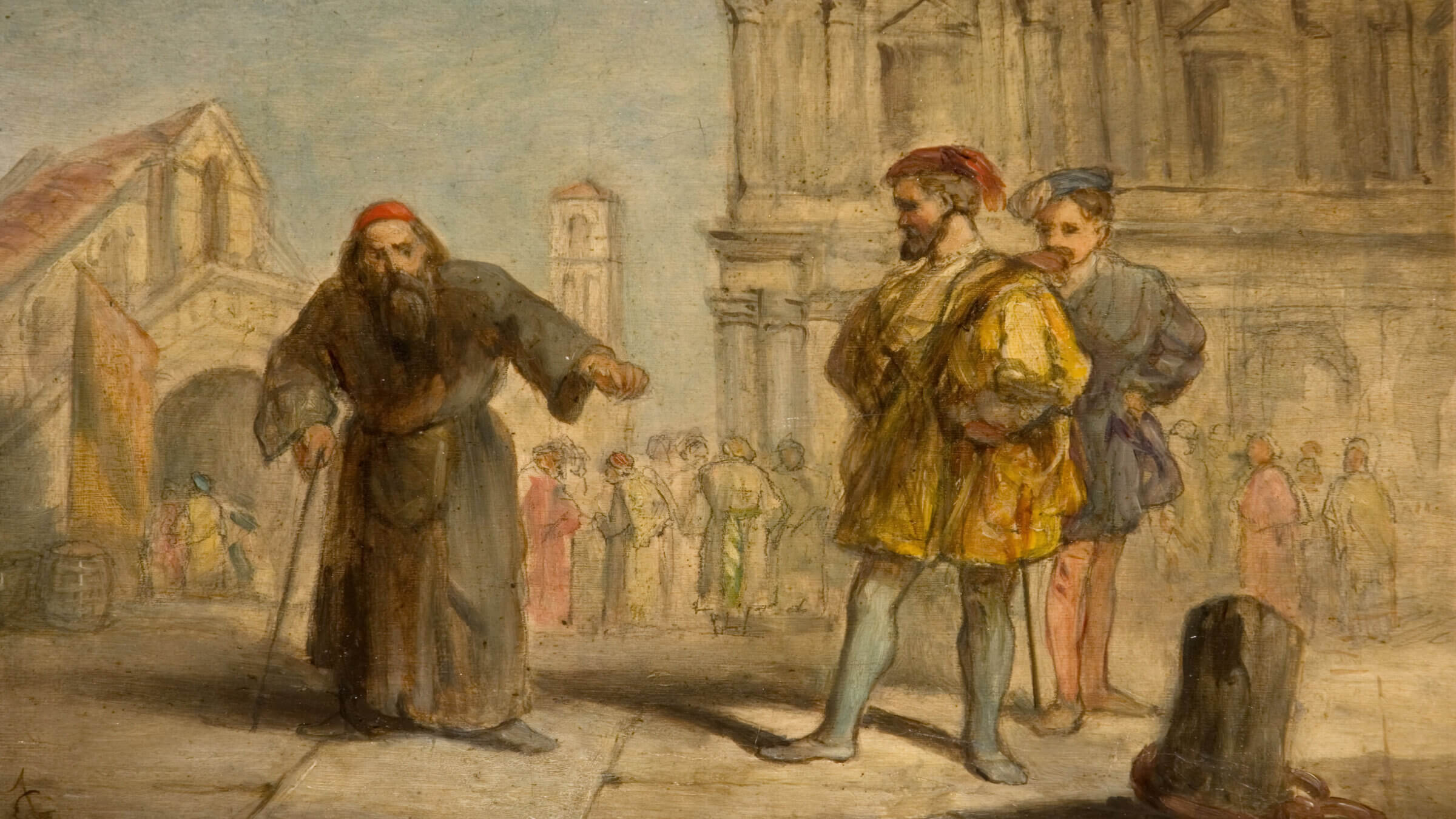
A scene from ‘The Merchant Of Venice,’ 1865. Image by Sir John Gilbert. (Photo by Heritage Art/Heritage Images via Getty Images)
The First Ghetto: Venice and the Origins of Modern Antisemitism
By Alexander Lee
Basic Books, 432 pages, $34
When one thinks of Venice and the Jews, the first figure that probably comes to mind is Shylock, literary history’s famous Jewish villain, a moneylender who demands a “pound of flesh” from the titular character in Shakespeare’s The Merchant of Venice.
In Alexander Lee’s new book, The First Ghetto: Venice and the Origins of Modern Antisemitism, Shylock is mentioned just twice, both times in the introduction, but his ghost hovers over the pages of the book. Much of Lee’s historical account of Jewish life in Venice is devoted to Jewish moneylenders, and the key role they played in keeping Venice’s economy afloat.
The First Ghetto centers on the uneasy and guarded relationship that the Venetian government and its Christian people — first as the Venetian Republic and later as part of the Italian nation — always had with its Jewish population. According to Lee’s account, Venice didn’t want the Jews, but it needed them, largely for their ability to provide credit.
As he tracks the rise and fall of the Venetian Ghetto across more than six centuries, from Venice’s first Jewish visitor in 1315 through the fateful deportation of its Jewish citizens in the Holocaust, Lee’s focus is so narrowly limited to the fluctuations of finance that he very nearly makes the word “Jew” synonymous with “moneylender” or “pawnbroker.”

That’s a pity, because readers can be left with the impression that the primary role Jews played in the life of the city nicknamed “La Serenissima” — the most serene place — was financial.
“More than once, the Ghetto’s Jews helped keep the Venetian economy from collapse,” writes Lee, an Italian Renaissance scholar at the University of Warwick who has previously published four books, including Machiavelli: His Life and Times. “They founded no fewer than eight glittering synagogues, each a masterpiece of its kind, founded innumerable charities, and administered their own affairs with democratic probity.”
There is, of course, validity to the argument that the Venetian brand of capitalism that emerged in the late Middle Ages and sustained the city through the 20th century was reliant on Jewish labor. Since the mid-12th century, the Catholic Church had prohibited usury, loans offered with interest. But this rule only applied to Christians lending to Christians. They could, however, take out interest-bearing loans from Jewish moneylenders, who were permitted to lend and borrow without, apparently, incurring sin.
The precarious arrangement proved, over time, to be mutually beneficial for the Venetians and the Jews. As long as they were supporting the city’s financial needs, Jews were tolerated — even as they were isolated, overtaxed and frequently attacked. When the Venetians had less of a need for Jewish resources, cruelty against them spiked. They were blamed for most of the city’s woes, including the Black Death, the loss of wars, and various forms of spiritual corruption.
Even if Jews’ contributions were valued by some, the majority of Venice’s Christians “still harbored a horror of moneylending in Venice itself — and almost all regarded Jews with unconcealed hostility,” Lee writes. To balance this necessity against their antipathy, Jews were permitted to live in Venice, as long as they remained apart. Thus the Venice Ghetto was born.
Beginning in 1516, they were segregated to an island of their own on the dilapidated site of a former municipal cannon foundry, Ghetto Nuovo, surrounded by high walls and an iron gate. They were constrained in cramped conditions, and allowed to associate with Christian residents only for business purposes, in daytime. They were marked as outsiders wherever they traveled within the city by a yellow circular patch on their clothing, and an oddly shaped yellow hat.
“The Ghetto was simply the easiest way of allowing Jewish loans to keep flowing,” writes Lee, “while keeping the spiritual ‘risks’ [of associating with Jews] to a minimum.”
Although Jews had been segregated and harassed in other settings for centuries, Venice’s Ghetto was a precursor of the many Jewish ghettos that would later be created throughout Europe. The word ghetto, borrowed from Venice, later “shed its purely Jewish connotations,” Lee writes, and became “shorthand for vulnerability, poverty and powerlessness,” in the living conditions of any minority group.
The first 150 pages of The First Ghetto track the vicissitudes of the explotive financial partnership between Venice and its largely captive population of a couple thousand Jewish residents. The periods of time when Jewish life could be conducted with some sense of security and ease were offset by periods of blame, harassment, and threats of expulsion. But, as Lee argues, the story of Venice’s Jews is one of resilience and survival.
Shakespeare penned The Merchant of Venice between 1596 and 1598, in a period that Lee describes as the Ghetto’s “Golden Age, 1589-1630.” Yet precisely why the character of Shylock emerged in England in this period or how the play related to the true conditions of moneylending and commerce are unfortunately never discussed.
Culture and humanity are strikingly absent from Lee’s account of the history of the Venice Ghetto. Lee notes that the inhabitants of the Ghetto were “poets and scientists, musicians and philosophers; they put on plays and held festivals; and they transformed Venice into the greatest center for Hebrew printing in the world.”
But, apart from a detailed account of the genesis of the book trade, Lee offers little description of these poets and scientists or philosophers, nor does he provide much insight into the daily life experienced in the Venice Ghetto. I yearned for a more vivid sense of how the Ghetto’s people passed their time, what they ate, how they socialized or practiced religious observance — and how they responded to the discrimination they faced.
The book’s subtitle, Venice and the Origins of Modern Antisemitism, suggests that Lee might dive into the genesis of antisemitic tropes or ideas — why did Christian Venetians believe that Jews ate babies, for example? — but this kind of analysis isn’t provided. Instead, Lee seems to regard antisemitism as a given, a force of nature that merely fluctuates depending on the conditions of the time.
“By 1630,” writes Lee, “Venice was the best place in the world to be a Jew.” And, “Anyone could see that the Ghetto was indispensable to Venice.” The bright moment didn’t last long, however, as that same year, the city was hit by a plague that took about a third of its population. Because they were still relatively isolated, the Jewish community lost only about 15% of its residents, but the larger city’s “glory days were now numbered,” Lee writes. “There would be no recovery — only a gradual slide into irrelevance.”
In 1797, Napoleon Bonaparte marched into Venice and forced its leaders to abdicate, effectively ending the Venetian Republic, and declared all its residents equal. The walls of Venice’s Ghetto were finally torn down; its gates were carried to the town square, smashed to bits, and burned. A member of the national guard, Raffaele Vivante, jumped up and gave a speech. “Here you have toppled the terrible doors which held our Nation as if locked up in a prison,” he cried, and then, as Lee writes, “The dancing went on till dawn.”
In the 1930s and 40s, under Mussolini’s fascist reign, the Venetians’ long-simmering hatred of its Jews rose to a boil. As the Jewish community was still small and somewhat contained, in spite of early 20th-century integration, it was easy to identify and decimate. The emptying of the Ghetto, handled here in about ten pages, resulted in the removal of around 2,100 people in 1943 and 1944, of whom hundreds were murdered.
In the 21st century, while the waves of antisemitism have once again crested, the notion that to be Jewish is to be linked to moneylending, banking, and usury has, sadly, gained new currency. Although this is not the only issue Lee touches upon, I wondered while reading the book if it was truly useful to hammer home this connection once again.
As I read Lee’s history, waiting for a better sense of the dimensions of humanity in the Ghetto, a line from the Merchant of Venice kept popping into my mind: “If you prick us, do we not bleed?” I would have liked to have seen a slightly more sanguine touch on these pages.

Did you know that only 2% of Forward readers donate to support our nonprofit newsroom? That 2% make it possible for millions to read the Forward without a paywall or subscription — removing any barriers to the full and fair Jewish story.
But while the Forward is free to read, it isn’t free to produce. Big stories — like deep dives into the antisemitism data, political scoops or reporting trips to college campuses — take months of research and fact-checking. All while we keep you informed of what you need to know each day.
— Rachel Fishman Feddersen, Forward Publisher & CEO
Support our mission to tell the Jewish story fully and fairly.