In a forgotten 20th century masterwork, a Holocaust story from the perpetrator’s perspective
Mieczysław Weinberg’s ‘Die Passagierin,’ on stage at the Dutch National Opera, is both lyrical and forceful
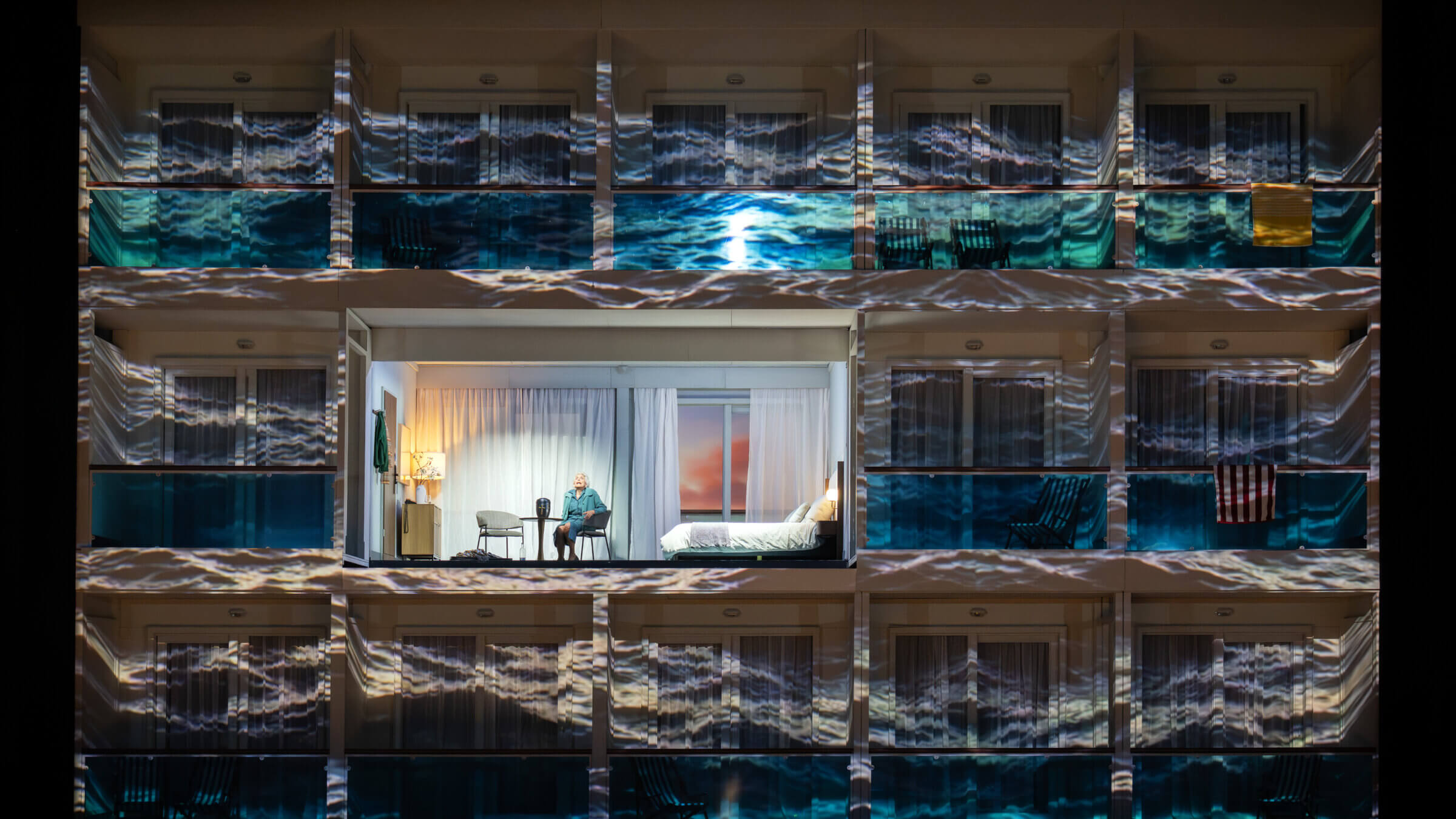
Sibylle Maria Dordel in ‘Die Passagierin.’ Photo by Monika Rittershaus
On stage at the Dutch National Opera, an elderly woman clutching a funeral urn containing her husband’s ashes stands on her balcony on a luxury cruise ship, gazing out at the imagined ocean.
She is dressed neatly in a blue dress with a red sash, and seems serene, until she catches a glimpse of a woman with long dark hair on a veranda below. Suddenly, she is catapulted into a memory, and a younger version of herself wearing the same dress appears on the balcony beside her.
The widow and her younger self are both Lisa, a German woman who holds a terrible secret. During World War II, she served as a Nazi camp guard in the women’s barracks at Auschwitz — a fact her husband, a German diplomat, did not know.
Seeing the dark-haired stranger triggers a flood of emotions, and Lisa is suddenly wracked with fear and guilt. She thinks she recognizes the woman as Marta, one of her former concentration camp prisoners. Could she possibly still be alive?
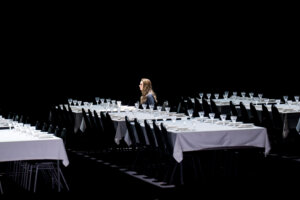
This is the beginning of Mieczysław Weinberg’s opera, Die Passagierin, (The Passenger), which opened Friday, April 17 at the Dutch National Opera and runs through May 2. The production, created in collaboration with the Bayerische Staatsoper (Bavarian State Opera) in Munich, where it premiered in 2024, is a modern adaptation of an opera that has been hailed as a forgotten 20th-century masterwork.
This extraordinarily powerful opera is by turns lyrical and overwhelmingly forceful, as it delves into the profound torment experienced both by the Holocaust’s helpless victims and their guilt-plagued tormentor. It presents Lisa with a surprising degree of compassion, but does not downplay her complicity, offering, instead, a twist at the end that reminds us who suffered most.
“You essentially hear mass killings, and later in the piece he shifts from such obvious descriptive writings and the music is much more a reflection of the internal world of the characters,” said Adam Hickox, the conductor of the Dutch National Opera production.
“It’s an illumination of Lisa’s internal world, then as we’re introduced to the prisoners in Auschwitz, an illumination of their experiences. You’ve got brutality and you’ve got sparseness and you’ve got lounge jazz, and all of this he puts together into one coherent whole.”
The Dutch production, directed by Tobias Kratzer, is only slightly changed from the Bavarian Opera’s version, with adaptations for the voices of the new cast of singers, said Hickox, including outstanding performances by soprano Sylvia D’Eramo (Marta), baritone Gyula Orendt (as her fiance, Tadeuz), and mezzo-soprano Jenny Carlstedt, as Lisa.
The first act takes place on a modern ocean liner, while the second act is set in a dining hall which serves as a set for the moments in the 1960s, and in flashbacks to a Nazi banquet hall in 1944, when Lisa is transported into her horrifying memories of the war.
The opera was based on a 1962 novel, Pasażerka, by the Polish author Zofia Posmysz, a Roman Catholic resistance worker during World War II who was arrested at age 19 by the Gestapo in 1942 and sent to Auschwitz. After the war, she became a journalist and award-winning writer and lived mostly in Poland, until she died in Oswiecim at age 98.
Posmysz came up with the idea for the story when she was a journalist on assignment in Paris in 1959, said Laura Roling, the production dramaturg at the Dutch National Opera. She heard someone calling something out in German, and she said she felt “nailed to the ground,” because it was the same tone and pitch as the voice of her captor in Auschwitz.
“What Posmysz did was to shift the perspective,” said Roling. “What if the guilty party were to recognize the people they have wronged, and what would that mean in terms of perpetratorship and guilt, and conscience?”
It was an unusual literary strategy — few novels had attempted to tell a Holocaust story from a perpetrator’s perspective; in the 1950s, the French novelist Robert Merle published La Mort Est Mon Métier (Death Is My Trade) based closely on the life and career of S.S. officer Rudolf Hoess, but such books were rare. Although Pasarzerka was very popular at the time, translated into more than a dozen languages and a Polish feature film, Posmysz received criticism for her approach.
“Trying to make a perpetrator into someone you can comprehend also makes them human,” said Roling. “It defies very clear black-and-white, good-and-evil boundaries. If you can say perpetrators were inhuman, they were monsters, that’s it. But we know that in reality they were human beings, who also did the most inhuman things. So it’s important to ask: How could they live with themselves afterwards?”
Weinberg, a Polish Jewish composer, who lost most of his family during the Holocaust, “experienced it as a duty as a survivor to somehow incorporate what happened into his work,” said Roling.
A musical prodigy, Weinberg (sometimes spelled Vainberg or Vaynberg as a transliteration from Cyrillic), entered the Warsaw Conservatory at age 12 to study piano. When Germany invaded Poland in 1939, he fled on foot to Minsk; the rest of his family was murdered.
In the Soviet Union, Weinberg continued to face antisemitism; he was followed by the Secret Service and arrested in 1953 and accused on trumped-up charges, according to Roland, of a conspiracy to create a Jewish state in the Crimea. There was apparently no evidence that he was involved in any such conspiracy, and he was released after a couple of months, when Stalin died.
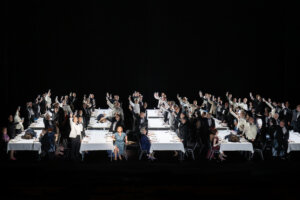
He completed his operatic adaptation of the novel in 1968 for a production that was planned to open at the Bolshoi Theater in Moscow. For reasons that are still not entirely known, said Roling, the performance didn’t take place. It was produced for the first time in 2006, ten years after the composer’s death.
Die Passagierin’s concert premiere took place in Moscow at the International House of Music. After its first full staging at the Bregenz Festival in Austria, in 2010, critics hailed it as the “rediscovery of the year.”
The Forward’s Benjamin Irvy described the satisfaction, in 2010, of seeing “a long-underrated composer finally receiving a deserved place in the sun.” The production subsequently moved on to London, Warsaw and Madrid, and later New York and Chicago.
During his career, Weinberg composed some 150 works, including several operas, 26 symphonies, and 17 string quartets, according to the Berlin Philharmonic. The composer Dmitri Shostakovich praised Die Passagierin for its “beauty and grandeur.”
Subsequent productions have varied in the way that they have approached Holocaust imagery. A 2024 version at the Teatro Real in Madrid had some singers in striped shirts with shaved heads, and others in SS uniforms.
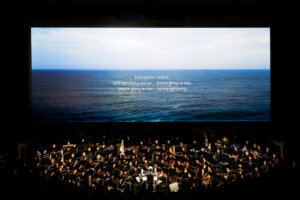
The Dutch National Opera’s version leaves more to the audience’s imagination, with all the players in both 60’s fashions and contemporary garb for the parts in the present; the concentration camp victims are in all black. Creating that distance from the facts of the Holocaust somehow makes the scenes even more poignant, as one calls to mind the real horrors without any prodding.
Conductor Adam Hickox said that Weinberg’s music has, until very recently, been under-appreciated. “The fact that he was a Jew meant that he was under increased Soviet censorship,” he explained. “He did have a certain amount of recognition in his life but it was short lived.” Only in the last several years, he said, has his enormous output been recognized, and his work been revived and championed.
A certain reluctance to produce Die Passagierin may also have something to do with a fear that any art about the Holocaust was somehow taboo in Europe, and among first and second-generation survivors. For the first two decades following World War II, there was a general feeling that creating art about the Holocaust would not be in good taste.
“In the 1960s, both survivors and perpetrators were still around and, of course, dealing with their own histories, responsibilities, or traumas,” said Roling. Today, she added, “There are still a lot of family secrets or even stories that have been lost because the people you could ask are no longer alive.”
This Dutch National Opera’s production of Die Passagierin may give some audience members a chance to open up conversations they haven’t had before, Roling said. “It’s a way into being able to discover what happened, what did my family do?” she said. “And also ask a question: What could a person do?”
Roling said the opera certainly does not let anyone off the hook for their behavior, but it might give some people pause when they consider their own actions today.
“I wouldn’t call it a cautionary tale, but it’s important to remember that nowadays we aren’t immune to this behavior, either,” Roling said. “It’s easy to think this was a specific time and place, and it couldn’t happen again, but I’m afraid that’s not true.”
Did you know that only 2% of Forward readers donate to support our nonprofit newsroom? That 2% make it possible for millions to read the Forward without a paywall or subscription — removing any barriers to the full and fair Jewish story.
But while the Forward is free to read, it isn’t free to produce. Big stories — like deep dives into the antisemitism data, political scoops or reporting trips to college campuses — take months of research and fact-checking. All while we keep you informed of what you need to know each day.
— Rachel Fishman Feddersen, Forward Publisher & CEO
Support our mission to tell the Jewish story fully and fairly.