An organ divided a synagogue. The fallout helped create Reform Judaism.
‘Happyland’ tells the true story of a synagogue in antebellum South Carolina
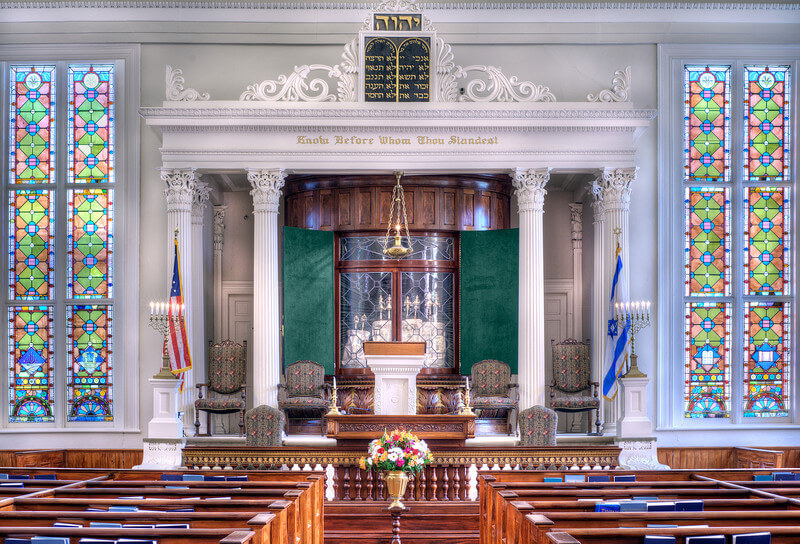
The sanctuary inside Kahal Kadosh Beth Elohim. Courtesy of Brandon Fish

By Hannah Feuer June 4, 2026
A new musical traces the origins of Reform Judaism to a question that, on paper, seems more likely to produce a subcommittee than a schism: Should a synagogue have an organ?
In 1840, a synagogue in Charleston, South Carolina, voted 46 to 40 to install a pipe organ in the sanctuary to accompany services.
The vote triggered a scandal: Organs were commonplace in American churches, but unheard of in synagogues, since rabbinic law traditionally holds that musical instruments should not be played on Shabbat.
The instrument caused such an uproar that those who opposed its installation started a breakaway congregation and fought for control of the synagogue in civil court. The case paved the way for a Reform Jewish movement that would embrace music as a key element of religious life.
Happyland, a musical based on those events, will debut Thursday at the same congregation where the real events took place, Kahal Kadosh Beth Elohim — today, still an operating Reform synagogue with an organ in its sanctuary. As the musical progresses, the organ becomes a vehicle for exploring broader questions of progress, including the uncomfortable reality that many Jews owned slaves in the antebellum South.
“It really embodies this tension in Reform Judaism, which is how much do you adapt to the wider culture around you, versus how much do you maintain your identity and your tradition?” said Elijah Siegler, co-producer of the show. “There’s no easy answer, and the organ is a perfect example of that.”
Charleston as happyland
The idea for Happyland came from an unusual pair in the theater world: a former synagogue president and a professor of religious studies.
Rob Turkewitz, a civil litigation attorney who had led Kahol Kadosh Beth Elohim, and Siegler, a synagogue member who teaches at the College of Charleston, thought that their congregation’s dramatic history had theatrical potential.
The duo set out to write historical rap songs emulating the Broadway show Hamilton. But they discovered they were out of their depth.
“We realized pretty quickly that we probably are not the right people to be writing a musical,” Turkewitz said. “Because we have no musical talent.”
Instead, they recruited Toby Singer, the congregation’s former music director and a Brooklyn-based composer, to write the script and songs.
The resulting show follows the arc of the real-life Kahol Kadosh Beth Elohim cantor, Gustavus Poznanski, who had been hired by the congregation in 1836 partly for his traditionalist bona fides.
But Poznanski ended up aligning with those who sought to modernize the synagogue. He supported the installation of the organ, conducted services in English rather than Hebrew, and advocated for observing just one Passover Seder instead of two.
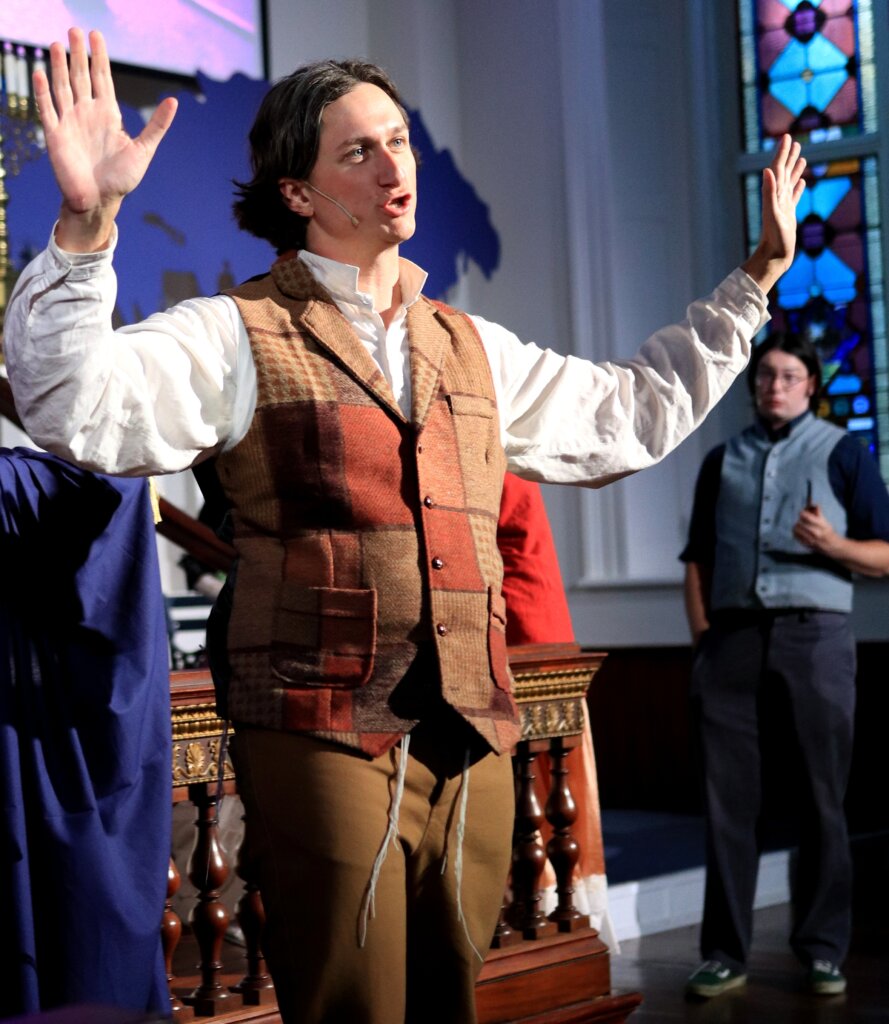
Born in Poland and educated in Hamburg, Germany — where a Reform Jewish movement had already taken root — Poznanski saw the New World as a place where Jews could shape a distinctly American Jewish life.
That vision was captured in a famous speech Poznanski gave in 1841 — the inspiration for the title of the show. “This synagogue is our temple, this city our Jerusalem, this happy land our Palestine,” he said, later adding, “America is our Zion and Washington our Jerusalem.”
But not everyone in Charleston shared his vision. Appalled by the reforms championed by Poznanski, a group of congregants took the dispute to state court.
A judge ruled in favor of the organ’s installation — not because he necessarily agreed with playing music on Shabbat, but because the synagogue had voted for it. According to Turkewitz, it was one of the first appellate rulings in American history that affirmed the separation of church and state.
“The court basically held that judges can’t determine for a religion how to practice,” Turkewitz said. “How could the judge tell the Jewish community how to practice their religion when the Jewish community doesn’t even agree?”
Reckoning with slavery
For Singer, the organ controversy was only part of the story. As congregants argued over what progress looked like inside the sanctuary, the nation outside was hurtling toward civil war.
“I just couldn’t shake the feeling that this was a story about religious freedom couched within a larger story about not freedom, because this was taking place in antebellum Charleston,” Singer said. “I needed to write a story that dealt with that and sat with the fact that the Jewish community of the South was complicit in the slave trade and was involved in it.”
Many of the founding members of Kahal Kadosh Beth Elohim came to Charleston to participate in the slave trade. And after the congregation’s first synagogue was destroyed in a fire, enslaved people built the replacement in 1840 — the grand Greek Revival structure that still stands today.
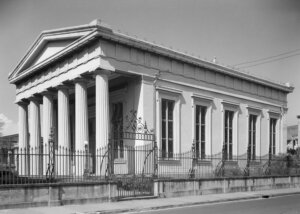
That history is woven throughout Happyland. In the musical, Poznanski grapples with the fact that his wife, Hetty, owns slaves. The second act takes place during a Passover Seder on the eve of the Civil War, as the characters confront the hypocrisy of celebrating Jews’ liberation from slavery in Egypt while slaves labor in their own home.
“Some people in the audience are going to see their great, great, great grandparents depicted on stage, because we still have Charleston Jews who are descendants of those Jews of the 1840s,” Siegler said. “I think some Jews don’t necessarily want to watch a musical about their ancestors owning slaves.”
Poznanski eventually resigned from his position, unable to bridge the divide between the traditionalist and reformist factions of the synagogue. A century later, in the 1960s, Rabbi Burton Padoll was forced to resign from the congregation after members objected to his support for the Civil Rights movement.
Today, the synagogue has made efforts to acknowledge that painful past, erecting a monument outside the congregation commemorating the enslaved people who built it.
For Siegler, the conflicts over slavery and religious reform share a common thread: how communities respond when long-held practices are challenged.
“One is a public fight over the organ, and then the other is this kind of family argument at the Seder table about owning enslaved people,” he said. “They actually are narratively linked by this idea of, what do we do to feel safe and secure?”
Did you know that only 2% of Forward readers donate to support our nonprofit newsroom? That 2% make it possible for millions to read the Forward without a paywall or subscription — removing any barriers to the full and fair Jewish story.
But while the Forward is free to read, it isn’t free to produce. Big stories — like deep dives into the antisemitism data, political scoops or reporting trips to college campuses — take months of research and fact-checking. All while we keep you informed of what you need to know each day.
— Rachel Fishman Feddersen, Forward Publisher & CEO
Support our mission to tell the Jewish story fully and fairly.