Is the art world finally ready to celebrate Diana Kurz?
In galleries and on Instagram the 89-year-old artist is having a moment
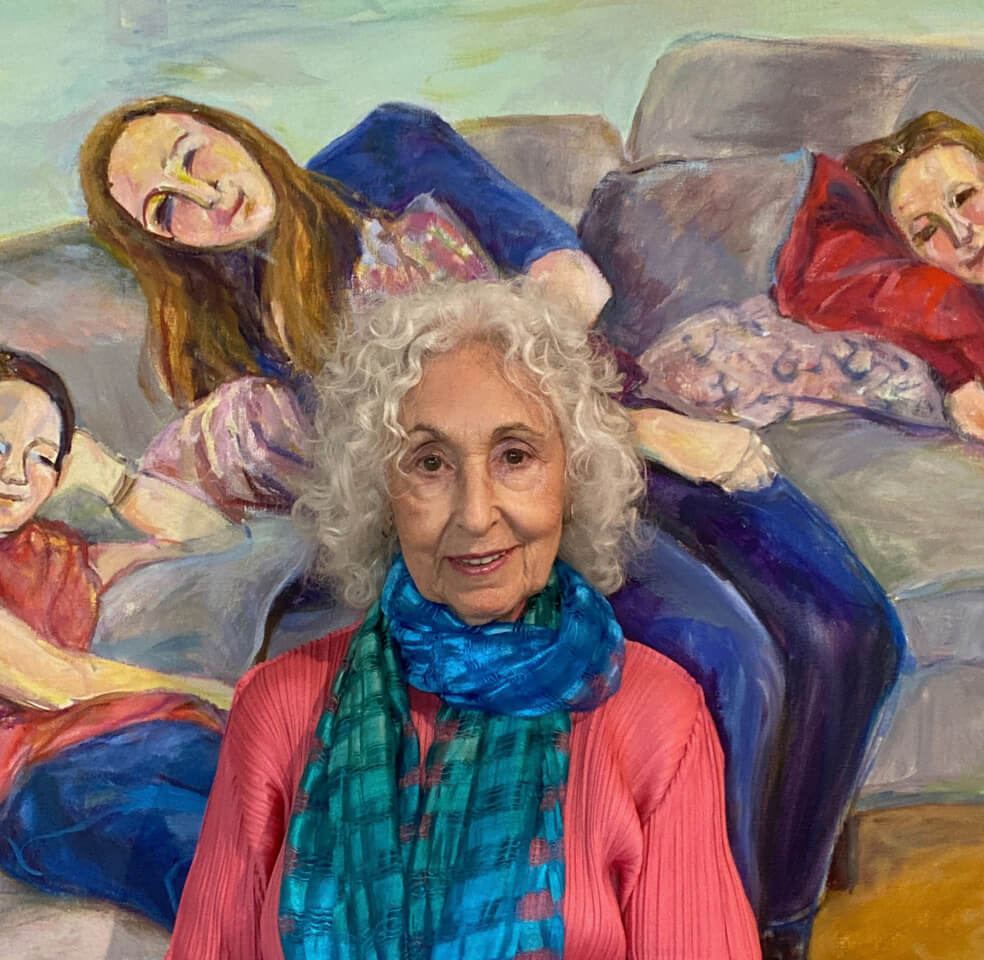
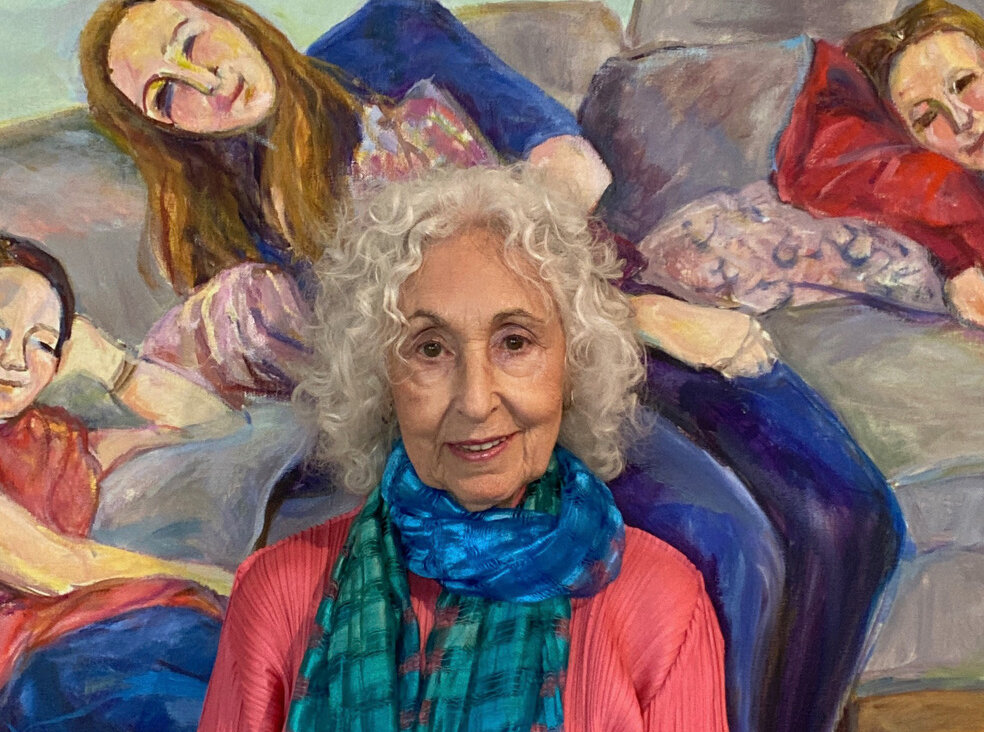
Diana Kurz will be features in ‘American Women Artists and the Century of Change,’ opening later this summer. Courtesy of Diana Kurz
Diana Kurz is on a roll. Last April, the 89-year-old, Viennese-born New York artist had a solo show of her abstract paintings, “Diana Kurz: A Journey of Discovery,” at the Lincoln Glenn Gallery in Chelsea. Motorists on the New York State Thruway can now see “The Hudson River Downtown, Triptych,” her large landscape reproduced as a permanent installation at the Ardsley Service Plaza, the first stop outside Manhattan. The US State Department recently chose two of Kurz’s still-life paintings for the US Embassy in Paraguay. And a series of Instagram reels featuring Kurz explaining aspects of her practice have earned her more than 24,000 followers. Kurz’s work will also be included in Lincoln Glenn’s “American Women Artists and the Century of Change,” opening later this summer.
“This is a time in New York to celebrate women artists of a certain age,” Kurz told me, mentioning that painters Joan Semel, Martha Edelheit, Lois Dodd and Judith Bernstein, all in their eighties and nineties, have been receiving renewed attention. “If you live long enough. But then, the work itself is what keeps you going.”
“Diana has been part of New York’s art culture since the early 1960s,” said Douglas Gold, co-founder of Lincoln Glenn, which focuses on artists who worked in New York between 1940 and 1980. “The women of this era continued painting despite an incredibly misogynistic culture. Dealers wouldn’t handle them or if they did, wouldn’t raise their prices, and the men of the period drank together and networked in downtown bars where women didn’t feel welcome. Historians, museums, people motivated to research this period, have taken note. It’s a moment to recognize the women who kept moving forward no matter what.”
‘One painting leads to another and another’
I first met Kurz in 1995 when I profiled her for the New York Jewish Week. Back then, the loft where she lives and works, a former doll factory in SoHo, had been taken over by a project both personal and enormous: larger-than-life paintings based on photos of men, women and children lost in the Holocaust, many of them her family members. She’d never intended to explore this material, had spent much of her artistic life avoiding the pain of her family’s narrow escape from the Nazis in 1940, when she and her parents boarded the last boat out of Southampton. Her father’s eyewear business had franchises beyond Austria, critical outposts that helped them flee.
When Kurz was growing up in Kew Gardens, Queens, in the 1940s and ‘50s, she was aware of family who’d perished in the concentration camps, but she also wanted to be an ordinary American and fit in. For many years, she denied her European background. Then, in 1989, on a trip to California, an aunt showed her a tiny photo of her uncle holding his baby daughter, both of whom died in the Holocaust (the family never learned the details of their fate) and she decided to make a painting based on the photo. “I never start out saying I’m going to do a big project, but sometimes one painting leads to another and another,” she told me.
A painter with roots in abstract expressionism, Diana is known for her dynamic use of color. “All that I learned painting abstractly, about composition, color, form and space, that’s in my figurative work too. It’s just as important to me as the image itself,” she said.
The luminous vitality of her palette and the depth it creates is what stays with me most in these works. In “Three,” which is nine-feet high, a father stands on crutches. He’s missing a leg, and on the lapel of his suit, he’s wearing the medal he earned in World War I. He holds the hands of his two small children, a little girl and boy each wearing the yellow star. The portrait is based on a photo of Eastern European Jewish war veteran Victor Fanjnzylber, whose heroic status exempted him from wearing the star but didn’t exempt his children. In the end, all three were still deported.
The little girl’s dress is a deep blue that almost glows, the boy’s shirt is apple green with yellow undertones (rhyming disturbingly with bits of the yellow star peeking out from under the suspenders of his short pants). The grey-violet of the father’s suit, with its folds and pleats, is deepened by its proximity to the daughter’s dress.
“Because of all the black-and-white photos we tend to associate with the Holocaust, people don’t realize how often the horrors took place on beautiful days, under clear skies,” said Kurz, “When reading people’s recollections, I was often struck by the irony of the fact that terrible, unspeaking things occurred while the sky was blue, with birds singing.”
‘I had no choice. I had to do that work.’
Kurz told me that she always knew she was an artist. “I remember my father saying to my mother that they’d better start frequenting museums because ‘if she’s going to be an artist we’d better know about it,’” she said. While working towards her MFA at Columbia in the late 1950s, she painted large, classically abstract expressionist paintings, and says she often learned more from her fellow students than from her teachers, who didn’t always take women seriously. Yet she persisted, and in 1966 won a Fulbright to Paris, where she was mentored by painter and art theorist Jean Hélion.
Hélion, a survivor of a German prison camp, encouraged her to try incorporating figures into her abstract work; he was the one who first gave her the photo that would become the painting “Three” two decades later. During residencies at Yaddo in 1968 and ‘69, she met Philip Guston, an important influence, who was remaking himself in those years, moving from the abstract to the tangible. Back in lower Manhattan, she became part of a group that included Mercedes Matter, Philip Pearlstein and Lois Dodd, all of whom were exploring figurative art and drew and painted from live models.
Solo shows followed, including three at the Green Mountain Gallery in the 1970s, and three at the Alex Rosenberg Gallery in the 1980s, highlighting her still life and portraiture. “Then I took on the Holocaust paintings and had no major shows for many years,” she said. “But I had no choice. I had to do that work.”
Kurz said she knew these paintings would be difficult to sell. “These are not portraits to hang over the couch or whatever,” she told me. Thus far, there have been 13 solo shows featuring the work, mostly in college and university galleries. “It’s allowed me to tell the history to newer generations, many of whom don’t know it.”
In 1998, the Bezirksmuseum Josefstadt in Vienna showed the “Remembrance” series in total as it existed then. Wien Museum (formerly known as the Historisches Museum der Stadt Wien) purchased two of the paintings. Another small canvas is at Yad Vashem. A major American museum has never done a comprehensive exhibit of all 18 portraits. This would seem the time for it.
Meanwhile Kurz continues to paint. “For me, inspiration comes through working,” she said. “You can’t sit there and wait for it.” Since 2005, she’s been painting a series of “small portrait heads,” mostly of actors, musicians, and dancers, young people from every possible background and ethnicity who are now filling up the same walls where “Remembrance” once dominated. The sitters are mostly under 30, and “I can look at them and see all this potential.” There are 43 so far, though she hopes one day to reach a hundred, and perhaps do an installation.
“I tell the models just to sit and look at me, and everyone puts such different energy into it. I find it fascinating,” said Kurz. “I love painting from life.”
Did you know that only 2% of Forward readers donate to support our nonprofit newsroom? That 2% make it possible for millions to read the Forward without a paywall or subscription — removing any barriers to the full and fair Jewish story.
But while the Forward is free to read, it isn’t free to produce. Big stories — like deep dives into the antisemitism data, political scoops or reporting trips to college campuses — take months of research and fact-checking. All while we keep you informed of what you need to know each day.
— Rachel Fishman Feddersen, Forward Publisher & CEO
Support our mission to tell the Jewish story fully and fairly.