A nose is a nose is a nose: A Brooklyn artist’s quest to paint 100 Jewish noses, including mine
I met up with Goldie Gross to discuss Jewish noses and to model my proboscis for her latest project
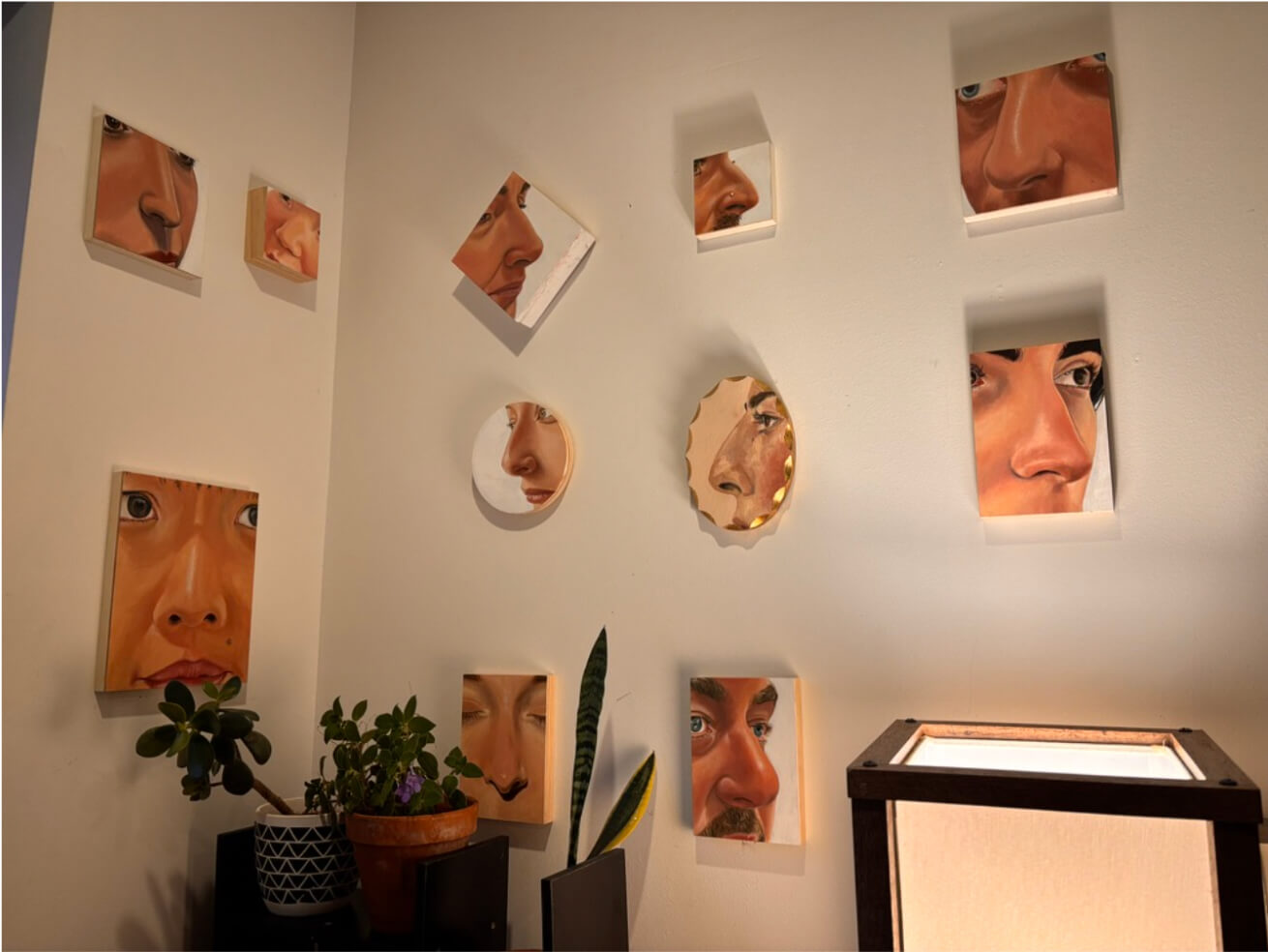
On the walls of Goldie Gross’ dwelling, a plethora of nasal art Photo by Clara Shapiro
I have never been good at resisting advertising, but one day last July, I came across a poster aimed at me like a heat-seeking missile: “Are you Jewish? Do you have a nose?”
Check and check.
The flyer went on: “Looking for noses for the 100 Jewish Noses Project, a series of 100 Jewish nose paintings.”
Strange forces were afoot on Franklin Avenue. I had seen a lot of papers taped to poles in my time, but never one that had seen me so clearly. The page was dominated by a painting of a nose, a handsome Romanesque specimen with an oily sheen. Below, the mystery artist invited me to “Submit your nose here” via a tinyurl link. I didn’t need to be asked twice.
After I filled out a Google Form that asked some basic questions (name, genre of Jewish heritage, availability to come to Brooklyn for reference photos) and a few more nasally-reflective inquiries relating to my nose-job status and my general relationship with my nose, I found myself in artist Goldie Gross’ Crown Heights apartment, preparing to do some modeling for the first time in my life. Gross was reserved but generous with her laughter. Her loose black dress, mane of golden-brown crinkly curls and red nail polish lended her a certain Jew-ne-sais-quoi.
“I don’t think there is such a thing as a Jewish nose,” said Gross once we had sat down on her couch to talk, “and so I wanted to do a series that captures the full range, the diversity of the Jewish nose across one hundred paintings.”

There are Jewish noses hanging on Gross’ living room wall. Well, paintings of Jewish noses. Noses of every conceivable style, from the aquiline to the Asiatic, the beringed to the bulbous. Gross began painting (not just noses) in 2012, when she was 15 or 16, before going on to earn a BA in Art and Business at Baruch College and an MA in Art History at NYU’s Institute of Fine Arts. The 100 Jewish Noses idea intrigued her because it fulfilled a trifecta of artistic goals.
“I wanted a longstanding series that would take time, that would be something on the easel, and that would allow me to master something that was also relevant to the current moment,” she told me.
To Gross, the stereotype of the “Jewish Nose” has cast a huge, humped and hooked shadow over Jewish collective self-esteem for centuries. And, Gross pointed out, unlike wearing a yarmulke or claiming the title “People of the Book,” the “Jewish Nose” is not a feature that the Chosen People chose to be known by.
“It goes back to the 12th or 13th century, just a way to differentiate Jews as ‘other,’” Gross said. “The Nazis really ran with it. A ton of Nazi propaganda has the big nose as this way to ‘other’ the Jew. This propaganda has, I think, become part of our cultural identity. We’ve accepted this image of the Jew as a big-nosed, unattractive person as an actual reflection of who we are and how we view ourselves.”
Like endocrine disruptors sneaking into the bloodstream, these nasal prejudices have been encoded in the Jewish cultural genome and passed from generation to generation. “Asking people to submit their noses, I asked people to write about their relationships with their noses. And so many people have bad relationships with their noses,” Gross said. “They’re like, ‘I hated it growing up, I was bullied, my family made fun of me.’ Or conversely, ‘I have a small nose; I was always proud of it.”
Proud of it? I snorted indignantly through my not-inconspicuous schnozz. Those tiny-nosed Jews — they might laugh now, but they would never, ever build the true grit demanded by a plus-size honker. I almost pitied them.
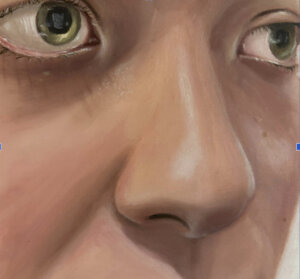
But as Gross positioned me in direct light and prepared to snap some nose pics, a bit of my bravado wore off. I thought of younger, bat-mitzvah-age Clara, who would have had the same reaction to an iPhone camera pointed at her nose as an AK-47. She would rather have posed nude for a remake of the “Draw me like one of your French girls” scene in Titanic than pose her nose.
Like many girls in middle school, I celebrated my entrance to womanhood by selecting at least one arbitrary physical feature to rag on. I picked my nose (not like that). For years, I fretted over my nose. I pinched and poked it. I spent many enriching hours flaring my nostrils in front of the mirror, amazed and horrified by the width I could achieve. I wished for a more unobtrusive nose, like Keira Knightley’s — or, failing that, Voldemort’s. Never mind that with a Korean-American mother and a Jewish father, looking like Voldemort wasn’t even phenotypically possible.
I don’t remember a revelatory flash that made me accept my nose. My father tried to inspire me by telling me about the “Black Is Beautiful” movement from the 1960s, but I struggled to apply it: “Jewish is … Jewtiful?!” By and by, I became too busy to worry about my nose. Noses receded into the rearview mirror as I sped down the highway of life.
Yet I wonder whether things might have changed for me if I had seen a project like Gross’ sooner. Even if I didn’t suddenly start reveling in my nose’s beauty, I might have seen that nature is creative and full of variety. There’s beauty in that. Around six months after I posed for Gross, she sent me a message on Instagram; my nose was finished. And there it was, Nose 14 of 100, nestled among its Jewish brethren. I blinked at it like a caveman examining his own reflection in a puddle. Could that be me? Yet there my Jewish nose was, one nose among noses beaked, beringed, button and bulbous. Paint me like one of your Jewish girls, I thought.

Did you know that only 2% of Forward readers donate to support our nonprofit newsroom? That 2% make it possible for millions to read the Forward without a paywall or subscription — removing any barriers to the full and fair Jewish story.
But while the Forward is free to read, it isn’t free to produce. Big stories — like deep dives into the antisemitism data, political scoops or reporting trips to college campuses — take months of research and fact-checking. All while we keep you informed of what you need to know each day.
— Rachel Fishman Feddersen, Forward Publisher & CEO
Support our mission to tell the Jewish story fully and fairly.