Stitched in faith, woven in memory, these precious artifacts bind Jews to their history
An exhibit of Torah binders shows the symbolic and functional aspect of Jewish ritual objects
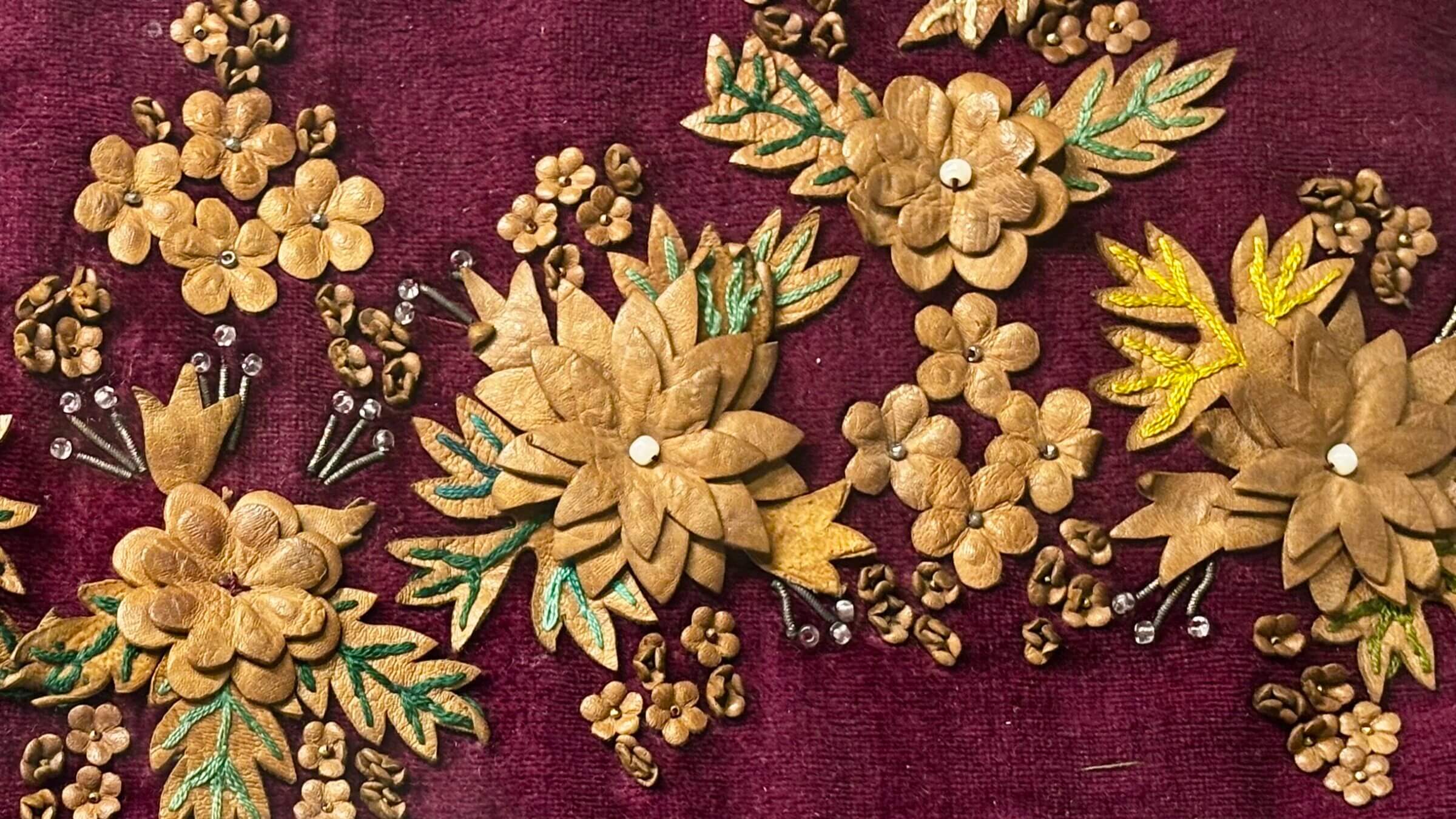
An intricately decorated 18th-century binder featuring intricate leatherwork flowers, embroidery and beads on plum-colored velvet. Photo by Cathryn J. Prince
The red stitching has long since faded, and the hand-woven linen has softened from white to ivory. Embroidered with a menorah, a double-headed eagle, a lion, and a Magen David, the 18th-century Torah binder is simple in design yet rich in history.
The binder is among 25 artifacts from London’s Memorial Scrolls Trust making their American debut in Fordham University’s “Binders of the Covenant” exhibition. Aside from showing how these functional objects, beautified, in keeping with hiddur mitzvah (beautifying a ritual object) the exhibition reveals the binders’ dual purpose: securing parchment Torah scrolls while symbolically binding families to their community.
“The binders allow us to see the artistic expression of the devotion; of how they reflect traditional values of Jewish identity, like going toward the Torah, toward the chuppah, and doing good deeds. But there is also an acknowledgement of local identity like in the Hapsburg double eagle or a German flag,” Magda Teter, a chaired professor of History and Judaic Studies at Fordham, told me.
Though women were historically excluded from reading or carrying the Torah, they were the primary creators of these binders. Through intricate needlework, they forged a physical connection to the sacred text. The collection includes a binder created by a grieving husband for his late wife, Esther, and another inscribed by a mother celebrating her daughter’s birth.
“It shows that women managed to get close to the Torah, they are bound to the Torah even if their physical bodies were not allowed to do that,” Teter said.
The history of these binders is rooted in survival.
Between the 14th and 20th centuries, Ashkenazi parents in Central Europe swaddled newborn boys in linen strips called wimples. Women embroidered them with religious and secular symbols. When a boy began formal Torah studies around age three, the family donated the wimple to the synagogue to be reused during milestones, such as a recovery from illness or the Shabbat before a wedding.
“It’s a collective story of community. Seeing these artifacts brings history to life,” guest curator Warren Klein said.
Over time, the creation of these binders evolved as women moved beyond traditional linen and cotton to incorporate silk, leather and velvet, reflective of Bohemian artistic traditions.
An intricately decorated 18th century binder featuring intricate leatherwork flowers, embroidery and beads on plum-colored velvet is a prime example.
“It shows an exchange of artistic ideas,” Klein said.
Over time, production shifted from hand-embroidery to sewing machines and paint. The inscriptions shifted as well, as German, Czech, and Yiddish frequently replaced traditional Hebrew.
Visitors to the exhibit will note the lingering shadow of the Shoah. A 1922 binder depicts a Magen David alongside a German flag; a display of pride in both Jewish and national Jewish identity created just two decades before the Holocaust.
Embroidered in canary-yellow silk thread on linen, a 1918 Bar Mitzvah binder for Ludwig Rosenzweig serves as a reminder of this era. On Oct. 26, 1942, Rosenzweig, his wife, and child were murdered at Auschwitz. Today, these binders remain the only physical witnesses to such interrupted lives.
“You can’t escape the loss but in order to appreciate the loss you need to understand the life. Those binders bring the people to life; they capture the moments of joy and celebration, and of course death. The binders create communal memory,” Teter said.
The tradition of hand-sewn binders has faded over the last half-century. Families are more apt to commemorate a child’s birth with the donation of engraved silver Judaica or prayer books with commemorative bookplates.
Yet, rather than lament this change, the exhibit brings the practice of creating binders to the present with the display of contemporary works by fabric artist Rachel Kanter.
“These community binders show vibrancy,” Teter said. “They show that Jewish life is ongoing,”

Did you know that only 2% of Forward readers donate to support our nonprofit newsroom? That 2% make it possible for millions to read the Forward without a paywall or subscription — removing any barriers to the full and fair Jewish story.
But while the Forward is free to read, it isn’t free to produce. Big stories — like deep dives into the antisemitism data, political scoops or reporting trips to college campuses — take months of research and fact-checking. All while we keep you informed of what you need to know each day.
— Rachel Fishman Feddersen, Forward Publisher & CEO
Support our mission to tell the Jewish story fully and fairly.