A Jewish soldier died saving a Christian friend. Eighty years later, a grave reunited their families.
PFC Frank Kurzinger was buried beneath a cross after dying in combat in Italy. Operation Benjamin helped restore a Star of David and reconnect the families linked by his final act
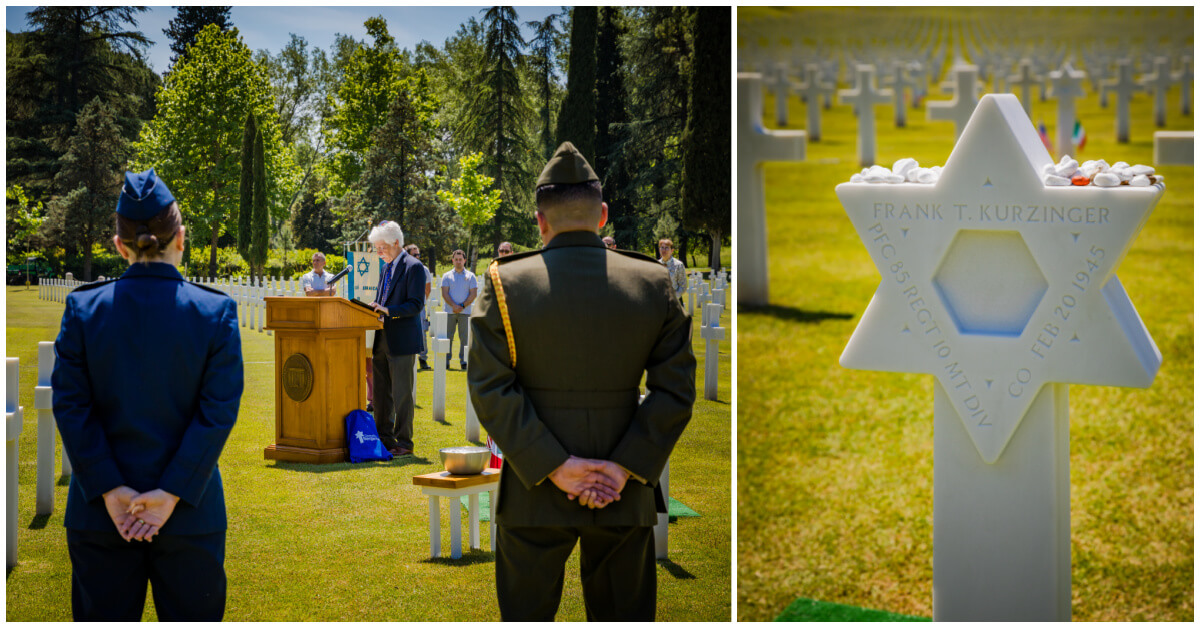
The dedication ceremony of the new headstone for Private First Class Frank T. Kurzinger. Photo by © Sabina Dumont – Anibas Photography
By Austin Albanese June 23, 2026
At a cemetery outside Florence, Italy, two families gathered around the grave of a young American soldier. For decades, they were unknown to each other. Yet they had been connected for 80 years.
Private First Class Frank T. Kurzinger was born in Germany and arrived in the United States with his family in 1938 after fleeing Nazi persecution. A few years later, he returned to Europe in an American uniform as a soldier in the 10th Mountain Division.
During training, he became close friends with a soldier from Wisconsin named Del Riley. The two met in 1943.
In February 1945, the division was preparing to assault Mount Belvedere in northern Italy. The attack would take place at night. Soldiers climbed in silence. Even their weapons had been unloaded to prevent an accidental discharge.
Ahead of Riley, a scout stepped on a landmine. The explosion tore through the darkness, severely wounding both men.
Riley called for a medic, and Kurzinger responded. He took several steps toward his friend, stepped on another landmine, and was killed. He was 21. Riley survived.
For the rest of his life, he wondered whether Frank Kurzinger might have survived the war had he never shouted for help.
“It really pained him,” said Shalom Lamm, co-founder and chief historian of Operation Benjamin. According to family accounts, Riley lived with survivor’s guilt for the rest of his life.
For a time, it seemed possible that Kurzinger himself would slowly fade from memory.
His family was small. The Holocaust had left gaps in family memory and silenced many conversations about the past. In remarks delivered at the 2025 dedication of Kurzinger’s new headstone, family member Michael Stern reflected that Frank had become little more than a distant name.
“There were no photographs,” Stern said. “No yahrzeit to observe, no role for him in stirring the longings for the warmth and intimacy of the larger family.” He might have remained, Stern said, “an anonymous stranger.”
Instead, a grave brought his life into relief.
The ceremony at Florence American Cemetery was organized by Operation Benjamin, a nonprofit that identifies Jewish servicemembers and veterans buried beneath incorrect religious markers and helps restore headstones that reflect their faith.
Kurzinger had been buried beneath a Latin Cross. Aware of the danger a German-born Jew would face if captured by the Nazis, he identified as Catholic on his dogtags.
Eight decades after he was buried, a Star of David was placed above his grave.
Yet the headstones are only part of the work. There is also the responsibility of restoring stories before they fade.
Operation Benjamin’s researchers reconstructed Kurzinger’s story. They traced descendants and gathered family memories. They also located the family of Del Riley, the Wisconsin soldier whose life Kurzinger had tried to save. The two families met for the first time in Italy ahead of the ceremony.
The next day they stood together at the cemetery.
For Lamm, Operation Benjamin is not simply about correcting the historical record. It is about zachor, the Jewish obligation to remember. He points to an unexpected moment in the Book of Exodus. As the Israelites leave Egypt, Moses fulfills a promise made generations earlier: “And Moses took with him the bones of Joseph.”
Joseph asked the Israelites to swear that when God redeemed them, they would carry his remains with them.
Lamm sees Operation Benjamin’s work as a series of “Moses moments.”
“No matter what’s going on in the world,” he said, “never forget your heroes.”
The stories beneath the stones
The organization’s work grew from a simple question. In 2014, Rabbi Jacob J. Schacter visited the Normandy American Cemetery and remarked that he expected to see more Stars of David among the graves. The observation led researchers to discover cases in which Jewish servicemembers had been buried beneath crosses because of wartime paperwork errors, mistaken records, or decisions made under extraordinary circumstances.
Since then, Operation Benjamin has reviewed thousands of cases and helped facilitate dozens of headstone corrections.
But a new headstone is only part of the story. Operation Benjamin’s researchers reconstruct lives that might otherwise be forgotten. “We will not forget you,” Lamm said. “We go back. We tell your story.”
In his remarks at the graveside, Stern reflected on what the journey had meant to his family. “Through the unlikely context of death and burial,” he said at the ceremony, “he has become a tangible link to life, to our roots, our history and the lineage from which we come. A second cousin once removed no longer feels as distant or abstract.”
In prepared remarks released by the U.S. Mission in Italy, U.S. Consul General Daniela Ballard noted that Kurzinger’s name was one of 4,392 at the military cemetery.
“Every name represents a young life lost and a family left behind,” she said. “But today, we are all Frank’s family. We are the ones who carry his memory forward.”
In remarks shared by Operation Benjamin after the ceremony, members of the Riley family described climbing Mount Belvedere with a commemorative challenge coin. One side bore Del Riley’s name and a Christian cross. The other bore Frank Kurzinger’s name and a Star of David.
The two men had set out for the mountain together in February 1945. Neither completed the mission. Frank was killed. Del was wounded. Eighty years later, the Riley family carried both men to the summit. They buried the coin at the 10th Mountain Division memorial.
Did you know that only 2% of Forward readers donate to support our nonprofit newsroom? That 2% make it possible for millions to read the Forward without a paywall or subscription — removing any barriers to the full and fair Jewish story.
But while the Forward is free to read, it isn’t free to produce. Big stories — like deep dives into the antisemitism data, political scoops or reporting trips to college campuses — take months of research and fact-checking. All while we keep you informed of what you need to know each day.
— Rachel Fishman Feddersen, Forward Publisher & CEO
Support our mission to tell the Jewish story fully and fairly.